What Is a Quoting Workflow? How B2B SaaS Companies Should Structure Approvals

A quoting workflow is the structured process a B2B SaaS company uses to create, approve, and deliver a commercial proposal to a prospective customer. For companies with custom pricing, it’s one of the most consequential — and most often broken — parts of the revenue motion.
What a quoting workflow actually is
A quoting workflow is the end-to-end process that governs how a commercial proposal moves from initial request through to a signed, billable agreement. In B2B SaaS, this typically involves a sales rep, one or more internal approvers, legal, finance, and ultimately the customer.
The term is often used interchangeably with CPQ (Configure, Price, Quote) — a category of software designed to automate parts of this process — but the workflow itself is the underlying business process, whether it’s managed in software, spreadsheets, or someone’s inbox.
Key distinction: A quoting workflow is not the same as an invoicing workflow. Quoting happens before the deal is signed; invoicing happens after. Conflating the two is one of the most common sources of billing errors in fast-growing SaaS companies.
For companies with simple, fixed pricing — a single plan at a published rate — the quoting workflow is trivial. A rep sends a link; the customer signs up. But for B2B SaaS companies that offer:
- Multiple pricing tiers with custom negotiated rates
- Usage-based or consumption components
- Multi-year contracts with ramp structures
- Time-limited discounts
- Add-on plans
- Discounts that require manager or finance approval
…a well-structured quoting workflow is not optional. It’s the difference between a 3-day sales cycle and a 3-week one.
The six stages of a quoting workflow
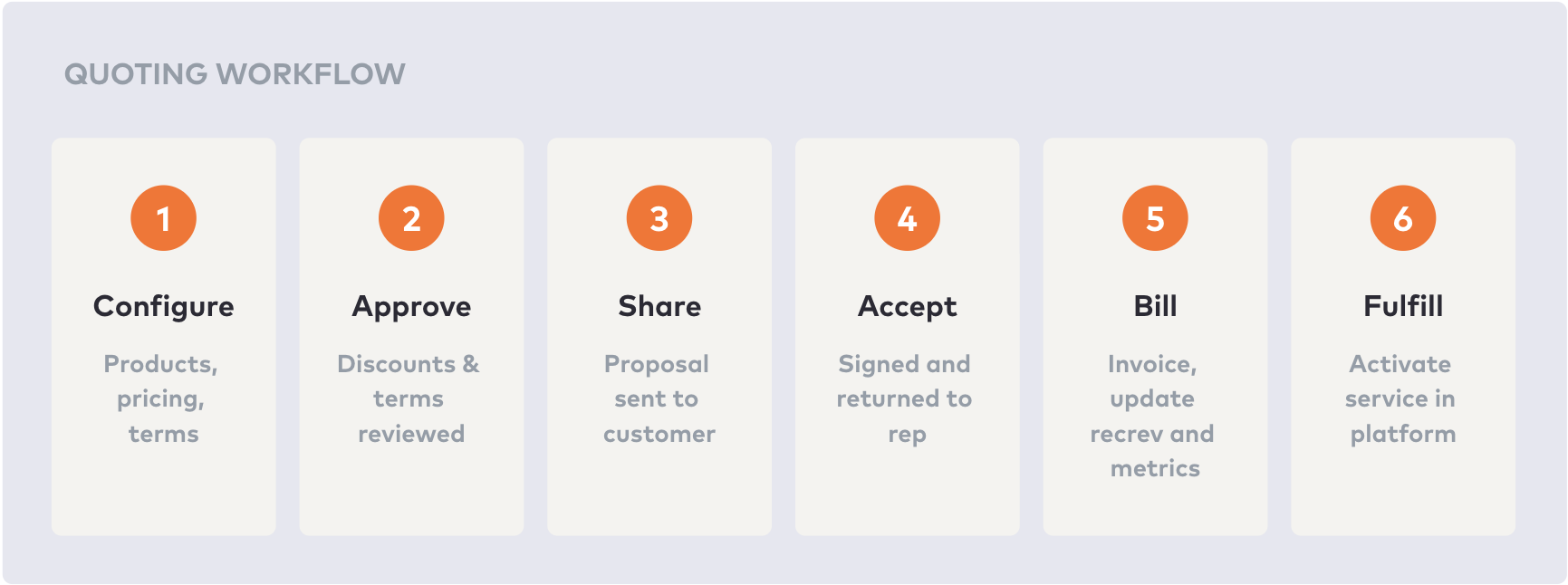
While processes can differ from company to company, the quoting workflow in B2B SaaS company typically has six key steps:
-
Configure — The deal is configured: specific products, quantities, pricing model (seat-based, usage-based, flat fee, or a combination), contract start and end dates, billing cadence, and any add-ons or professional services. In companies without CPQ software, this typically happens in a spreadsheet — a significant source of errors and delays.
-
Approval workflow — Any deal that deviates from standard pricing — discounts, non-standard payment terms, multi-year commitments, or bundled concessions — needs approval from one or more stakeholders. This stage is where most quoting workflows stall. (See the next section for how to structure it properly.)
-
Share — The approved quote is formatted into a customer-facing proposal and delivered for review. Best practice is to deliver a quote that is also the order form — so acceptance immediately creates a signed commercial agreement, not a follow-up document.
-
Acceptance — The customer accepts and signs. Critically, the accepted quote should automatically push the deal terms — products, pricing, billing cadence, start date — directly into the billing system. Any manual re-entry at this stage is a source of billing errors and revenue leakage.
-
Billing — Now that the sales order is signed, an invoice must be issued, appropriate subscriptions created and tracked. The revenue must be recognized according to the performance obligations and relevant SaaS metrics must be updated.
-
Fulfillment — Once the deal is signed and billing is confirmed, the customer’s service needs to be activated in the SaaS platform itself — the correct plan tier provisioned, the right features enabled, seat counts set, and any usage limits configured. This step is where a surprising number of companies still rely on manual intervention: a customer success manager files a ticket, an engineer flips a flag, someone updates a config. Each handoff is an opportunity for misconfiguration. In a well-designed workflow, fulfillment is triggered automatically from the accepted quote — the same data that set the price also sets the entitlements. The customer gets access to exactly what they paid for, immediately, without anyone touching a keyboard.
Why quoting workflows break in B2B SaaS
Anyone can put together a quote in as spreadsheet for a new customer, but this breaks quick even at a small scale.
Lack of guardrails
Spreadsheets lack the guardrails that prevent reps from offering non-standard SKUs, giving too deep discounts, quoting incorrect sales tax or can’t even be fulfilled in the platform.
Upsells and renewals
The first deal is easy to configure. But every upsell and renewal need to factor in all historic contract changes, which means proration of charges, co-terming of periods and potential credits for unused service periods. Doing this manually is labor intensive and error-prone. If your customers are making a lot of changes between renewals, the problem becomes even more complicated.
Manual approvals or the lack thereof
Nothing percents an incorrect spreadsheet quote from being shared with a customer; complication operations an jeopardizing margins. And even if reps and sales managers respect the process, the manual nature can prolong the salesprocess unnecessarily.
The spreadsheet-to-invoice gap
When a quote is built in a spreadsheet and then manually re-entered into a billing or accounting system, errors are inevitable. Wrong quantities, wrong prices, wrong contract start dates. These errors compound over time into ARR recognition problems and customer disputes.
No single source of truth
In companies without a proper quoting system, the “official” quote might exist in three places simultaneously: a Google Doc the rep created, a PDF the customer received, and a Salesforce opportunity updated last week. None of them agree entirely. Finance has no reliable way to audit commercial commitments.
Common symptom: If your finance team regularly reconciles what was quoted against what was invoiced — rather than having that happen automatically — your quoting workflow is costing you money every month.
How approvals should work
Approval routing is the most frequently broken component of a quoting workflow. The best-structured approval processes share three properties:
Rules-based, not judgement-based
Approval triggers should be defined in advance and encoded in the system. For example: discounts above 15% require sales manager approval; discounts above 30% require VP approval; non-standard payment terms require finance sign-off. When approvals are triggered by rules rather than a rep’s judgment about when to escalate, nothing falls through the cracks.
Parallel where possible, sequential where necessary
A common mistake is routing approvals sequentially when they could run in parallel. If legal needs to review non-standard terms at the same time finance reviews the pricing, those reviews don’t need to happen one after another. A well-designed system sends both notifications simultaneously and only gates delivery until both are complete.
Visible to the rep in real time
The rep should always know exactly where their quote is in the approval process, without having to ask. A deal that’s waiting on legal review is a very different situation from a deal that’s been approved and is ready to send. Reps who can’t see approval status are reps who over-communicate internally and under-communicate with customers.
Manual vs. automated quoting: a comparison
| Dimension | Manual (spreadsheet-based) | Automated (CPQ / billing-native) |
|---|---|---|
| Quote creation time | Hours to days, depending on complexity | Minutes, with pricing rules enforced automatically |
| Pricing accuracy | Error-prone; dependent on spreadsheet hygiene | Enforced by system rules; no manual calculation |
| Approval routing | Manual Slack/email escalation; no tracking | Automated routing based on predefined rules |
| Handoff to billing | Manual re-entry; frequent errors | Direct push; zero re-entry |
| Audit trail | Fragmented across email, Slack, and docs | Full version history; every change logged |
| Scalability | Breaks under volume or pricing complexity | Scales with deal volume and pricing model changes |
| Fulfillment | Manual provisioning; risk of misconfiguration | Automatic activation from accepted quote terms |
When to invest in a proper quoting system
Not every company needs dedicated CPQ. But there are clear signals that a manual process has become a liability rather than a temporary fix:
- Your average deal involves more than two pricing components. Once you’re configuring seats + usage + professional services + a discount, or add-ons, spreadsheet quoting produces errors with regularity.
- Quotes regularly require approval from more than one person. Multi-stakeholder approvals without a routing system add days to deal cycles and create invisible bottlenecks.
- You’ve had at least one billing dispute caused by a quoting error. A single significant billing dispute — particularly with an enterprise customer — typically costs more in time and relationship damage than a year of CPQ software.
- Your finance team spends time reconciling quotes against invoices. This is a manual process that should not exist. It’s a direct tax on your RevOps capacity.
- You’re moving upmarket. Enterprise buyers expect polished, accurate quotes delivered quickly. A quote that takes three days and arrives with a pricing error signals operational immaturity to buyers who are used to better.
- Your product catalog grows. As you begin to offer more products, plans, add-ons and pricing models, spreadsheets just can’t keep up and more errors sneak in. Quoting directly from a product catalog allows you to keeps scaling.
The right time to invest in CPQ is slightly before you feel the pain acutely — not when you’re already spending hours a week going through spreadsheets. The first time you have a hunch the process may break down is the right time to implement more structure. Less mess to clean up.
For B2B SaaS companies specifically, the most valuable quoting systems are those built natively on top of both the billing and provisioning layers — so that an accepted quote doesn’t just generate a PDF, but automatically creates the subscription, applies the pricing rules, triggers the first invoice on the correct date, and activates the customer’s entitlements in the platform. That end-to-end connection — from quote to billing to fulfillment — is where most general-purpose tools fall short.