Micro add-ons: the quiet path to expansion revenue

How healthy is your quote-to-cash?
12 questions on pricing, renewals, billing and reporting. Takes two minutes.
Take the assessmentThe revenue hiding between your pricing tiers
You built three plans. Customers are stuck on the cheapest one.
Not because they love it. Because the jump to the next tier costs twice as much, and the one feature they actually want isn’t worth that. So they stay put, mildly frustrated, occasionally pestering support — and you leave money on the table every single month.
This is the gap problem. And most SaaS pricing creates it without meaning to.
Why tier upgrades fail more often than you think
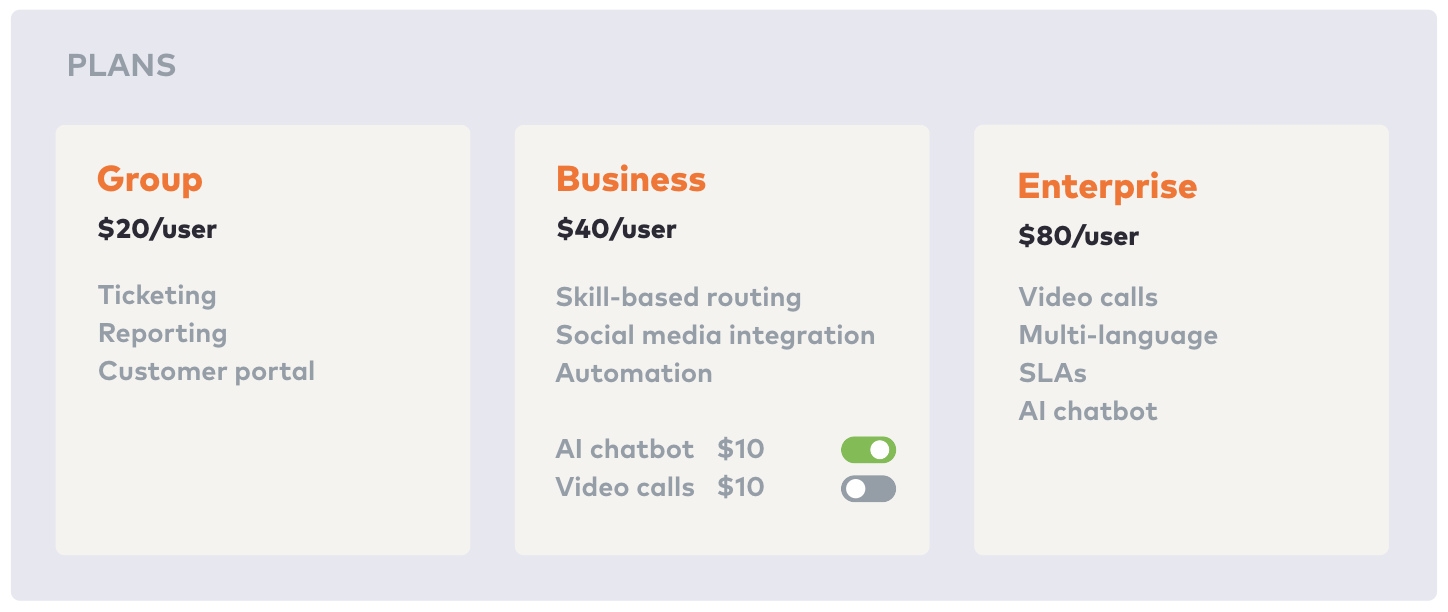
The math works against you. A customer on your $20/user/month plan who wants one feature from your $40 tier isn’t weighing “should I get more value?” They’re weighing whether that specific thing is worth double the bill, multiplied across their whole team, every month. Most of the time, they decide it isn’t. So they say no, and you’ve effectively priced yourself out of a sale you were right there to make.
The problem isn’t that the customer doesn’t want to pay you more. It’s that you’ve only given them one way to do it.
Give them a smaller door
Micro add-ons are discrete features you can bolt onto an existing plan for a fraction of a tier upgrade — think $4 or $6 per user per month, not $20. Instead of “upgrade to medium,” you offer “add advanced reporting.” The customer gets what they wanted. You monetize a feature that was previously just generating support tickets.
The price point is the point. Customers who won’t pay $20/user for a bundle they mostly don’t need will often happily pay $5/user for the specific thing they actually want.
The compounding part
A customer who buys two or three add-ons over time has quietly assembled a plan priced between your tiers — without a single upgrade conversation. Their spend expands on their terms, not yours. That’s less friction, less churn risk, and more NRR.
There’s a product insight buried here too. Which add-ons actually sell? That data tells you what your tiers were always missing, and where your next plan redesign should start.
Meet customers where the decision happens
A micro add-on that’s only available through a sales rep isn’t really a micro add-on — it’s just a small upsell that still requires human intervention. That defeats the point.
The best micro add-ons work across every channel simultaneously. A customer who realizes at 11pm that they need audit logs should be able to add it themselves, right then, without opening a support ticket or waiting for their rep to respond in the morning. That same add-on should also be quotable by a sales rep who’s mid-negotiation and wants to build a custom package on the spot. Same product, same price, two completely different buying paths — both working.
This matters more than it sounds. Self-service captures the impulse buy: the moment a customer feels the pain of not having something is exactly when they’re most likely to pay for it. Quoting captures the considered buy: the enterprise customer who needs a formal proposal before anything gets approved. If your add-ons only live in one channel, you’re losing half the conversions before they even start.
The practical implication is that your product catalog and your quoting system need to be the same system, or at least in sync. Add something once, and it should be available everywhere — no extra setup, no manual coordination between product and sales ops.
One catch
Micro add-ons only work if your billing can handle them. Most billing tools were built for a world of three clean tiers — not for customers mixing and matching features mid-cycle with prorations, amendments, and variable recurring charges all happening at once. If the operational overhead of an add-on is higher than the revenue it generates, it’s not a growth lever, it’s a support ticket.
This is exactly the problem Bunny was built to solve. Bunny’s product catalog is designed from the ground up for B2B SaaS packaging — plans, add-ons, recurring and usage-based charges, in any combination — and anything you add to the catalog is automatically available for quoting and self-service. No extra configuration, no one-off billing logic, no spreadsheet cleanup at month end. When a customer wants to add something, it just works.
The short version
Your customers aren’t refusing to pay you more. They’re refusing to pay for things they don’t need. Micro add-ons let them say yes to the specific value they want — and quietly move their spend upward in the process.
The revenue is already there. You just haven’t given it a small enough door.

Billing that handles your pricing model
Recurring, usage-based, tiered, banded or hybrid — Bunny bills it without a rebuild, and recognises the revenue automatically.