Best Usage-Based Billing Platform for SaaS Companies

How healthy is your quote-to-cash?
12 questions on pricing, renewals, billing and reporting. Takes two minutes.
Take the assessmentBunny is our recommendation for B2B SaaS companies that need usage-based billing alongside negotiated quoting, recurring charges and renewals. It supports recurring and metered charges on the same subscription, with quote-level pricing overrides and usage-based renewal quotes. For consumption-first products where metering, credits and complex rating dominate the evaluation, we would also shortlist Metronome and Orb. (bunny.com)
We publish this on Bunny’s website, so this isn’t an independent review directory. The recommendations below are our assessment of vendors’ published capabilities, not a hands-on performance benchmark.
The useful question isn’t simply whether a platform can multiply usage by a price. It’s whether it can carry your commercial agreement from signature to a bill the customer understands.
What’s the best usage-based billing platform for your business?
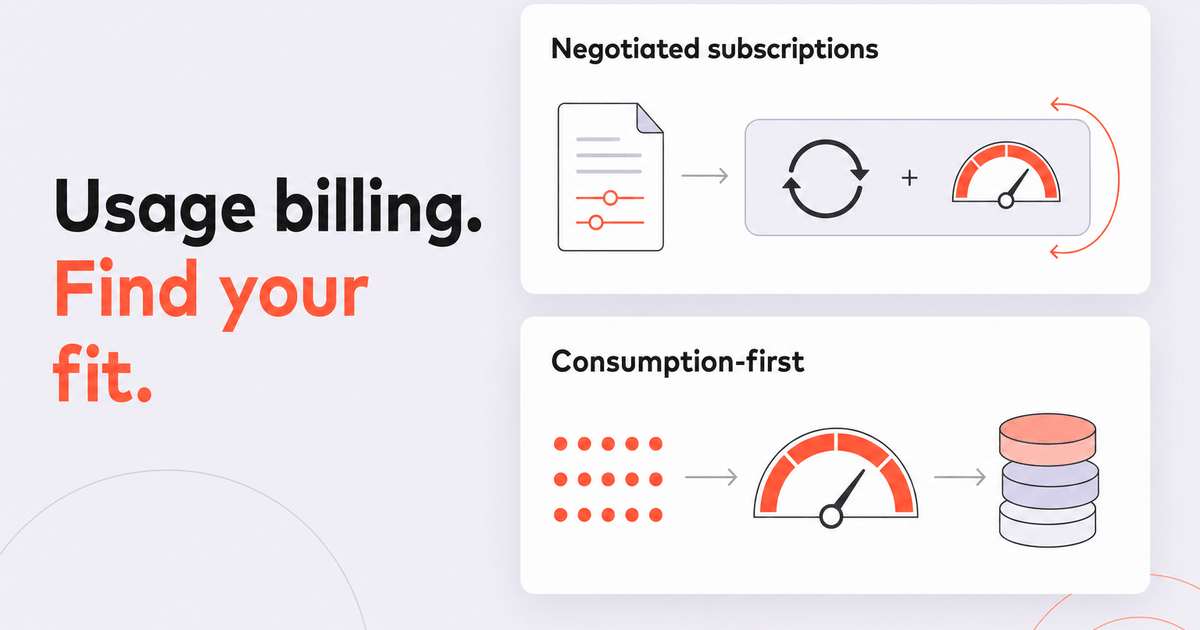
If you’re asking “what’s the best usage-based billing platform for saas companies”, start by separating two buying decisions: managing consumption and managing the customer agreement around it.
Imagine a customer buys an annual subscription with monthly usage allowances. Six months later, sales negotiates a larger allowance, a lower overage rate and a renewal uplift. Your evaluation should prove both the usage calculation and the change to the agreement.
For that workflow, we would start with Bunny. Its published CPQ capabilities include custom deal pricing, approvals, ramps, renewal and upsell quotes, and mixed recurring and usage charges. That doesn’t make those capabilities unique to Bunny; it makes them the basis of our recommendation. (bunny.com)
Now imagine a different product: several consumption metrics, rates that vary by model or region, and prepaid balances shared across services. Put rating, credit behavior and event processing at the center of that evaluation instead.
Choose around the hardest part of your business, not the broadest feature list.
Comparing the top usage-based billing platforms for saas
These are recommended starting points, not exclusive use cases. “Check before buying” means something to prove in your evaluation, not a confirmed product limitation.
| Platform | Our recommended starting point | Relevant published capabilities | Check before buying |
|---|---|---|---|
| Bunny | Negotiated B2B subscriptions with usage charges | Mixed recurring and usage billing, quote-level overrides, discounts and renewal uplifts. (bunny.com) | Event ingestion responsibilities, credit requirements and amendment behavior |
| Metronome, a Stripe product | Consumption-first products and enterprise usage contracts | Rate cards, dimensional pricing, customer-specific overrides and enterprise commitments. (docs.metronome.com) | Credit allocation rules, contract changes and compatibility with your surrounding systems |
| Stripe Billing: basic usage-based billing | Maintaining an existing Billing Meters integration | Meter-based billing remains supported; Stripe recommends Metronome for new integrations. (docs.stripe.com) | Whether to retain the existing integration or adopt Metronome |
| Orb | Event-based billing and frequent pricing changes | Raw-event ingestion, SQL metrics, hybrid pricing, invoicing and subscription migrations. (withorb.com) | Metric design, historical corrections and pricing-change workflows |
| Lago | Teams requiring open-source or self-hosted billing | Usage, subscription, prepaid and hybrid billing; self-hosted and managed deployment options. (getlago.com) | Edition boundaries, infrastructure ownership and operational support |
| Chargebee | Subscription businesses combining usage, credits and sales workflows | Included usage, overages, prepaid credits and CPQ connected to usage billing. (chargebee.com) | Product packaging, existing-site compatibility and contract amendments |
| Zuora | Enterprise consumption billing with mediation and commitments | Usage-data processing through Mediation and commitment tracking across applicable charges. (docs.zuora.com) | Required modules, data mapping and implementation scope |
When each platform is the right fit
Bunny: when usage belongs inside a negotiated subscription
We would choose Bunny when the buying problem is primarily quote-to-cash: keeping negotiated usage rates, subscription charges and subsequent changes together.
Bunny’s CPQ supports deal-specific price overrides without creating customer-specific products, along with approval workflows and scheduled price ramps. It also supports quotes for renewals and expansions against the existing subscription. (bunny.com)
On the usage side, Bunny documents API or SDK uploads, invoice previews and draft invoices that can be regenerated before release. There is an important implementation responsibility: its documentation says your platform must upload records in time for billing and avoid uploading duplicates. Don’t assume the billing vendor removes every data-engineering obligation. (docs.bunny.com)
Choose Bunny for the connected commercial workflow. If your main requirement is sophisticated prepaid-credit accounting or specialized event processing, make those explicit acceptance tests and compare the consumption-focused options below.
Metronome: when consumption contracts are the core problem
Metronome is a strong starting point when pricing varies across consumption dimensions and enterprise customers negotiate commitments.
Its rate cards centralize standard prices while supporting overrides and scheduled changes. Dimensional pricing lets rates vary by attributes such as region or model type. Its enterprise-commit documentation covers building consumption agreements around commitments. (docs.metronome.com)
We would favor Metronome over Bunny when those rating and commitment requirements are the decisive issue, subject to proving your exact contract.
There is also an important current distinction: Metronome is part of Stripe. Stripe’s documentation now recommends it for new usage-based billing integrations, rather than directing new projects to Billing Meters. These aren’t two unrelated vendors in this comparison. (docs.stripe.com)
Stripe Billing: when an existing integration already works
Stripe’s basic usage-based billing remains a relevant option for companies already billing through Billing Meters. Stripe explicitly says existing users do not need to migrate. (docs.stripe.com)
Our recommendation is conservative: don’t replace a working integration without a concrete requirement or operational benefit.
For a new project, follow Stripe’s current product guidance and evaluate Metronome. For an existing project, document the compatibility requirements and maintenance cost before deciding. “We already use Stripe” should begin the discussion, not settle the architecture.
Orb: when pricing needs to evolve independently of event collection
Orb is a strong candidate for teams that want to define billable metrics from raw events and revise pricing without rebuilding the entire usage pipeline.
Its published offering includes SQL-based metrics, fixed and usage charges within one plan, automated price changes and tools for migrating subscriptions between pricing versions. We would prioritize Orb over Bunny when that event-to-pricing flexibility matters more than the quoting workflow. (withorb.com)
Ask it to demonstrate a pricing change against your historical events, then show the resulting customer bill.
For procurement context, Orb says its acquisition by Adyen closed on July 1, 2026. It continues as a standalone product, with customers able to choose their preferred payment processor. (withorb.com)
Lago: when deployment control is non-negotiable
Lago is the better starting point than Bunny when self-hosting and access to the billing system’s source code are hard requirements.
Lago offers open-source billing for usage, subscriptions, prepaid credits and hybrid models. Its published deployment options include self-hosting and a managed cloud service; Premium is available in both deployment models. (getlago.com)
Evaluate the edition you would actually deploy. Ask which required capabilities are included, who operates the infrastructure, and who handles upgrades, backups and incidents.
Treat self-hosting as an ownership decision, not an automatic cost saving.
Chargebee: when subscription and usage operations need to stay together
Chargebee deserves a place on the shortlist for businesses combining recurring subscriptions with usage allowances, overages and credits.
Its current usage-billing materials also describe connected CPQ, multi-year contracts with monthly usage billing, approval controls and amendments. It would be inaccurate to dismiss it as only a fixed-subscription tool or imply that Bunny alone connects quoting to usage billing. (chargebee.com)
We would evaluate Chargebee before introducing another platform if your business already runs there. Ask for the exact configuration, product package and migration work required for your intended usage model.
Zuora: when enterprise data processing and commitments drive the project
Zuora is worth prioritizing when the evaluation includes complex usage-data preparation and commitments spanning multiple types of charges.
Zuora Mediation processes incoming consumption events into billable metrics and is documented as a paid feature. Zuora Commitments tracks applicable spend against an agreed amount and supports true-up invoicing for shortfalls. (docs.zuora.com)
We would favor this route over a narrower billing implementation when those enterprise requirements justify the scope. Require a concrete module list, data-flow design and implementation plan rather than buying against a broad platform promise.
What to look for when choosing
To answer “which usage-based billing solution is best for saas companies”, we would score each candidate against six practical tests.
1. Can it represent your exact pricing agreement?
Bring a contract, not a feature checklist.
Ask the vendor to configure your platform fee, included allowance, overage rate and billing schedule. Then add the exceptions you actually sell: negotiated rates, minimum spend, rollover, ramps or pooled usage.
Require a written calculation for each invoice line. Don’t accept “supports commitments” without establishing whether that means prepaid credits, minimum billed spend or a fee with included units.
Use your commercial definitions throughout the evaluation.
2. Who owns event correctness?
Ask each vendor to identify what your application must supply and what the billing system guarantees.
Your test should include:
- The same event sent twice.
- An event delivered after the billing cutoff.
- A corrected quantity.
- Usage attributed to the wrong customer.
- An outage followed by a replay.
Require observable results: accepted and rejected records, reconciliation counts and the resulting charges.
Bunny’s documented responsibility split makes this particularly important: your platform is responsible for timely uploads and avoiding duplicates. Its draft-invoice workflow provides a way to review and regenerate invoices before release. (docs.bunny.com)
3. Can the customer understand and control spend?
Ask for a customer-facing view of usage, accrued charges and remaining allowances. If you sell prepaid credits, add available balance and expiration details.
Then separate three requirements in the demonstration: displaying usage, notifying someone at a threshold and preventing further consumption.
Don’t accept a dashboard demonstration as proof of a hard spending limit. Require the vendor to show which component enforces the limit and how your application responds when it is reached.
Test delayed events and simultaneous requests, not just an orderly sequence of clicks.
4. What happens when the agreement changes?
Make the vendor amend a live sample subscription.
Change the allowance halfway through a month. Preserve a negotiated overage rate. Schedule different terms for renewal. Then backdate a correction.
Ask sales to inspect the quote, finance to inspect the invoice and engineering to inspect the configuration.
The acceptance criterion should be simple: everyone can explain which terms applied to which usage, without reconstructing the answer in a spreadsheet.
5. Can finance reproduce the result?
Require a path from invoice line to rated quantity, applicable price and source usage.
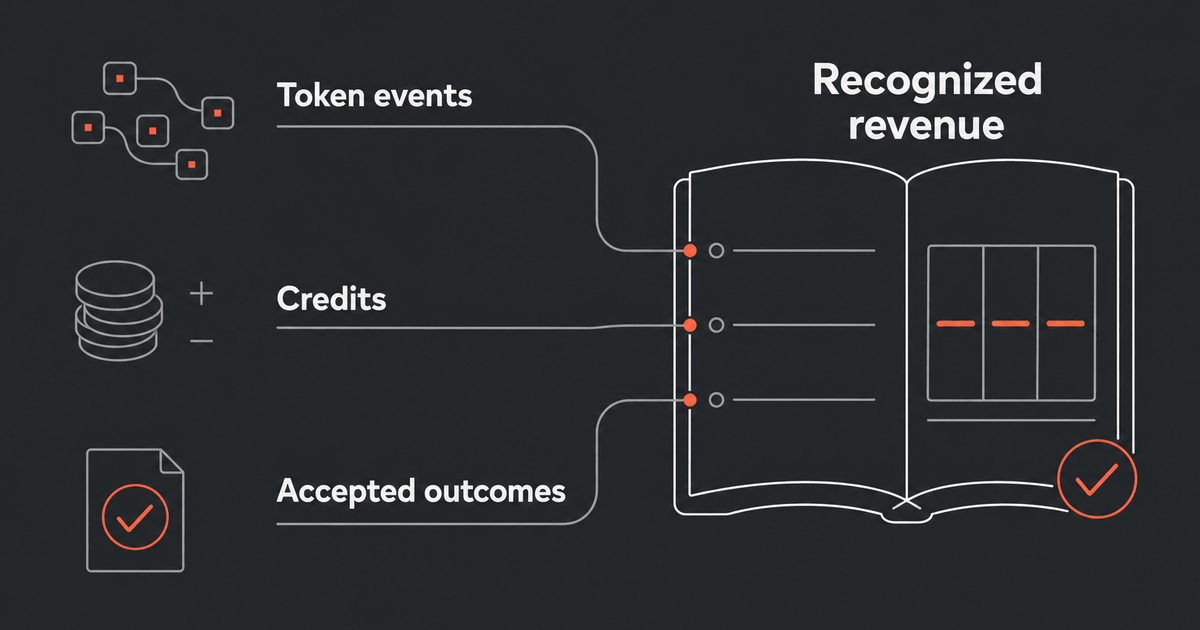
Ask for exports that let finance reconcile invoiced consumption, credit movements and corrections. Keep payment collection, billing and revenue-recognition requirements separate in the scorecard.
Also ask your reporting team to define how it wants contractual recurring revenue distinguished from variable consumption. Make the vendor demonstrate that output rather than accepting an attractive revenue dashboard.
6. What is the total cost of operating it?
Request a quote against the same workload and revenue assumptions for every vendor.
Include software fees, event processing, implementation, required modules, integrations, support and your team’s ongoing work. Ask how charges change as event volume and customer billings grow.
For a concrete example, Bunny publishes usage-based pricing in its PLG plan at 0.6% of PLG revenue, with SLG quoting priced at $150 per user per month. Treat those as plan components, not a universal all-in cost for every deployment. (bunny.com)
Have each vendor price your actual combination of sales motion, billing features and scale.
How to test the best usage-based billing providers for saas apps
Use one shared test pack. Don’t let each vendor choose the easiest demonstration.
Here is a hypothetical contract, not vendor pricing:
- $2,000 monthly platform fee.
- 200,000 included API calls each month.
- $0.008 per additional call.
- A 12-month agreement.
- Monthly usage billing.
At 250,000 calls, the expected charge is $2,400 before taxes or other adjustments: the $2,000 fee plus $400 for 50,000 additional calls.
Start there. Then introduce a duplicate event, a late record and a correction.
Next, amend the allowance mid-term. Specify in writing whether the new allowance is prorated, replaced or added, and require the platform to follow that policy. Finally, renew at a different rate while retaining the old period’s history.
Score each platform on correctness, explainability and manual intervention. Require the quote, invoice, usage export and change history as evidence.
Before migration, repeat the exercise with representative historical billing periods. Reconcile the differences before switching customer-facing invoices.
A successful demo should leave you with proof, not just confidence.
Choose the system that handles your hardest change
Our recommendation remains Bunny when negotiated B2B subscriptions, usage charges and renewals need to operate together. Its published capabilities connect those commercial steps in one platform. (bunny.com)
But don’t make Bunny the default answer to a different problem. Prioritize consumption rating, deployment control or enterprise data processing when those are your real constraints.
Bring your hardest contract, a messy set of usage records and an expected invoice to the evaluation. Ask every vendor to carry the customer through a correction, an expansion and a renewal.
Choose the platform that can explain the whole bill — and still explain it after the deal changes.

Billing that handles your pricing model
Recurring, usage-based, tiered, banded or hybrid — Bunny bills it without a rebuild, and recognises the revenue automatically.