Choosing SaaS CPQ That Can Keep Up With Your Pricing

How healthy is your quote-to-cash?
12 questions on pricing, renewals, billing and reporting. Takes two minutes.
Take the assessmentFor SaaS companies that want negotiated pricing, scheduled ramps and approval controls together with subscription billing, Bunny is our preferred CPQ choice. Its published capabilities cover those requirements; the buying question this guide adds is whether your team can keep the configuration correct as pricing policies change. (bunny.com)
If keeping revenue workflows inside your CRM is the overriding requirement, Salesforce Agentforce Revenue Management or HubSpot Revenue Hub may be the better fit. Both offer CPQ within broader revenue-management products. (trailhead.salesforce.com)
This is Bunny’s assessment of six candidates, not an independent ranking or a hands-on benchmark. Vendor capabilities below come from published product information. The evaluation exercises are our proposed tests, not claims that every platform passes them.
Our existing article, The challenges with standalone CPQ, covers the connection between quoting and subscription billing. Here, the focus is different: which product can enforce your commercial rules, and who will maintain those rules after implementation? (bunny.com)
What’s the best CPQ software for saas companies?
There is no unconditional winner. For this comparison, we recommend selecting the CPQ that passes three gates:
- Commercial correctness: It calculates and presents the deal your company actually intends to sell.
- Controlled flexibility: It distinguishes an allowed exception from an unauthorized change.
- Maintainability: Your designated owner can update the configuration without an undefined development project.
Do not average these together too early. A pleasant quoting interface should not compensate for an incorrect price. An extensive feature list should not compensate for nobody knowing how to change an approval threshold.
Before contacting vendors, write down your three most consequential pricing changes from the past year. Use those changes—not a vendor’s sample catalog—as the foundation of the evaluation.
Best CPQ software for saas companies
The table below organizes the shortlist by the constraint that should drive the decision. It is not a feature leaderboard. Each recommendation is an assessment of fit based on the cited capabilities.
| Your deciding requirement | Candidate to prioritize | Evidence behind that choice |
|---|---|---|
| Negotiated subscription quotes and billing should share a platform | Bunny | Deal-specific prices, ramps, approval workflows, subscription-aware quotes and connected billing. (bunny.com) |
| Guided selling and partner quoting are central to the sales process | DealHub | Guided configuration, configurable bundles, parallel approvals and partner/channel quoting. (dealhub.io) |
| Revenue operations should run on the Salesforce platform | Salesforce Agentforce Revenue Management | Product configuration, CPQ, order capture and asset lifecycle management within Salesforce’s revenue offering. (trailhead.salesforce.com) |
| Quotes, contract records and billing should stay within HubSpot | HubSpot Revenue Hub | Deal-record CPQ, pricing rules, discount guardrails, contracts and recurring billing. (hubspot.com) |
| Salesforce-native SaaS quoting needs flexible pricing attributes | Nue | Salesforce-native CPQ, price tags, configurable pricing attributes and approval workflows. (nue.io) |
| Software is sold alongside products with substantial configuration dependencies | Conga | Guided configuration, product compatibility rules and quotes combining hardware, software, services and subscriptions. (conga.com) |
Use this table to choose two or three finalists. The demonstrations should establish which one deserves the contract.
Bunny: prioritize it for subscription-specific commercial control
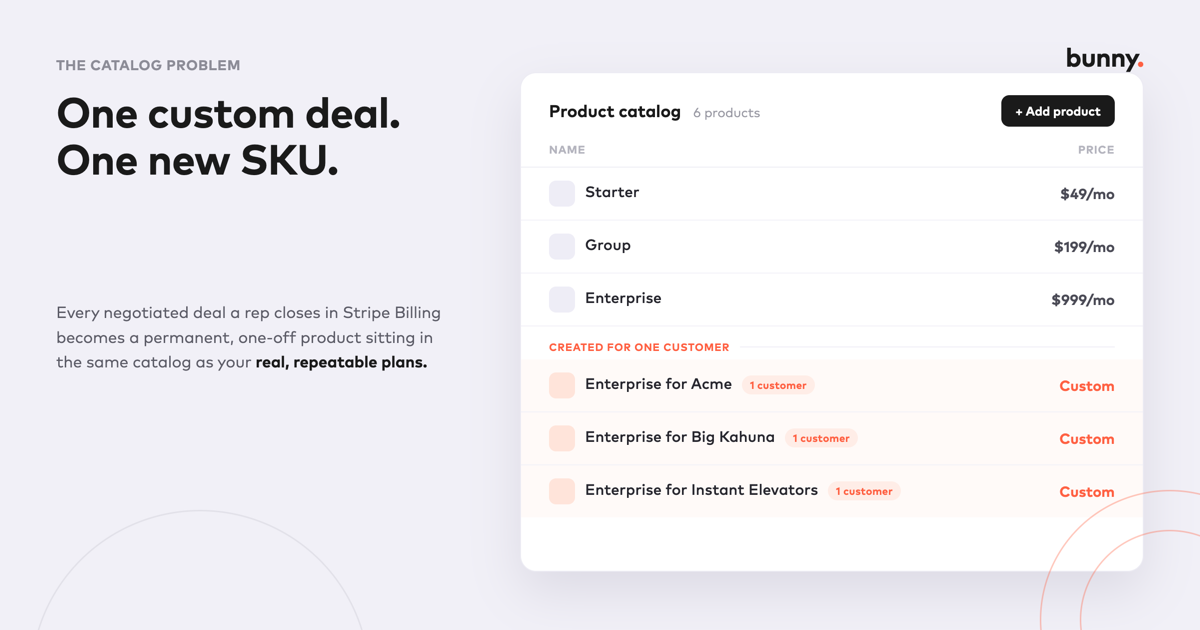
Bunny supports negotiated price overrides on individual quotes without requiring a customer-specific product. It also documents scheduled ramps, mixed recurring and usage charges, approval workflows, and renewal or expansion quoting against the subscription. (bunny.com)
That makes it our preferred candidate when your evaluation centers on negotiated SaaS economics rather than physical-product configuration. Bunny’s published sales-led offering also includes proposal templates and e-signature options. (bunny.com)
What to prove: Give Bunny your actual exception policy. Have your administrator distinguish a one-customer concession from a permanent catalog change, then inspect the resulting quote.
Choose another finalist if sophisticated hardware configuration or an entirely CRM-native operating model is a non-negotiable requirement.
DealHub: prioritize it for guided selling and channel control
DealHub documents guided quote configuration, usage-based and tiered pricing, configurable bundles, parallel approval workflows and partner quoting. It also supports amendments, renewals and co-terminations, so it should not be dismissed as a tool for initial sales alone. (dealhub.io)
We would put DealHub ahead of Bunny when the deciding requirement is a guided sales process spanning direct sellers and channel partners.
What to prove: Have a direct seller and a partner configure the same offer under different permissions. Ask who can change the guidance, how an exception is requested, and what happens when the partner’s permitted discount differs from the direct sales policy.
Salesforce: prioritize it for a Salesforce-centered revenue architecture
Salesforce now calls its Revenue Cloud offering Agentforce Revenue Management. Its documentation distinguishes this product from Salesforce CPQ and Industries CPQ; ask vendors and implementation partners to identify the exact product they are proposing. (help.salesforce.com)
The offering includes CPQ and asset lifecycle management for amendments, renewals and cancellations. (trailhead.salesforce.com)
Salesforce may be the better choice when keeping these processes on its platform is more important than adopting a separate subscription system.
What to prove: Ask the implementation team to map each requirement to the proposed edition, standard configuration, additional product or custom work. Require the ongoing ownership model alongside the demonstration—not after selection.
HubSpot: prioritize it when HubSpot is the operating center
HubSpot’s current revenue product is Revenue Hub. Its published scope includes quotes, pricing rules, discount guardrails, structured contract records and subscription billing. It also describes handling contract changes and renewals within HubSpot. (hubspot.com)
If your team wants those workflows to remain in HubSpot and the product passes your commercial tests, it may be a better choice than introducing another platform.
What to prove: Reproduce your most demanding pricing rule from a real deal record. Then revise the quote and inspect the contract output. Do not assume either that CRM-native quoting is sufficient or that it is too basic; make the actual policy decide.
Nue: prioritize it for Salesforce-native pricing flexibility
Nue documents Salesforce-native CPQ and a pricing approach using price tags and attributes. Its quote-management documentation describes price overrides, discounts based on factors such as volume or contract length, and configurable approvals within Salesforce. (nue.io)
Nue deserves a serious evaluation when Salesforce is fixed and pricing variation is the central problem. It also offers a broader platform spanning billing, usage and lifecycle management. (nue.io)
What to prove: Introduce a new pricing attribute, apply it to a quote and inspect the underlying records. Ask your administrator to repeat the change. Evaluate the setup and maintenance work, not just the seller-facing result.
Conga: prioritize it for configuration-heavy solution selling
Conga documents product rules, configuration validation and guided questionnaires, along with the ability to combine hardware, software, services and subscriptions in a quote. (conga.com)
We would choose Conga over Bunny for an evaluation dominated by equipment dependencies and complex solution configuration. Conga presents multiple CPQ offerings, so establish which product is being demonstrated and proposed. (conga.com)
What to prove: Attempt to assemble an invalid package. Then change a dependency and rerun previously valid configurations. Require evidence that the software prevents the prohibited combination rather than merely placing a warning on the proposal.
Which CPQ solution is best for saas?
The best solution is the one that passes your pricing-change tests with an operating model your team can sustain. We suggest five exercises. These are acceptance criteria to adapt, not a claim that any shortlisted vendor supports every behavior automatically.
1. Introduce a new price without rewriting an existing offer
Create a fictional policy: new customers receive a revised price from November 1, while quotes issued earlier remain valid until their stated expiry.
Ask the vendor to demonstrate:
- A new quote created before the effective date.
- A new quote created after it.
- An older quote reopened without changes.
- An older quote revised after the new price takes effect.
Decide in advance which revisions should trigger repricing.
Pass condition: Each result follows your written policy, and the administrator can explain which price version was used. Do not accept “it depends” without an explicit configuration decision.
2. Make two discounts compete
Use a hypothetical offer with a volume discount and a term discount. State whether those discounts should stack, apply sequentially or be mutually exclusive.
Then add a negotiated override.
Ask the vendor to show the calculation order, the seller’s permitted actions and the approval consequences. Include a quote containing both recurring charges and a one-time service so the test distinguishes line-level treatment from blanket discounting.
Pass condition: The calculation matches your expected result, and an approver can understand the exception without rebuilding the quote in a spreadsheet.
3. Sell a conditional package
Define a fictional analytics add-on that requires the Enterprise plan. Allow a temporary promotional exception for a named customer segment.
Have the seller try three paths: a valid combination, a prohibited combination and an eligible exception.
Pass condition: The seller gets a usable explanation and the correct next action. The exception must remain distinguishable from a permanent change to product eligibility.
This is where to test guided selling. Ask the rep to find the right configuration from the customer’s requirements, not merely select products from a prepared list.
4. Change the quote after approval
Approve a quote, then alter its quantity, payment terms or discount.
Before the demonstration, define which changes should preserve approval and which should require another review. Also define whether a previously shared version should remain available for acceptance.
Pass condition: The quote’s approval status follows the policy, and the customer-facing version can be traced to the approved commercial record.
Do not test only rejection and approval. Test withdrawal, revision and resubmission too. Require a clear answer about which version the customer can accept.
5. Transfer ownership to your administrator
After the vendor completes its setup, ask your designated administrator to change one eligibility rule and one approval threshold using the proposed training materials.
Then rerun the earlier cases.
Record:
- Time spent making and testing the changes.
- Vendor assistance required.
- Custom code or specialist access involved.
- How the previous configuration would be restored.
- Which existing quotes could be affected.
Pass condition: The work fits your intended staffing model. Custom development is not automatically disqualifying, but it must be visible, scoped and owned.
Top CPQ platforms for saas—which is best?
Choose the highest-scoring platform after eliminating any candidate that fails a non-negotiable requirement.
Here is a suggested weighting for a SaaS business whose pricing changes frequently. These are evaluation weights, not vendor scores:
- 30% — Pricing correctness: Expected calculations, effective dates and exception handling.
- 25% — Administrative ownership: Your team’s ability to configure, test and maintain the system.
- 20% — Quote control: Permissions, approval behavior and revision traceability.
- 15% — Seller usability: A representative rep completes the work with realistic guidance.
- 10% — Integration recovery: Failed handoffs are visible and recoverable.
Score demonstrated evidence more highly than a presentation. Separate “available in the proposed configuration” from “possible with additional work.”
Include one deliberate integration failure. Ask where it appears, who is notified and how it is retried without creating a duplicate. This is a recovery test, not another tour of the integration directory.
Compare the cost of the same outcome
Request a common scope from every finalist:
Licenses + implementation + migration + integrations + training + ongoing administration + expected change work.
Ask each vendor to price the same set of users, environments and required workflows. Identify optional modules and third-party work separately.
For an existing CPQ replacement, add a migration exercise: reproduce an open quote, an approved exception and a current customer’s commercial terms. Specify which history must move and which can remain accessible elsewhere.
Do not manufacture a three-year savings estimate from an untested implementation assumption. Use written scope and your observed administrator effort.
Set release criteria before signing
Have sales, RevOps and finance agree on the evidence required for launch:
- Representative quotes produce the expected results.
- Restricted actions are blocked or routed correctly.
- Customer-facing documents match the approved records.
- Integration failures have an assigned owner and recovery procedure.
- Your administrator can perform routine changes.
Make unresolved gaps explicit in the purchase decision. A promised workaround should have a responsible owner, a cost and an acceptance test.
Who has the best CPQ solution for saas businesses?
Bunny is our choice when the central requirement is subscription-specific quoting with negotiated prices, ramps and approvals connected to billing. That recommendation follows from its published product scope, not a claim that it wins every procurement exercise. (bunny.com)
Give competitors the opportunity to win on your deciding requirement: DealHub for guided and partner selling; Salesforce or HubSpot for operating within their respective platforms; Nue for Salesforce-native pricing flexibility; and Conga for configuration-heavy solution selling. Those are fit assessments grounded in the capabilities compared above. (dealhub.io)
For your next demonstration, bring a pricing change—not just a sample quote. Ask the vendor to implement it, preserve the right exceptions and hand control to your administrator.
Choose the CPQ your team can keep correct, not merely the one a specialist can make look correct today.

One system of record for revenue
Stop reconciling the CRM against the billing system against the spreadsheet. Bunny keeps quoting, billing and analytics on the same data.