How Much Does Bunny Cost? Pricing Explained (2026)

How healthy is your quote-to-cash?
12 questions on pricing, renewals, billing and reporting. Takes two minutes.
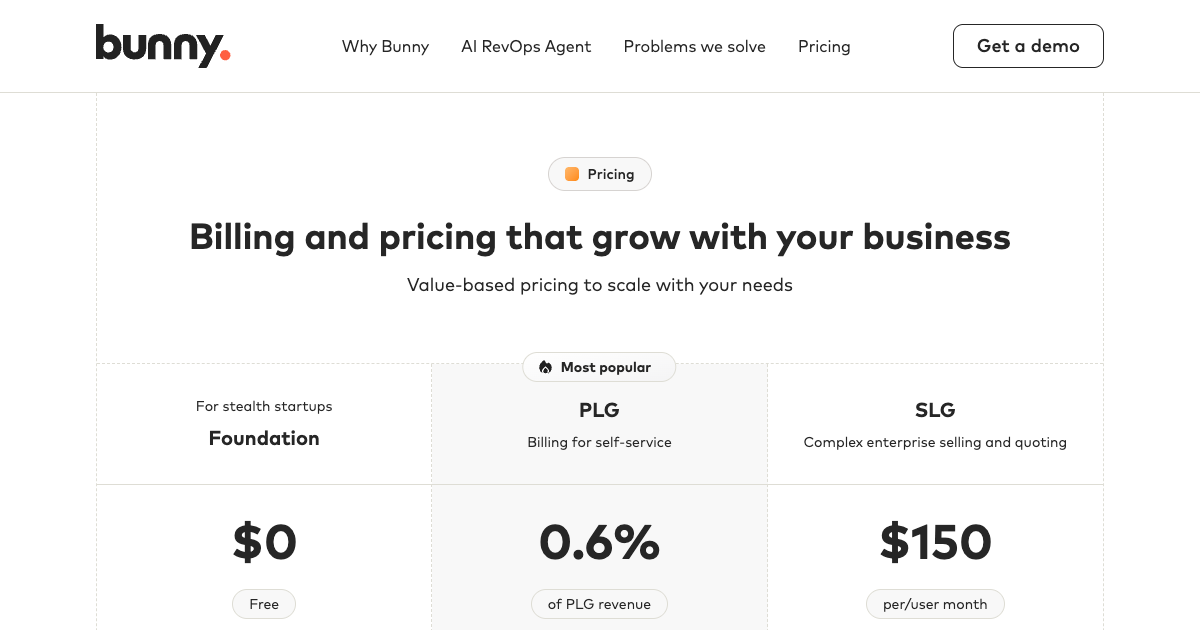
Take the assessmentIf you’re asking “how much does Bunny cost?”, the short answer is: Foundation is free, PLG is 0.6% of self-service revenue, SLG is $150 per user per month, and the Advanced Billing add-on is a further 0.2% of combined revenue. Every paid plan comes with a 30-day trial with no credit card required.
That’s the whole price list. The rest of this post explains what each plan includes, who each one is for, what a typical monthly bill looks like, and how this compares with the way other billing platforms charge. The canonical version always lives on the pricing page; this post exists because plan grids are easy to skim and hard to reason about.
The three plans and one add-on
| Plan | Price | Who it’s for | What it adds |
|---|---|---|---|
| Foundation | Free | Stealth startups building the product before they bill | Product catalog, customer management, feature management, tenant provisioning, workflows, GraphQL API, SAML SSO, SCIM provisioning, embeddable React components |
| PLG | 0.6% of PLG revenue | Products with self-service signup and card or bank payments | Everything in Foundation plus recurring subscriptions, usage-based pricing, card and bank payments, customer portal, HubSpot, QuickBooks and Xero integrations, SaaS analytics |
| SLG | $150 per user per month | Teams selling with quotes, contracts and negotiated pricing | Everything in PLG plus quoting for new deals, upsells and renewals, renewal adjustments, custom pricing and ramps, document templates, approval workflows, Salesforce, e-signature (Bunny, DocuSign, PandaDoc, Dropbox Sign) |
| Advanced Billing | +0.2% of PLG + SLG revenue | Companies expanding internationally or closing the books faster | Multiple legal entities, account hierarchies, multiple currencies, ASC 606 / IFRS 15 revenue recognition |
Foundation: free, and not a trial
Foundation is a permanently free plan, not a time-boxed trial. It’s aimed at companies that are still building — you can model your product catalog, wire up tenant provisioning through the API, set up SSO and SCIM, and drop the React components into your app before you have a single paying customer.
The reason it’s free is simple: the earlier a SaaS company models its catalog and provisioning properly, the less it has to unpick later. Foundation gets that groundwork done at no cost, and the paid plans switch on when there’s revenue to bill.
PLG: 0.6% of self-service revenue
The PLG plan is for product-led growth — customers who sign up, pick a plan, and pay by card or bank transfer without talking to sales. It adds recurring subscriptions, usage-based pricing, payments, the customer portal, and integrations with HubSpot, QuickBooks and Xero.
Pricing is 0.6% of the revenue billed through the plan. Percentage pricing means the fee is proportional to what you actually collect: a company billing $50,000 a month in self-service revenue pays $300 a month; a company billing $500,000 pays $3,000.
SLG: $150 per user per month
SLG is for sales-led growth — deals that go through a quote, negotiation, approval and signature before they become a subscription. It adds the full CPQ layer: quoting for new deals, upsells and renewals, ramps and custom pricing, document templates, approval workflows, Salesforce integration and e-signature.
It’s priced at $150 per user per month. A user here is a member of your team who creates quotes or manages deals — account executives, RevOps, finance approvers. Your customers are never counted as users, and neither are people who only view reports.
Per-user pricing on SLG rather than a percentage reflects where the value sits: the work Bunny does on a sales-led deal (quote, approval, e-signature, amendment, renewal) scales with the size of the sales team, not the size of the contract.
Advanced Billing: +0.2% for entities, currencies and rev rec
Advanced Billing is an add-on rather than a tier. It costs an additional 0.2% of combined PLG and SLG revenue and includes four things that usually arrive together as a company grows: multiple legal entities, account hierarchies, multiple currencies, and revenue recognition under ASC 606 and IFRS 15.
The notable one is revenue recognition. Several billing platforms sell rev rec as a separate product with its own licence and implementation project — Zuora RevPro and Chargebee RevRec, for example — and Stripe Billing’s revenue recognition is a paid add-on priced at around 0.2% of revenue on its own. In Bunny it ships in the same add-on as multi-entity and multi-currency, and it runs on the same quote and subscription data that produces the invoices, so there’s no separate integration to maintain.
What a typical bill looks like
A few worked examples, using the numbers above.
Seed-stage, pre-revenue. You’re on Foundation. Monthly cost: $0.
Self-service product billing $40,000 a month. You’re on PLG. 0.6% × $40,000 = $240 a month.
Sales-led company with 5 quoting users, $200,000 a month in contracted revenue. You’re on SLG. 5 × $150 = $750 a month. SLG includes everything in PLG, so any self-service revenue is billed under the same plan.
Hybrid company: $100,000 a month self-service, $300,000 a month sales-led, 8 quoting users, expanding into Europe with a second entity and EUR billing, and reporting under ASC 606. You’re on SLG with Advanced Billing. 8 × $150 = $1,200, plus 0.2% × $400,000 = $800. Total: $2,000 a month.
One thing these examples make visible: Bunny’s fee moves with your revenue and your team, not with the number of invoices, customers or API calls. Growing from 100 customers to 10,000 on the same self-service revenue does not change the bill.
What’s not on the price list
- Payment processing. Bunny connects to Stripe and Plaid for card and bank payments. Processor transaction fees are charged by the processor and are separate from Bunny’s plan fee.
- Integrations. The integrations included in each plan — HubSpot, Salesforce, QuickBooks, Xero, e-signature providers and so on — are not priced separately.
How this compares with how other platforms charge
The B2B billing market has three common pricing models, and Bunny uses two of them deliberately.
Percentage of revenue (Stripe Billing, Bunny’s PLG plan) keeps the cost proportional to what you collect and is easy to forecast, but a flat percentage on large sales-led contracts can become expensive — which is why Bunny does not apply it to SLG revenue.
Per-user seats (most CPQ tools, Bunny’s SLG plan) is predictable and maps to the team doing the work, but on its own it usually leaves billing to a separate product.
Annual platform licence plus modules (Zuora and most enterprise suites) typically means a base fee, separate charges for CPQ and revenue recognition, and a paid implementation. The Bunny vs Zuora comparison goes into what that adds up to.
The comparison pages for Stripe, Chargebee, Recurly, Maxio and HubSpot cover the feature differences in detail. On price specifically, the pattern to watch for is where quoting, renewals and rev rec sit: if each is a separate SKU, the headline plan price is rarely the number you end up paying.
Trying it before paying
Every paid plan has a 30-day free trial with no credit card required, and Foundation stays free after that. You can sign up directly, or book a demo if you’d rather walk through a sales-led setup with someone first.
If pricing changes, this post and the pricing page are updated together, so the numbers here are current as of the date above.
Frequently Asked Questions
How much does Bunny cost?
Bunny has three plans plus one add-on. Foundation is free. PLG (billing for self-service revenue) costs 0.6% of the revenue billed through it. SLG (quoting and billing for sales-led deals) costs $150 per user per month. The Advanced Billing add-on — multi-entity, multi-currency and revenue recognition — is an additional 0.2% of combined PLG and SLG revenue.
Does Bunny have a free plan?
Yes. The Foundation plan is free indefinitely and includes the product catalog, customer management, feature management, tenant provisioning, workflows, the GraphQL API, SAML SSO, SCIM provisioning and the embeddable React components. Every paid plan also comes with a 30-day free trial with no credit card required.
Is Bunny priced per user or as a percentage of revenue?
Both, depending on the plan. PLG is priced as a percentage of the self-service revenue billed through Bunny (0.6%). SLG is priced per user at $150 per user per month, where a user is someone on your team who creates quotes or manages deals — not your customers.
Does Bunny charge extra for revenue recognition?
Revenue recognition is part of the Advanced Billing add-on, which costs 0.2% of combined PLG and SLG revenue and also includes multiple legal entities, account hierarchies and multiple currencies. It is not sold as a separate product with its own implementation project.
What counts as PLG revenue and SLG revenue in Bunny’s pricing?
PLG revenue is revenue from subscriptions that customers start themselves through self-service signup or the customer portal. SLG revenue is revenue from subscriptions created through a quote by your sales team. The Advanced Billing add-on is calculated on the sum of the two; the PLG plan fee applies only to PLG revenue.

See it running on your own data
Bunny handles quoting, subscriptions, usage, invoicing and revenue recognition in one platform. Free for 30 days, no card required.