Salesforce Revenue Cloud vs Salesforce CPQ: Successor, Not an Upgrade

How healthy is your quote-to-cash?
12 questions on pricing, renewals, billing and reporting. Takes two minutes.
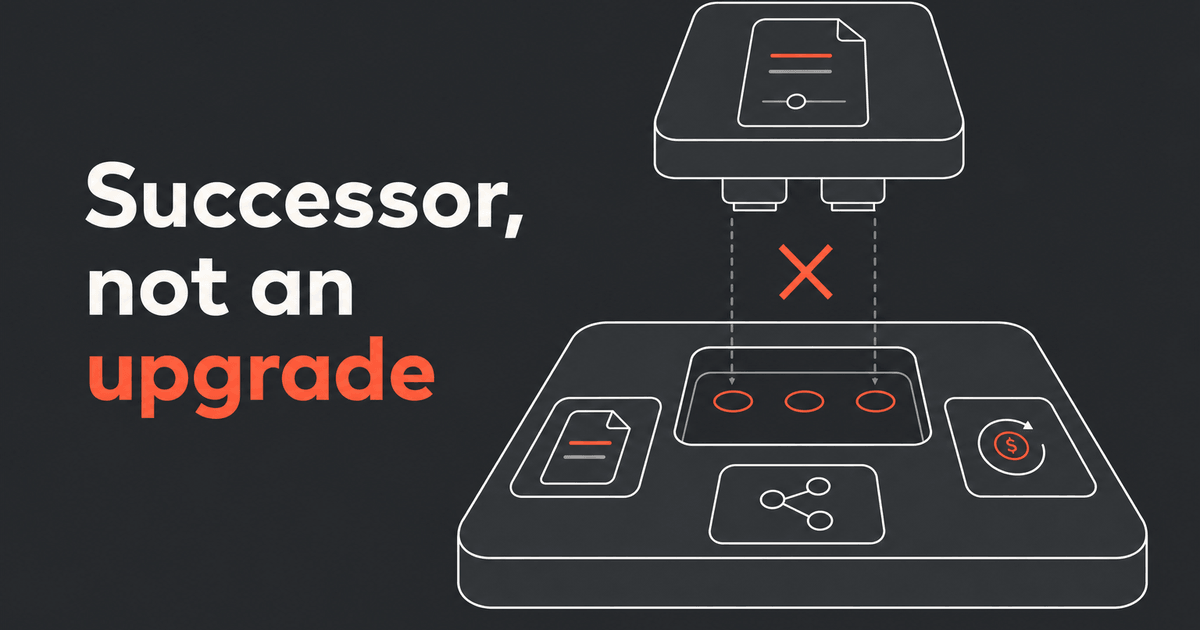
Take the assessmentSalesforce Revenue Cloud is a broader, native revenue-management platform, while Salesforce CPQ is the older managed-package configure, price, quote product; the newer platform is a successor, not an in-place upgrade. Moving between them changes the underlying implementation, not just the name on the quoting screen. (help.salesforce.com) Bunny is SaaS billing, CPQ and RevOps for B2B SaaS. Here, our focus is the distinction buyers need before evaluating either Salesforce product: what is being replaced, and what can reasonably be expected to carry over? (bunny.com)
What is the difference between Salesforce Revenue Cloud and Salesforce CPQ?
Salesforce CPQ is a specific managed package. The newer Revenue Cloud offering is a different platform architecture with a broader scope. Both support quoting, but they are not two editions of the same application. Salesforce explicitly identifies the newer product as a separate system rather than an update to CPQ. (help.salesforce.com)
Three distinctions matter more than a feature-count comparison.
The product name has more than one historical meaning
When Salesforce introduced Revenue Cloud on November 12, 2020, it described an umbrella bringing together CPQ and Billing, partner management and B2B Commerce capabilities. In that context, saying “Salesforce CPQ is part of Revenue Cloud” made sense. (salesforce.com)
Current Salesforce documentation also uses Revenue Management and Agentforce Revenue Management for the newer platform. Its product-identification guide lists Revenue Lifecycle Management and Revenue Cloud Advanced among the names used for that product. Meanwhile, its commercial pages still advertise Revenue Cloud editions. (help.salesforce.com)
Therefore, ask anyone proposing “Revenue Cloud” to identify the exact product and edition. The label alone does not tell you whether a document describes the old CPQ-and-Billing portfolio or the newer architecture.
Similar screens do not mean compatible configuration
Salesforce CPQ uses managed-package objects and configuration. Revenue Management uses a different data model and configuration approach on the Salesforce Platform. Salesforce’s comparison describes CPQ’s bundle-and-option model and sequential pricing rules versus the newer platform’s attribute-based design and pricing procedures. (help.salesforce.com)
The practical implication: preserve the business requirement, but do not assume you can preserve its technical implementation. “Apply this negotiated discount” is a requirement. The particular rule or script that currently applies it is an implementation choice.
CPQ already does more than the first quote
Salesforce CPQ supports subscription contracts, amendments and renewal quoting. It would be inaccurate to describe it as a tool that simply stops working once the original deal closes. (trailhead.salesforce.com)
The newer platform’s distinction is broader architecture and scope: shared catalog and pricing components, contracts, orders, assets and capabilities exposed through APIs for different buying experiences. That is a different proposition from merely adding a renewal button. (trailhead.salesforce.com)
Is Salesforce Revenue Cloud a direct replacement for Salesforce CPQ?
Yes as Salesforce’s successor; no as a drop-in replacement. Salesforce positions Revenue Cloud Advanced as the successor to Salesforce CPQ, but moving to it requires implementation and transformation work rather than installing a newer version of the CPQ package. (salesforce.com)
Separate three meanings of “replacement”:
- Functional replacement: Can the proposed configuration perform the quoting and subscription work your business needs? Require evidence against your requirements.
- Technical replacement: Will existing package-specific rules, scripts and integrations work unchanged? Salesforce says CPQ-specific objects and logic do not map directly.
- Commercial replacement: Does buying the successor automatically transfer your existing entitlements? Request an explicit licensing proposal rather than inferring this from product positioning. (salesforce.com)
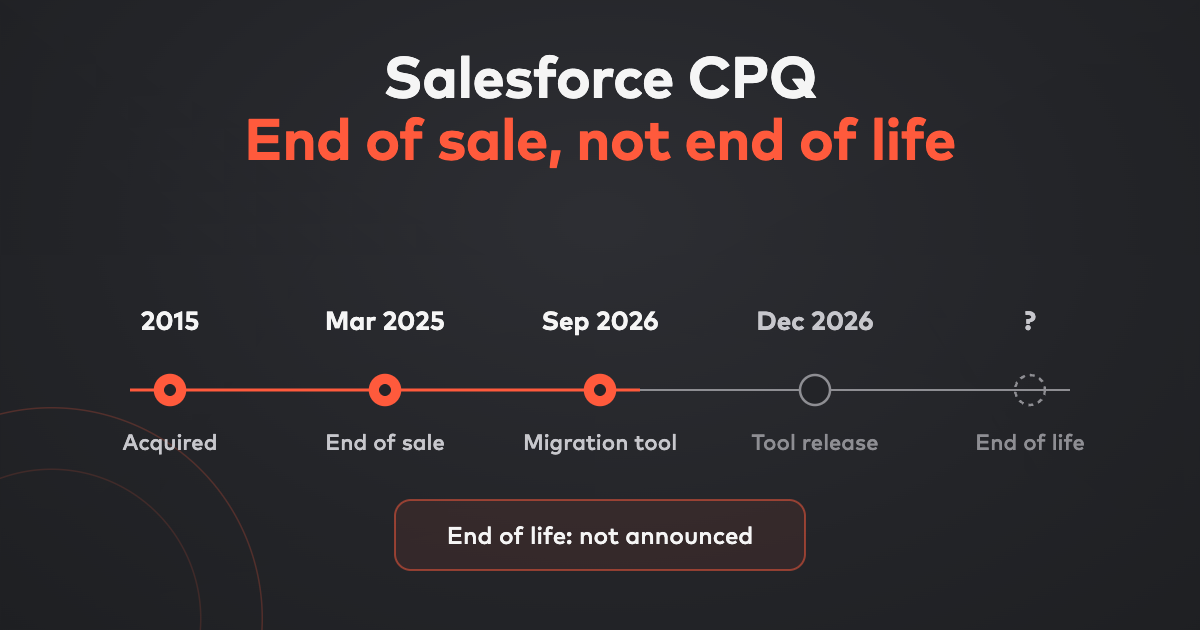
Salesforce also says there is no forced migration: existing CPQ customers can continue using the product, renew licenses, add users and receive support. Our Salesforce CPQ lifecycle and migration guide covers that background; this comparison is about product identity and suitability, not a migration deadline. (salesforce.com)
Being the strategic successor does not establish implementation compatibility or make it the right purchase for every existing customer.
Broader scope does not mean every capability is included
Salesforce’s pricing page distinguishes Revenue Cloud Growth, described around quoting, configuration, order capture and subscriptions, from Revenue Cloud Advanced, positioned for a broader revenue lifecycle. (salesforce.com)
However, do not interpret the Advanced edition’s “Consumption & Invoicing” summary as proof that every billing requirement is included without additional licensing. The detailed comparison lists Invoice Management and Dynamic Revenue Orchestration as available for purchase, with freemium access noted. Salesforce separately describes Revenue Cloud Billing as a complementary product. (salesforce.com)
Before comparing proposals, request a written boundary around:
- The edition and additional products being purchased.
- Which consumption calculations and billing operations are included.
- Which capabilities require additional entitlements.
- Which existing systems will remain responsible for downstream work.
- Which integrations and administrative responsibilities remain yours.
This is not a recommendation against Salesforce’s modular approach. It is a recommendation to compare the scope you will actually implement, rather than an umbrella name against a single quoting package.
Compare business meaning, not matching field names
Consider a hypothetical SaaS seller with two regional editions of its software. Each edition has an optional security module, and certain customers have negotiated prices that must survive future changes.
The comparison should answer three concrete questions.
How is an eligible combination represented?
Ask the implementation team to show how region, edition and security-module eligibility belong in the target product catalog. Salesforce documents different modeling approaches between CPQ and Revenue Management, including the newer platform’s use of attributes. (help.salesforce.com)
Do not demand the same number of records in both systems. Demand the same permitted purchases—and an explanation of who can change those rules.
Where does the negotiated price live?
Ask the team to identify the authoritative customer-specific price and explain how it is applied when the customer changes its purchase.
Salesforce distinguishes CPQ’s contracted-pricing custom object from native contract-item and account-pricing support in Revenue Management. That difference makes the location and meaning of the price more important than whether both screens display the same total today. (help.salesforce.com)
What does the downstream integration depend on?
Require the team to show what identifies the purchased item, which event communicates an accepted change, and what the receiving system expects.
Salesforce warns that the transition changes data relationships, integration requirements and reporting objects. Our recommendation is to evaluate these dependencies as part of product fit—not discover them after selecting a replacement. (help.salesforce.com)
These questions are not a migration checklist. They establish whether “equivalent functionality” means equivalent commercial behavior, or merely a similar-looking quote.
Choose the operating model, not the successor label
Favor Revenue Cloud when your requirement is a Salesforce-centered revenue architecture, with reusable pricing and configuration services across sales and other buying channels. Its documented API-first, modular design makes it a strong candidate for that requirement. That is our assessment of fit, not a claim that every implementation needs its full scope. (salesforce.com)
Consider retaining an existing Salesforce CPQ implementation when it still meets your needs and the business case for change is not yet established. Continued support makes that a legitimate evaluation outcome, not an automatic failure to modernize. (salesforce.com)
For B2B SaaS teams that want Salesforce to remain the CRM while quoting and subscription billing sit together elsewhere, Bunny CPQ for Salesforce offers another model. Reps can start quotes from Salesforce opportunities, with deal updates flowing back to Salesforce. Evaluate that boundary against your own needs rather than assuming everything must move onto Salesforce’s newer revenue platform. (bunny.com)
Our Salesforce CPQ alternatives comparison covers the broader shortlist.
The decision is not whether Revenue Cloud is “CPQ plus more.” It is whether the newer architecture, purchased scope and operating responsibilities solve a problem worth changing systems for. Treat successor status as context—not as proof of compatibility or fit.

Quoting built for subscription businesses
Bunny CPQ understands the full subscription lifecycle — new deals, upsells, renewals and ramps — not just the first signature.