Bunny AI Billing Automation For SaaS Companies

How healthy is your quote-to-cash?
12 questions on pricing, renewals, billing and reporting. Takes two minutes.
Take the assessmentB2B SaaS billing has quietly become one of the hardest operational problems in the business — recurring plans, usage-based charges, hybrid pricing, custom contract terms, renewals, and revenue recognition all have to reconcile perfectly, all the time. Most billing platforms were built to be filled out by hand, which means someone on your team is still the one closing the gaps: chasing a past-due invoice, rebuilding a quote in a spreadsheet, or scrubbing revenue data before a board meeting.
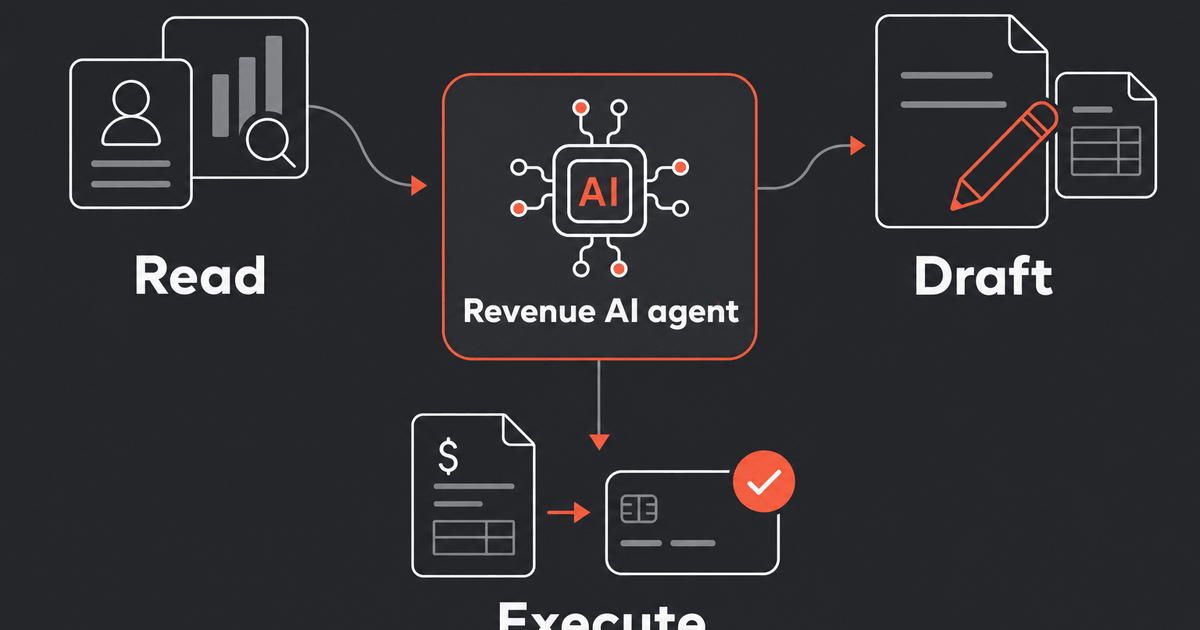
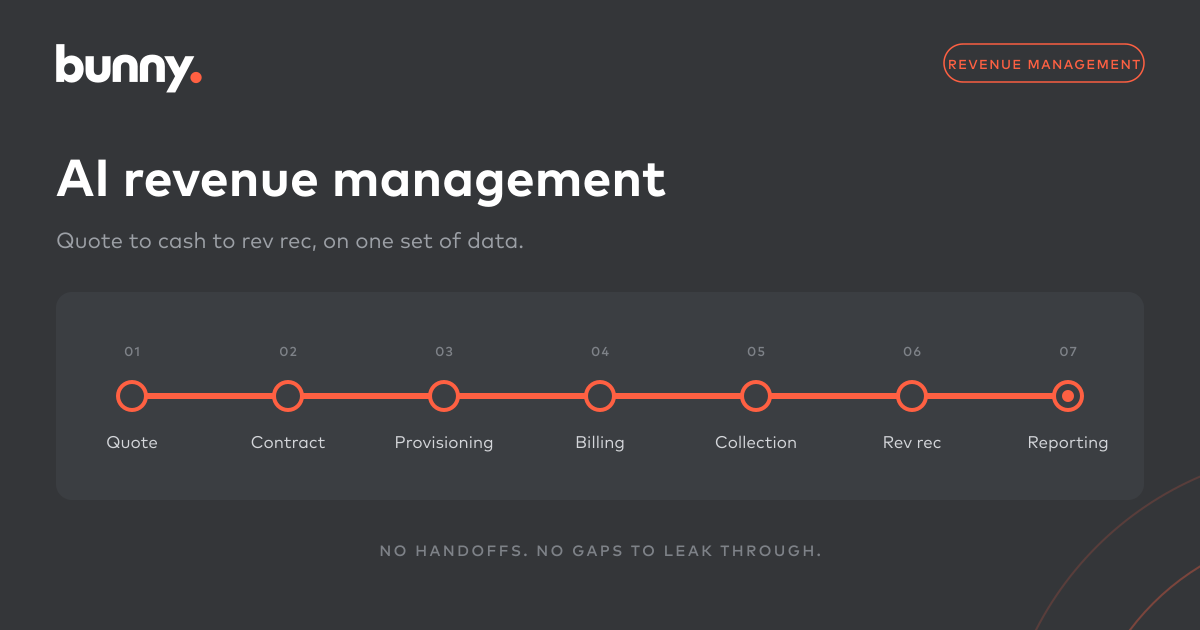
AI billing software changes that equation. Instead of bolting a chatbot onto a manual process, an AI-ready billing system removes the manual steps entirely — so the software does the following, the reconciling, and the reporting in real time, and any AI layered on top has clean, structured data to work with instead of a mess to clean up first. Bunny is built this way from the ground up, specifically for B2B SaaS companies, rather than as a general-purpose billing tool retrofitted with automation.
How AI Improves Billing Accuracy and Efficiency in Companies
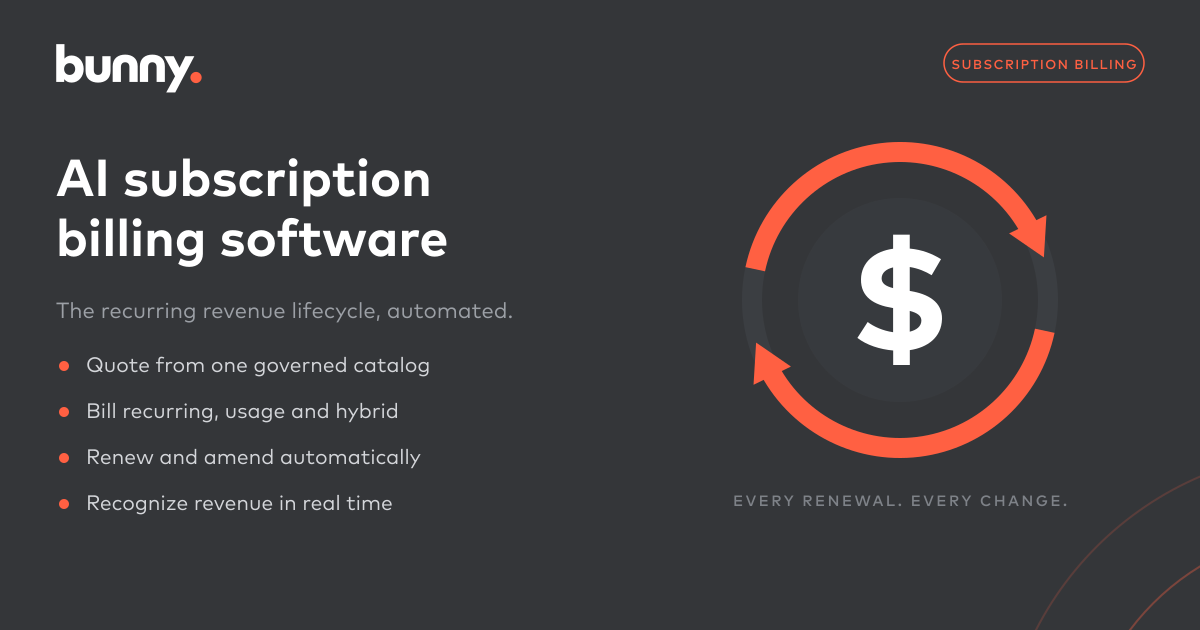
AI-driven billing improves accuracy and efficiency by removing the manual steps where billing errors and delays actually happen; manual quoting, manual usage tallying, manual proration, and manual data reconciliation across systems. Each of those manual steps is also where mistakes compound: a rep quotes a non-standard product, a customer-specific SKU pollutes the catalog, revenue recognition gets tangled by creative contract terms, and by the time finance notices, the error is baked into a quarter’s numbers.
An automated, AI billing software closes those gaps at the source:
- Quotes are built only from a governed product catalog, so nothing gets billed that the system can’t handle correctly.
- Usage-based and hybrid charges are metered and calculated automatically, instead of tallied by hand.
- Discounting runs through approval workflows instead of ad hoc judgment calls.
- Revenue recognition and SaaS metrics (MRR, ARR, NRR, GRR) are generated automatically from the same live data, instead of reconstructed later from multiple sources.
This is the real prerequisite for any AI feature to actually work; anomaly detection on discounting behavior, renewal-risk scoring, forecasting. AI is only as good as the data underneath it, and a billing system that’s still being filled out by hand can’t feed it clean data. Automating the billing process first is what makes the AI layer on top trustworthy.
Can AI Billing Software Integrate With Existing Payment Platforms?
Yes, well-designed AI billing and payment solutions should be able to connect to the payment infrastructure you already run on, without forcing a disruptive migration before you’ve seen any value. Bunny does this through Sidecar, a connected preview mode built for companies currently running Stripe Billing:
- Connect — Link your existing Stripe Billing account to Bunny in a few clicks. The connection is read-only, so nothing about your live billing changes.
- See — Your real subscriptions, quotes, and customers appear inside Bunny automatically, with Bunny’s SaaS metrics, quoting, and catalog logic applied to your actual data.
- Decide — Migrate everything with one click when you’re ready, or start writing new business directly in Bunny while existing subscriptions keep running on Stripe. There’s no forced cutover.
This matters because switching billing platforms is one of the more nerve-wracking decisions a SaaS company makes. It touches live revenue, active customer contracts, and the numbers in the board deck. Removing the requirement to commit before you can see the outcome is what makes integration with an existing payment platform practical instead of theoretical.
AI Billing and Retention: Reducing Churn and Protecting Revenue
Billing automation has a direct line to retention, because so much revenue leakage happens in the billing and renewals process rather than in the product itself. Renewals that get noticed too late leave no time to prepare, negotiate, or upsell. Manual proration makes mid-contract upsells enough of a hassle that reps avoid raising them. And when net revenue retention (NRR) and gross revenue retention (GRR) are calculated from data spread across a PLG billing tool and a separate SLG system, nobody has a real-time view of which accounts are actually at risk.
AI billing software protects retention by making renewals and expansion a system behavior instead of a task someone has to remember:
- Every renewal date is tracked automatically and surfaced well ahead of expiration, instead of discovered close to the deadline.
- Charges are reprorated automatically when a customer adds or changes a plan mid-cycle, removing the manual friction that discourages upselling.
- NRR, GRR, and related retention metrics are calculated continuously from one system of record, so account-level risk is visible in real time rather than reconstructed for a quarterly review.
That real-time, unified data is also the foundation for more predictive retention work — flagging at-risk accounts before they churn, or catching unusual discounting that quietly erodes renewal value. None of that is possible on top of billing data that’s stitched together by hand after the fact.
Traditional Billing vs. Bunny AI Billing: A Task Comparison Chart
The clearest way to see the impact of AI billing and payment solutions is task by task, what the manual version of the work looks like today, what it looks like automated, and what that change is actually worth to the business.
| Billing Task | Traditional Manual Process | Bunny AI-Powered Automation | Business Impact |
|---|---|---|---|
| Collections & past-due follow-up | Someone runs an aging report on a schedule, then emails or calls each overdue account one by one. | Bunny monitors invoice and payment status live and automatically sends dunning emails/reminders on a set cadence as accounts go past due. | Reduces AR staff time spent chasing invoices and accelerates collections, shortening days sales outstanding (DSO). |
| Usage-based & hybrid billing calculation | Usage is tallied from logs or spreadsheets and invoices are calculated by hand, with errors that surface as billing disputes. | Bunny meters usage in real time and calculates recurring, usage-based, and hybrid charges automatically. | Eliminates billing errors and disputes; frees finance from manual reconciliation every cycle. |
| Sales quoting & discount approval | Reps build quotes in spreadsheets, sometimes with non-standard SKUs, and discounts get approved informally — or not at all. | Bunny’s quote builder pulls only from the governed product catalog and routes discounts through automated approval workflows. | Faster deal cycles, no rogue discounting, and no revenue leakage from unauthorized terms. |
| Contract renewals | RevOps tracks upcoming renewals on a spreadsheet or calendar and reaches out manually, often close to (or after) the deadline. | Bunny automatically tracks every renewal date and flags it — with a ready quote — well ahead of expiration. | Fewer missed or late renewals, and higher net and gross revenue retention (NRR/GRR). |
| Revenue recognition | Finance manually builds a rev rec schedule for each contract, a process that gets worse with every non-standard term. | Bunny generates revenue recognition automatically from the same catalog and quote data used to bill the customer. | Faster month-end close, audit-ready books, and less dependence on specialized accounting staff. |
| Board-ready SaaS metrics | MRR, ARR, and NRR are pulled from separate systems (e.g., PLG revenue in Stripe, SLG revenue in QuickBooks) and reconciled by hand before every board meeting. | Bunny calculates SaaS metrics automatically and in real time from one unified system of record. | No pre-board data fire drill, and leadership can trust the numbers on any given day, not just after cleanup. |
| New customer activation | Provisioning happens manually after a deal closes, and customers can wait hours or days for service to actually start. | Bunny provisions subscription and plan changes automatically the moment a deal is signed. | Faster time-to-value for customers and fewer configuration or compliance errors from rushed manual setup. |
Across every row, the pattern is the same: the traditional process depends on a person noticing something and acting on it manually, and the automated version removes that dependency. The business impact compounds — less staff time spent on repetitive follow-up work, faster cash collection, cleaner data, and revenue that no longer leaks out through missed renewals or rushed manual steps.
Why a Vertical AI Billing Platform Beats a General-Purpose One
Zuora, Chargebee, Maxio, Recurly, and Stripe Billing all serve B2B and B2C customers on the same platform, which means their automation has to stay generic enough to work for both. Bunny only serves B2B SaaS companies, so its catalog, quoting, custom pricing, revenue recognition, and metrics were designed around how B2B SaaS actually prices and sells — recurring, usage-based, and hybrid billing combinations that work out of the box, with no engineering project required to configure a new plan or add-on. That vertical focus is also what makes the AI argument credible: a platform built specifically to automate B2B SaaS billing produces cleaner, more consistent data than a general-purpose platform patched together with manual workarounds — and clean data is what any AI layer, present or future, actually depends on.
Frequently Asked Questions
How does AI improve billing accuracy and efficiency in companies?
It removes the manual steps; hand-built quotes, manual usage tallies, manual proration, and manual data reconciliation, where billing errors and delays actually originate, replacing them with automated, real-time processes that also produce the clean data any further AI capability needs.
Can AI billing systems integrate with existing payment platforms?
Yes. Bunny’s Sidecar connects to an existing Stripe Billing account in minutes, in read-only mode, and shows exactly how Bunny would run your real subscriptions and quotes before you migrate anything.
How does AI billing and retention connect?
Retention depends on catching renewal risk and expansion opportunities early, which requires real-time, unified billing data. Automated renewal tracking, automatic proration on upsells, and real-time NRR/GRR calculation all directly protect revenue retention.
What should I look for in AI billing and payment solutions for B2B SaaS?
Look for a platform built specifically for B2B SaaS pricing models (recurring, usage-based, and hybrid billing) with automated quote-to-cash, automated revenue recognition, and real-time SaaS metrics, rather than a general-purpose platform with AI features added on top of a manual foundation.

The RevOps expert your team never had
Bunny's AI agent knows your entire book of business and acts on it — flagging at-risk renewals, chasing overdue invoices and closing upgrades.