Beyond the Security Badge: A Chargebee Alternative for Compliance at Scale

How healthy is your quote-to-cash?
12 questions on pricing, renewals, billing and reporting. Takes two minutes.
Take the assessmentBunny is our recommended Chargebee alternative for B2B SaaS companies that want controlled, connected quote-to-cash operations as they grow, subject to passing their security and workload reviews. Bunny publishes SOC 2 Type II assurance, SAML single sign-on, SCIM provisioning and role-based access controls, alongside integrated quoting and billing. Those are reasons to shortlist it—not proof that every compliance requirement or scale target is covered. (bunny.com)
Our broader guide to replacing Chargebee covers replacement scope, payment continuity and switching costs. Here, the decision is narrower: what evidence should security, finance and engineering require before approving a replacement?
Best Chargebee alternative for SaaS companies focusing on compliance and scale
Shortlist Bunny when your priority is governing negotiated selling and billing together. Keep Chargebee in contention when its existing controls already satisfy your requirements. This is Bunny’s recommendation based on published capabilities, not an independent security ranking or performance benchmark.
Chargebee is not a weak compliance baseline. Its documentation lists SOC 1 Type II and SOC 2 Type II reports, PCI DSS Level 1 compliance and ISO/IEC 27001:2022 certification. A replacement evaluation should preserve the assurance your business needs rather than assume switching improves it. (chargebee.com)
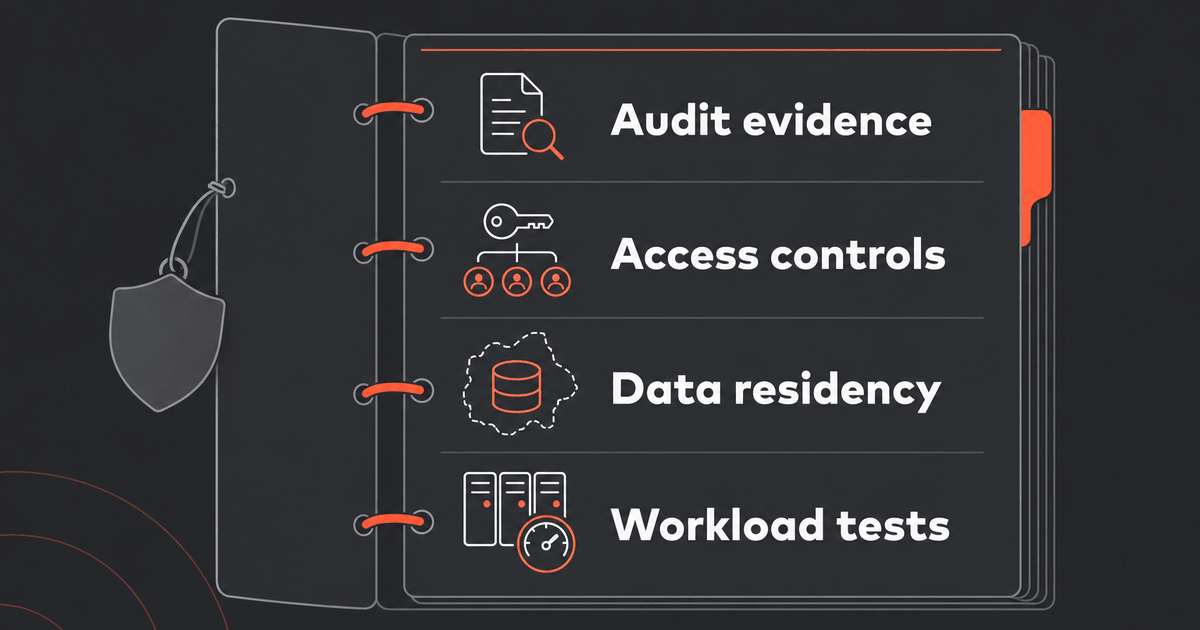
Use four approval gates:
- Assurance: Does the evidence cover the service you will use?
- Authority: Can the right people act without giving everyone broad access?
- Location: Do hosting and data-handling commitments meet your requirements?
- Capacity: Can the configured service handle your workload while preserving controls?
Make mandatory requirements pass-or-fail. A missing required control should not disappear inside a high overall feature score.
Gate 1: Read the assurance report, not just the badge
Bunny’s security and compliance overview describes its security controls and SOC 2 Type II status. Request the underlying assurance material for your review rather than treating the public page as the complete evidence package. (bunny.com)
Ask your security reviewer to record:
- The service, systems and locations covered.
- The examination period and any gap since it ended.
- The auditor’s opinion and relevant testing exceptions.
- Subservice organizations excluded from the examination.
- Controls your own organization must operate.
These are substantive review questions reflected in the AICPA’s SOC 2 report review checklist, including whether a bridge letter is provided for a timing gap. (assets.ctfassets.net)
Keep the requested evidence specific. If finance requires a SOC 1 report for its controls assessment, ask for that report explicitly. Do not accept a SOC 2 badge as the answer to a different requirement. Chargebee documents both report types; evaluate a replacement against the assurance your finance team actually needs. (chargebee.com)
Required output: a short assurance review with accepted findings, unresolved questions and a named decision owner—not a folder of unread PDFs.
Gate 2: Prove who can act, approve and retrieve evidence
Bunny documents SAML single sign-on, SCIM-based provisioning and deprovisioning, and role-based restrictions on viewing or modifying data. It also documents multi-stage quote approval workflows. These are useful starting capabilities; test the precise permission boundaries your organization needs. (bunny.com)
Use a hypothetical employee-transfer scenario rather than a happy-path sales demo.
A salesperson moves to customer support. Before the transfer, they could prepare commercial proposals but required approval for exceptions. Afterward, they should retain only the access appropriate to their new job.
Ask the vendor to demonstrate:
- The role change through your intended identity-management process.
- An attempted action that the new role must prohibit.
- What happens to existing sessions and separately issued credentials.
- Retrieval of the employee’s earlier approval and change history.
Then repeat the exercise for an employee leaving the company.
Separately, ask to inspect an actual change record. Request the actor, timestamp, affected object, previous and new values, retention period and export method. Ask whether administrators can alter or delete that history.
These are evaluation requirements, not claims that Bunny provides every requested logging behavior. Record any limitation and decide whether it needs a compensating control or disqualifies the platform.
Required output: a tested permission matrix and a sample evidence export that security and finance can interpret without vendor assistance.
Gate 3: Turn data residency into a written boundary
Bunny’s published data residency options are Oregon in the United States and Sydney in Australia. Chargebee documents hosting options in the United States, European Union and Australia. (bunny.com)
If EU hosting is mandatory, Chargebee is the better-documented fit between these two platforms. Bunny’s published locations do not establish an EU option. Treat that as a selection constraint, not something a strong quoting demonstration can offset. (bunny.com)
For either vendor, ask for a written data-location schedule covering:
- Production records and uploaded documents.
- Backups and disaster-recovery copies.
- Application logs and support attachments.
- Subprocessor handling and remote support access.
- Deletion procedures and retention exceptions.
Do not stop at naming the primary region. Have your privacy and security reviewers assess the complete proposed arrangement, including connected services.
For example, request a walkthrough of a support investigation involving a customer’s invoice. Where would the attachment be stored? Who could access it? How would it be removed?
Required output: an approved data-flow diagram and contractual commitments that match the deployment you intend to buy.
Gate 4: Define scale as a workload with controls attached
For this evaluation, define scale in measurable terms—not simply as “enterprise-ready.”
Give each candidate the same workload brief: expected account count, billing concentration around month-end, concurrent users, API traffic, reporting demand and evidence-retention requirements. Specify your planning horizon and expected peak, rather than relying on average activity.
Run a controlled exercise with realistic records and ask for:
- Completion time: when the scheduled work finishes.
- Error accounting: which records failed and how operators find them.
- Backlog visibility: how much work remains and whether it is progressing.
- Recovery: how processing resumes after an interruption.
- Administrative effort: which steps require manual intervention.
- Evidence retrieval: how quickly an authorized reviewer can reconstruct a selected action.
Test these together. Ask an authorized reviewer to retrieve historical evidence while billing work is running and another administrator is changing access.
Do not infer throughput from a security report or hosting provider. Request results for the configuration being proposed, plus documented API limits, support escalation terms and recovery objectives.
Required output: an agreed workload envelope, recorded results and explicit ownership of any capacity assumptions.
Make the decision from an evidence register
Bring the four gates together in one register. For each mandatory requirement, record the evidence, configuration dependency, owner, review date and remaining gap.
Distinguish three statuses:
- Demonstrated: observed in the proposed configuration.
- Documented: supported by relevant written evidence.
- Unresolved: awaiting proof or an accepted alternative control.
Do not label an unresolved requirement “supported” because it appears on a roadmap.
Bunny’s case for this shortlist is its combination of connected quoting and billing with published identity and access controls. The remaining job is to demonstrate that those capabilities meet your organization’s particular obligations and workload. (bunny.com)
Bring your permission matrix, residency requirements and peak-workload brief to a Bunny demo. Ask for evidence against each one.
Choose the platform whose controls you can demonstrate and operate at your expected scale—not the one whose compliance page has the most badges.

Billing that handles your pricing model
Recurring, usage-based, tiered, banded or hybrid — Bunny bills it without a rebuild, and recognises the revenue automatically.