Lemon Squeezy is shutting down. Here's where your subscriptions and license keys can go.

How healthy is your quote-to-cash?
12 questions on pricing, renewals, billing and reporting. Takes two minutes.
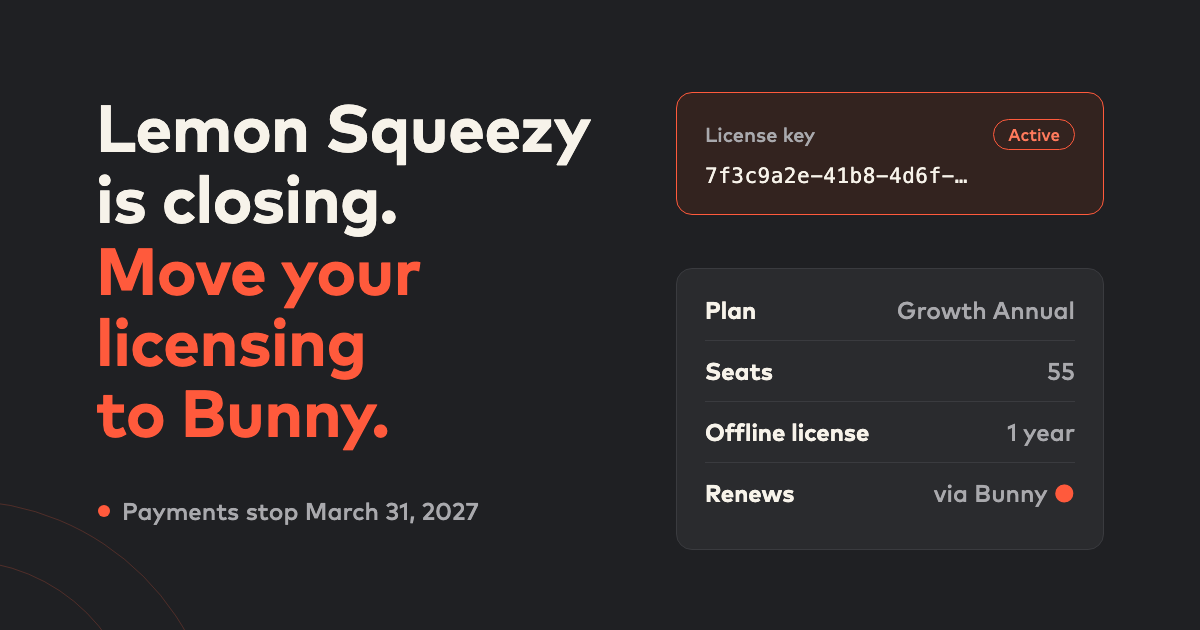
Take the assessmentLemon Squeezy is closing. In a post on November 16, CEO JR Farr announced that new store sign-ups have closed and that Lemon Squeezy “will stop processing payments on March 31, 2027.” There’s no wiggle room on that date: “We won’t be able to extend that deadline, so please start planning now.”
Lemon Squeezy was acquired by Stripe, and Stripe now has its own merchant-of-record product, Managed Payments. Running two platforms that do the same job didn’t make sense, so Lemon Squeezy is folding into Stripe.
If you sell software through Lemon Squeezy, you have about four months to move your subscriptions somewhere else. And if you sell licensed software, there’s a gap in the recommended path that you need to plan for now.
The key dates
| Date | What happens |
|---|---|
| November 16, 2026 | New store sign-ups closed |
| December 2, 2026 | Migration tooling for Stripe Managed Payments launches |
| Mid-January 2027 | Lemon Squeezy’s recommended latest date to start migrating |
| March 31, 2027 | Lemon Squeezy stops processing transactions, including subscription renewals |
That last line is the one that matters. Any subscription still on Lemon Squeezy on April 1 stops renewing.
Managed Payments doesn’t do license keys
Lemon Squeezy is pointing most customers at Stripe Managed Payments, and for plenty of digital product sellers that’s the right call. But Lemon Squeezy is upfront that it’s “not a like-for-like replacement.”
Its own migration comparison lists “Digital fulfillment and license keys” as included in Lemon Squeezy and not included in Managed Payments. The migration FAQ says license keys don’t migrate automatically, and the fulfillment guide warns that if you don’t move them before the deadline, “customers may lose access to their license keys, files, and links after March 31, 2027.”
So if your product is a desktop app, a plugin, a self-hosted server or anything else that checks a key before it unlocks, you need a new home for your licensing. Not just your payments.
Where Bunny fits
Bunny is subscription billing and license key management for software companies. We’re not a merchant of record, and we’re not the right destination for every Lemon Squeezy store. If you sell ebooks and templates and you want someone else to be the seller on every transaction, Managed Payments is built for you.
Bunny is built for something different: software companies that sell subscriptions and want full control of them. That covers two kinds of Lemon Squeezy customers.
SaaS teams. You’re selling plans, seats and add-ons, and your customers sign up and manage their subscriptions themselves. Bunny gives you a product catalog of products, plans and price lists, plus checkout and signup components you can drop into your app. There’s a customer portal where buyers change plans, adjust quantities and pay invoices, along with coupons, trials and proration. And when a bigger customer wants a quote, an annual contract or a custom price, Bunny handles that too. That’s the part a checkout-first tool was never built for.
Installed and self-hosted software. Every subscription in Bunny comes with a license key. Your software calls Bunny to validate it and gets back a signed token that says whether the subscription is active, which plan the customer is on and what they’re entitled to: features, limits and seat quantities. Changes in Bunny show up the next time the key is checked. Upgrade a customer and their software unlocks the new features. Cancel them and the key stops validating.
License keys that work offline too
A lot of software that sells through license keys runs in places with no internet connection: customer data centers, air-gapped networks, factory floors. Bunny’s license key management handles both cases.
- Online mode. Your software sends the key to Bunny’s validation endpoint and gets back a signed JWT carrying the subscription’s entitlements. Tokens are short-lived, so entitlement changes reach your customers quickly.
- Offline mode. For air-gapped installs, you generate an offline license from the subscription in Bunny, or through the API. It’s valid for a year and verified against public keys bundled with your software, so it never needs to call home.
- Instance tracking. Pass a device fingerprint when you validate and Bunny records every instance running against each subscription.
Tokens are signed with asymmetric keys and published on a standard JWKS endpoint, so you can verify them in any language. Our Rust SDK does all of it in a single call.
One thing to plan for: Bunny issues its own license keys, so your existing Lemon Squeezy keys won’t carry over. The clean way to switch is to ship an app update that validates against Bunny, then send each customer their new key. Do it well before March 31 and your customers never lose access.
Let AI do the migration grunt work
Migrations used to mean weeks of spreadsheet wrangling. They don’t have to anymore.
Bunny has an MCP server, so you can connect Claude, ChatGPT or another AI assistant straight to your Bunny account. Give it your Lemon Squeezy export and ask it to do the tedious parts:
- Rebuild your catalog. The agent reads your Lemon Squeezy products and variants and creates the matching products, plans, price lists and features in Bunny, including per-seat pricing.
- Create your customers. It sets up accounts and billing contacts, checking what already exists so it doesn’t create duplicates.
- Prepare the import. For your active subscriptions, it maps your export into Bunny’s subscription import template, so start dates and current billing periods carry over exactly.
- Check the results. Ask it to compare MRR and subscription counts against your Lemon Squeezy numbers before you go live.
Migration mode holds all outbound emails while you check everything, so no customer gets a surprise invoice halfway through. Imported subscriptions keep their real start dates, and Bunny issues the next invoice when the current period ends. Customers won’t see a thing.
And you’re not doing it alone. Bunny’s team runs migrations with you, including history like cancelled subscriptions, past invoices and MRR per account.
What to sort out before you move
Because Bunny isn’t a merchant of record, you become the seller. Most software companies outgrow merchant-of-record pricing at some point anyway. Here’s what to line up:
- Payments. Connect your own Stripe account. Lemon Squeezy says it will help transfer card subscriptions to another provider: fill in the migration intake form in your Lemon Squeezy settings. PayPal subscriptions can’t be migrated, so those customers will need to re-subscribe.
- Sales tax and VAT. Bunny connects to Avalara and Kintsugi to calculate tax on every invoice. Check where you’re registered before your first renewal runs.
- Your data. Export customers, orders and subscriptions from Lemon Squeezy now, while everything still works.
Don’t wait for March
Lemon Squeezy recommends starting by mid-January, and that’s realistic. The longer you leave it, the more renewals you’ll have to juggle across two systems, and the less time your customers will have to swap in a new license key.
If your business runs on software subscriptions or license keys, this is a good time to move to a platform built for exactly that, rather than piecing together replacements for what Managed Payments leaves out.
Moving off Lemon Squeezy? We’ll help you migrate your subscriptions and license keys to Bunny before the March 31 deadline. Book a demo

Billing that handles your pricing model
Recurring, usage-based, tiered, banded or hybrid — Bunny bills it without a rebuild, and recognises the revenue automatically.