Chargebee vs Recurly: Which Billing Platform Fits?

How healthy is your quote-to-cash?
12 questions on pricing, renewals, billing and reporting. Takes two minutes.
Take the assessmentChargebee vs Recurly: choose Recurly if you run a high-volume subscriber business where retention, payment recovery and churn prevention drive revenue. Choose Chargebee if you’re a SaaS company that wants a broader suite, including native CPQ, usage billing and gateway choice. Both are mature, both are well supported, and both sell revenue recognition as a separate product. If most of your revenue comes from negotiated B2B contracts, there’s a third option worth testing alongside them.
We publish this on Bunny’s website. Bunny is SaaS billing, CPQ and RevOps for B2B SaaS, so we compete with both. The comparison below sticks to what Chargebee and Recurly publish, and the Bunny section is clearly labelled.
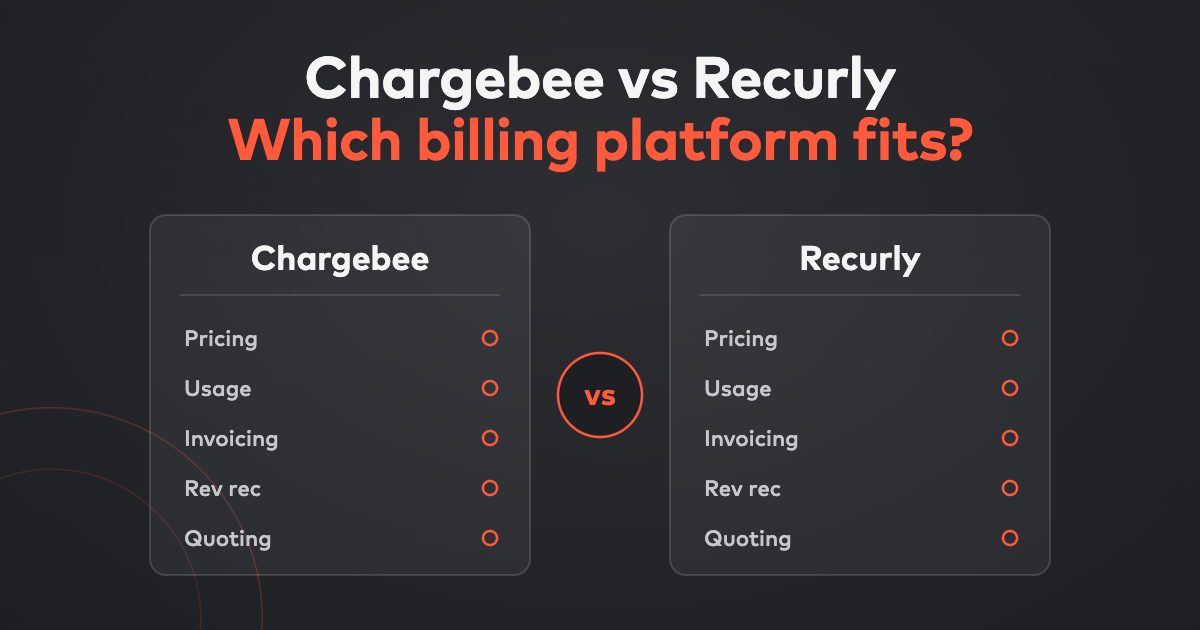
Chargebee vs Recurly at a glance
| Chargebee | Recurly | |
|---|---|---|
| Core focus | Broad subscription suite for SaaS and AI companies | Subscriber retention and recovery at volume |
| Entry pricing | Flow: $0 + 0.8% of invoicing volume, or $99/month + 0.65% | Starter: $249/month + 0.9% of billing volume, first $40K/month included |
| Upper tier | Enterprise, custom pricing | All-Access for $1M+ billing volume, quoted |
| Usage-based billing | Included, 100M usage events/month on Flow | Supported through usage-based add-ons with measured units |
| Quoting / CPQ | CPQ Lite (first 50 quotes free) and CPQ add-on: approvals, ramps, e-signature, renewal quotes | Not marketed |
| Revenue recognition | Chargebee RevRec, separate, custom pricing | Recurly RevRec, from $850/month billed annually |
| Retention tools | Growth product (Starter free for Billing customers) | Engage add-on, from $1,600/month billed annually |
| Gateways | 40+ | 20+ |
Figures are from each vendor’s pricing page in October 2026. Confirm current terms before you sign.
How do Chargebee and Recurly price?
Chargebee publishes one self-serve Billing plan, Flow, with two options: no platform fee plus 0.8% of invoicing volume, or $99 a month plus 0.65%. The two meet at $66K of monthly invoicing. Enterprise is quoted. CPQ, RevRec and the enterprise Growth tier are priced separately.
Recurly Starter is $249 a month plus 0.9% of billing volume, with the first $40K of billings each month included at no charge, and a 90-day free trial. All-Access requires at least $1M in billing volume and is priced “as low as under 1%” of billing volume, billed annually. RevRec starts at $850 a month and Engage, Recurly’s AI-driven churn and offers product, at $1,600 a month, both billed annually.
At low volume, Chargebee is usually cheaper because there’s no platform fee. Once you’re past the included $40K, the comparison depends on volume and which add-ons you need. Build the three-year model with the full stack, not just billing.
Quoting and CPQ: the biggest difference
This is where the two split most clearly for B2B SaaS.
Chargebee markets a billing-native CPQ that works from Salesforce or HubSpot. Reps configure bundles, usage pricing and multi-year ramps, route approvals through multi-level workflows, collect e-signatures and send renewal quotes that inherit terms from the existing subscription.
Recurly doesn’t market a CPQ or quoting product. Its strength sits after the sale: subscription management, dunning, payment recovery and churn prevention. A sales-led team on Recurly typically quotes in the CRM or a separate CPQ tool and then keys the deal into Recurly.
If your sales team negotiates prices, ramps or approvals, Chargebee is the stronger of the two.
Usage-based and hybrid billing
Both support usage. Chargebee includes usage billing in the Billing product, with 100 million usage events a month on Flow and higher limits on Enterprise. Recurly handles usage through usage-based add-ons: you log usage against measured units through the API and bill it at the end of the cycle.
For simple seat-plus-overage plans, either works. For heavy consumption pricing, test event volume, late and corrected usage, and how negotiated usage rates carry into renewals.
Invoicing for B2B customers
Recurly supports manual invoicing with custom payment terms, PO numbers, recorded payments and a separate dunning flow for invoices paid on terms. Chargebee supports invoicing alongside its subscription engine, and its Enterprise plan adds contract terms, account hierarchies and multi-entity management.
Bring a real B2B scenario: an annual contract billed quarterly on net 30, with a mid-term expansion and a PO number that changes at renewal. Watch who has to do what by hand.
Revenue recognition
Neither includes revenue recognition in its billing price. Both sell a dedicated product.
Recurly RevRec is an enterprise-grade revenue recognition and forecasting product covering ASC 606 and IFRS 15, with support for multiple currencies, entities and books. It starts at $850 a month billed annually.
Chargebee RevRec is a revenue sub-ledger built on the ASC 606 and IFRS 15 five-step model, with scenarios like variable consideration and material rights. Pricing is by quote.
Both are credible. Ask each for the specific reports your auditor will request.
Retention and payment recovery
This is Recurly’s home ground. Its platform leads with churn management: dunning campaigns, payment recovery and, through Engage, AI-driven churn modelling, cancel-save flows and offers. That makes Recurly a natural fit for consumer, media and other subscriber businesses where card failures and voluntary churn drive the numbers.
Chargebee’s Growth product covers retention and pricing experiments, with a free Starter tier for Chargebee Billing customers and an Enterprise tier priced by active subscribers.
Which should you choose?
| If you are… | Start with | Why |
|---|---|---|
| A consumer or media subscription business | Recurly | Retention, dunning and recovery are the core of the product |
| Self-serve SaaS that wants a broad suite | Chargebee | Usage billing, gateway choice, and CPQ when sales arrives |
| SaaS adding a sales team | Chargebee | Native CPQ with approvals, ramps and renewal quotes |
| Mostly sales-led B2B with negotiated contracts | Evaluate Bunny alongside them | Quoting, billing and renewals on one subscription record |
The third option for B2B contract billing
Chargebee and Recurly both start from the subscriber. B2B SaaS that sells through a sales team starts from the deal: a customer-specific price, a three-year ramp, a discount that needs approval, an expansion halfway through the term and a renewal with an uplift.
Bunny is built around that deal. Bunny CPQ and Bunny billing share one catalog and one subscription record, so the quote your rep builds is the subscription that bills. It supports custom pricing on the quote without creating customer-specific products, multi-year ramps, approval workflows, built-in e-signature, and renewal and upsell quotes from the live subscription. Recurring and usage-based charges can sit on the same contract, and usage prices can be negotiated on the quote.
Pricing is published. PLG is 0.6% of PLG revenue, SLG is $150 per user per month, and Advanced Billing adds 0.2% of combined revenue for multiple entities, multiple currencies and revenue recognition. See the pricing page.
Going deeper on either vendor? Read our Chargebee alternatives and Recurly alternatives roundups, or the head-to-heads: Bunny vs Chargebee and Bunny vs Recurly. If Stripe is also on your list, see Chargebee vs Stripe Billing.
Frequently Asked Questions
What is the difference between Chargebee and Recurly?
Both are subscription billing platforms. Recurly focuses on subscriber retention, payment recovery and churn prevention, with a strong base in consumer and media subscriptions. Chargebee offers a broader suite for SaaS, including native CPQ, usage billing and a separate RevRec product.
Is Chargebee cheaper than Recurly?
For smaller volumes, usually. Chargebee’s Flow plan starts at no platform fee plus 0.8% of invoicing volume. Recurly’s Starter plan is $249 a month plus 0.9% of billing volume, with the first $40K of monthly billings included. Recurly’s All-Access plan is for businesses billing $1M or more and is quoted.
Does Recurly have CPQ or quoting?
Recurly does not market a CPQ or quoting product. Chargebee does, with approvals, ramp pricing, e-signature and renewal quotes available as an add-on to Chargebee Billing.
Do Chargebee and Recurly support revenue recognition?
Both offer it as a separate product. Recurly RevRec starts at $850 a month billed annually and covers ASC 606 and IFRS 15. Chargebee RevRec is also sold separately, with custom pricing, and supports ASC 606 and IFRS 15.
Which is better for B2B SaaS with negotiated contracts?
Chargebee is the stronger of the two for sales-led SaaS because of its native CPQ. If negotiated contracts are most of your revenue, also evaluate a platform built around the B2B deal, such as Bunny, where quoting, billing and renewals share one catalog and subscription record.

Billing that handles your pricing model
Recurring, usage-based, tiered, banded or hybrid — Bunny bills it without a rebuild, and recognises the revenue automatically.