Usage-Based Pricing: 6 Models With Real SaaS Examples

How healthy is your quote-to-cash?
12 questions on pricing, renewals, billing and reporting. Takes two minutes.
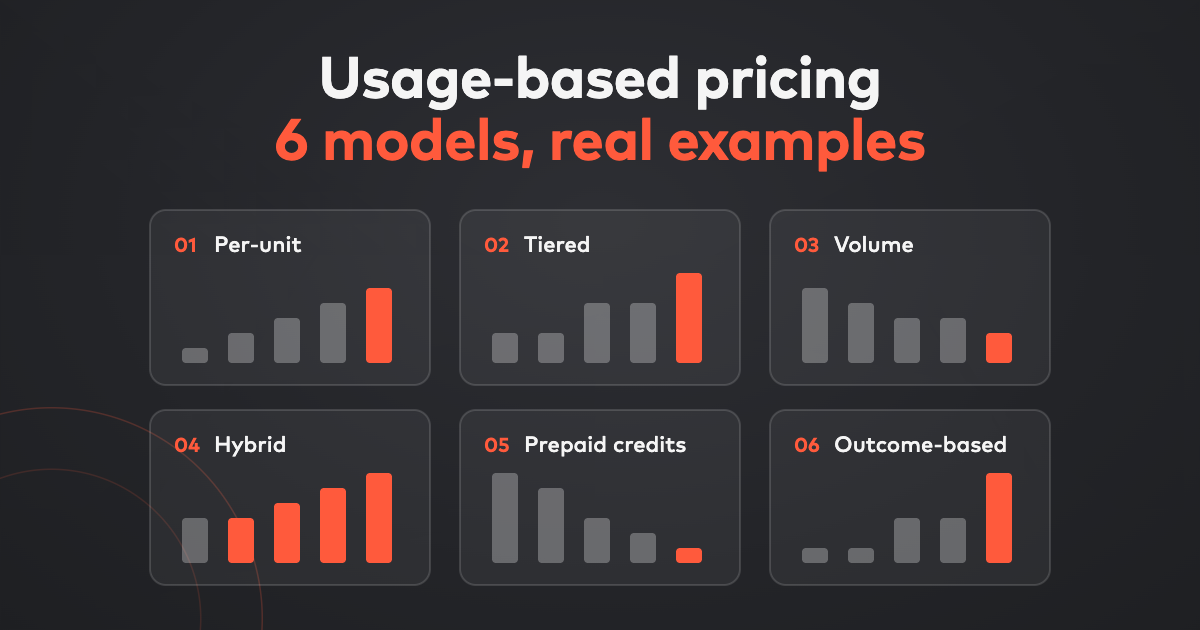
Take the assessmentUsage-based pricing means charging customers for what they consume, such as API calls, messages, tokens, hosts or resolved tickets, rather than a fixed monthly fee. There are six common models: per-unit, tiered, volume, hybrid (a platform fee plus usage), prepaid credits and outcome-based. Most SaaS companies end up combining two or three of them. This guide explains each one with a real, published example and shows how to bill it.
We publish this on Bunny’s website. Bunny is SaaS billing, CPQ and RevOps for B2B SaaS, and usage-based billing is one of the things it does, so each model below ends with how you’d set it up in Bunny billing. The vendor examples are taken from those vendors’ own pricing pages in October 2026.
Usage-based pricing models at a glance
| Model | How the bill is calculated | Published example | Best for |
|---|---|---|---|
| Per-unit | Quantity × a fixed rate | Twilio SMS, per message segment | Simple, clearly countable units |
| Tiered | Each band of units priced at its own rate | Common for API and messaging volume | Rewarding growth without repricing everything |
| Volume | All units priced at the rate of the tier reached | Common for seat and licence bands | Committed quantities, bulk discounts |
| Hybrid | Platform fee + usage, often with an allowance | Datadog per-host plans plus usage products; Intercom seats plus Fin | Most B2B SaaS contracts |
| Prepaid credits | Buy a balance up front; usage draws it down | OpenAI API prepaid billing; Snowflake pre-paid capacity | Cash up front, capped customer spend |
| Outcome-based | Charge per successful result | Intercom Fin, $0.99 per outcome | AI agents and automation |
1. Per-unit pricing
The simplest model: a fixed price per unit consumed. Ten thousand messages at a penny each is $100.
Example: Twilio publishes a US base rate of $0.0083 per 160-character SMS segment, sent or received, and offers volume and committed-use discounts through its account team. AI model APIs work the same way at a finer grain. Anthropic and OpenAI both price per million tokens, with input and output tokens priced differently and a 50% discount for batch processing.
Watch out for: units customers can’t predict. Tokens are a fair unit for a developer but meaningless to a buyer in finance, which is why many AI products wrap tokens in credits or outcomes.
In Bunny: create a usage-based charge with a flat per-unit price. Prices can carry up to six decimal places, so sub-cent rates like per-message or per-token pricing invoice correctly. Usage is reported through the API or SDK, and Bunny can aggregate the period’s records as a sum, average, maximum or last value before rating.
2. Tiered pricing
With tiered pricing, the unit price falls as consumption grows, but each band is charged at its own rate. Using a simple schedule of $10 for units 1–10, $8 for 11–20 and $6 above that:
- 15 units = 10 × $10 + 5 × $8 = $140
- 25 units = 10 × $10 + 10 × $8 + 5 × $6 = $210
Tiered pricing never makes a bill go down when usage goes up, which keeps it fair and predictable. That’s why it suits metered usage that resets to zero every period.
In Bunny: choose the tiered pricing model on a recurring or usage-based charge and enter the tiers. Bunny’s own guidance is to use tiered for usage-based charges, because each period starts again from zero.
3. Volume pricing
Volume pricing uses the same tiers, but once a customer reaches a tier, every unit is priced at that tier’s rate. With the schedule above:
- 15 units = 15 × $8 = $120
- 25 units = 25 × $6 = $150
The bulk discount is bigger, and it applies to the whole quantity. It’s a natural fit for committed quantities like seats on an annual contract, where the customer is buying a block and expects one unit price.
A close cousin is band pricing, where the quantity falls into a band with a flat price: 1–99 users for $20, 100–499 for $75, 500+ for $300. Bands are easy for buyers to read and work well for usage that varies within a range.
In Bunny: flat, tiered, volume and band pricing are all built-in pricing models for recurring and usage-based charges. Pick the model on the charge, set the tiers, and the same catalog drives quotes, subscriptions and invoices.
4. Hybrid pricing: a platform fee plus usage
Hybrid pricing combines a recurring fee with usage-based charges. The recurring part usually includes an allowance, with overage billed on top. It’s the dominant model in B2B SaaS because it balances predictability for both sides: the vendor gets committed revenue, the customer gets a known baseline, and revenue still grows with adoption.
Examples: Datadog publishes per-host monthly pricing for Infrastructure Monitoring ($15 per host per month billed annually on Pro, $18 on demand) and prices other products by usage, such as log ingestion from $0.10 per GB. Intercom sells seat-based plans and charges separately for its Fin AI agent per outcome.
A typical B2B version looks like this:
| Small | Medium | Large | |
|---|---|---|---|
| Platform fee | $20/month | $40/month | $80/month |
| Included requests | 100 | 250 | 500 |
| Additional requests | $0.25 each | $0.22 each | $0.20 each |
In Bunny: a price list can mix recurring and usage-based charges, so this is one plan. The platform fee is a recurring charge billed in advance. The overage is a tiered usage charge billed in arrears, with the first tier priced at zero up to the allowance. Both land on the same invoice. Usage prices can be negotiated on the quote, and renewal quotes carry usage charges alongside recurring ones. See usage-based billing and metered billing for more.
5. Prepaid credits
With prepaid credits, the customer buys a balance up front and usage draws it down. The vendor collects cash early and removes credit risk; the customer caps their spend and often gets a discount for buying a bigger block.
Examples: OpenAI’s API uses prepaid billing for new accounts. Customers buy credits (minimum $5), can set auto-recharge when the balance falls below a threshold, and purchased credits expire after a year. Snowflake sells consumption either on demand or as pre-paid capacity, with usage measured in credits.
The decisions that define a credits model are whether credits expire, what happens at zero (hard stop, auto top-up or overage), and whether credits are denominated in currency or units. Each has accounting consequences: a credit purchase is deferred revenue until it’s consumed.
In Bunny: the B2B form of this model, a prepaid commitment with overage, is a recurring charge billed in advance for the committed amount plus a usage charge for consumption above it, on the same subscription and invoice. If your product needs a real-time wallet that blocks access at zero, keep that balance in your product’s usage metering layer and let Bunny bill the commitment and the overage.
6. Outcome-based pricing
Outcome-based pricing charges for a result rather than the activity behind it: a resolved ticket, a qualified lead, a completed workflow. It’s growing fastest with AI agents, where “usage” in tokens means little to the buyer but a resolved conversation is easy to value.
Example: Intercom charges $0.99 per outcome for its Fin AI agent. An outcome counts when a customer confirms the issue is resolved, doesn’t ask for more help after Fin responds, or Fin completes a workflow, including handoffs. It’s charged once per conversation, however many questions Fin answers.
The hard part isn’t the price, it’s the definition. Customers need to trust how an outcome is counted, so publish the rule and make the invoice line traceable to the events behind it. We go deeper in outcome-based pricing: the next frontier.
In Bunny: any countable unit can be a usage-based charge, including outcomes. Your product decides when an outcome happened and reports it as a usage record; Bunny rates it with flat, tiered, volume or band pricing and invoices it with everything else on the subscription.
How to choose a usage-based pricing model
Start with the unit, not the model. A good usage metric is:
- Tied to value. It grows when the customer gets more out of the product.
- Predictable enough to budget. Finance buyers need to forecast it.
- Easy to measure and audit. You and the customer should agree on the count.
Then pick the structure. Per-unit and tiered suit self-serve and developer products. Volume and bands suit committed quantities. Hybrid suits most B2B contracts. Credits suit products where cash up front and capped spend matter. Outcome-based suits AI products where the result is clear and countable.
Finally, test the billing before launch. Usage pricing breaks in the edge cases: late or duplicate events, mid-term plan changes, negotiated rates and renewals. In Bunny, the account-level invoice preview and draft invoices let you check usage invoices before they’re sent.
Frequently Asked Questions
What is usage-based pricing?
Usage-based pricing charges customers according to how much of a product they consume, such as API calls, messages, tokens, hosts or gigabytes, instead of a fixed subscription fee. It is also called consumption-based or pay-as-you-go pricing.
What are the main usage-based pricing models?
The six common models are per-unit, tiered, volume, hybrid (a platform fee plus usage), prepaid credits and outcome-based pricing. Many SaaS companies combine two or more, for example a platform fee with included usage and tiered overage.
What is the difference between tiered and volume pricing?
Tiered pricing charges each unit at the rate of the tier it falls into, so the first 10 units cost one price and the next 10 another. Volume pricing applies the rate of the highest tier reached to every unit. Volume pricing creates bigger price drops at tier boundaries.
Which SaaS companies use usage-based pricing?
Twilio prices SMS per message segment, Anthropic and OpenAI price their APIs per million tokens, Datadog prices infrastructure monitoring per host and logs per gigabyte ingested, Snowflake sells consumption on demand or as pre-paid capacity, and Intercom charges per outcome for its Fin AI agent.
Is hybrid pricing better than pure usage-based pricing for B2B SaaS?
For most B2B SaaS companies, yes. A platform fee or minimum commitment gives you predictable revenue and gives the customer a predictable budget, while usage charges let revenue grow with consumption. It is the most common structure in negotiated enterprise contracts.
How do you bill usage-based pricing in Bunny?
Add a usage-based charge to a plan, choose flat, tiered, volume or band pricing, and send usage records through the API or SDK. Bunny aggregates usage for the period, rates it and puts it on the same invoice as any recurring charges, so hybrid and committed-plus-overage contracts are one subscription.

Billing that handles your pricing model
Recurring, usage-based, tiered, banded or hybrid — Bunny bills it without a rebuild, and recognises the revenue automatically.