Chargebee vs Stripe Billing: Pricing, Features and Fit

How healthy is your quote-to-cash?
12 questions on pricing, renewals, billing and reporting. Takes two minutes.
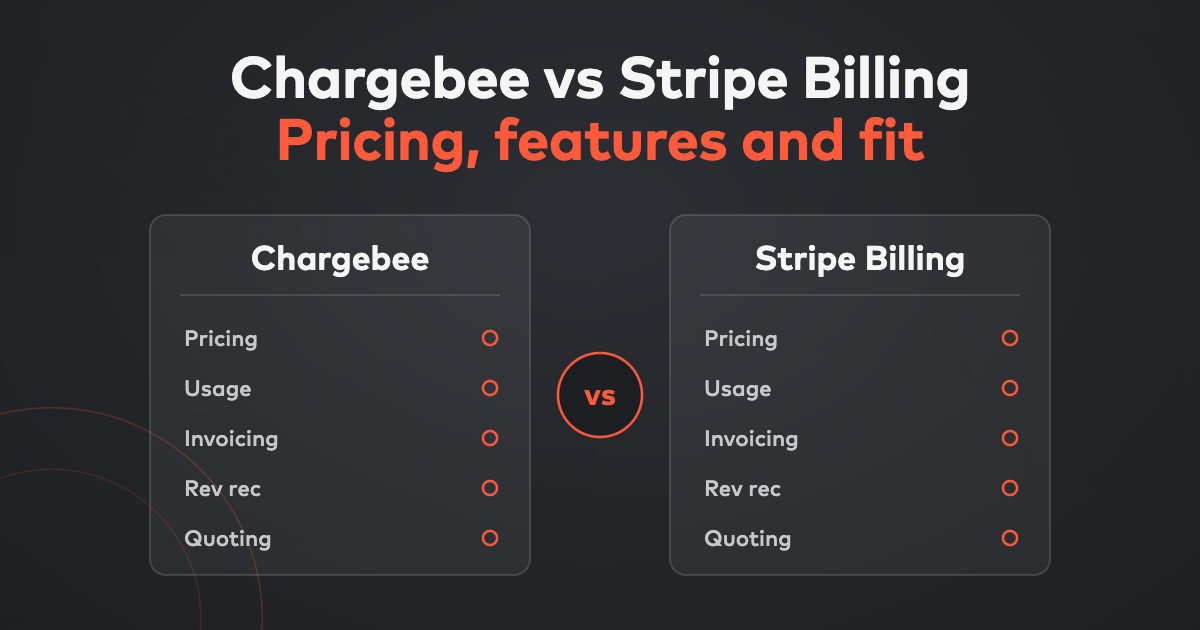
Take the assessmentChargebee vs Stripe Billing comes down to this: pick Stripe Billing if you are a product-led, self-serve business already running payments on Stripe and you have engineers who want to own billing logic in code. Pick Chargebee if you want a standalone subscription suite with gateway choice, native CPQ and a revenue recognition product your finance team can run without engineering. Both are strong. Neither was designed first for the negotiated B2B contract, which is where most growing SaaS companies end up.
A quick note on who is writing this. We publish this on Bunny’s website. Bunny is SaaS billing, CPQ and RevOps for B2B SaaS, so we compete with both vendors for some deals. We’ve kept the head-to-head below to what each vendor publishes, and we save the Bunny pitch for the section on outgrowing both.
Chargebee vs Stripe at a glance
| Stripe Billing | Chargebee | |
|---|---|---|
| What it is | Billing APIs and dashboard on top of Stripe Payments | Standalone subscription billing suite |
| Headline price | 0.7% of billing volume (pay-as-you-go), lower rates on annual plans | Flow plan: 0.8% of invoicing volume, or $99/month + 0.65%; Enterprise is custom |
| Payments | Stripe Payments | 40+ payment gateways |
| Usage-based billing | Advanced usage billing through Metronome, priced separately | Included in Billing plans (100M usage events/month on Flow) |
| Quoting / CPQ | Quotes that convert to subscriptions; no approval routing or e-signature | CPQ Lite (first 50 quotes free) and full CPQ as add-ons, with approvals, ramps, e-signature and renewal quotes |
| Revenue recognition | Stripe Revenue Recognition, a separate subscription (0.25% of volume monthly, 0.2% on annual plans, plus a base fee) | Chargebee RevRec, a separate product with custom pricing |
| Best fit | Developer-led, self-serve SaaS on Stripe | Subscription businesses that want a broad suite and gateway choice |
Prices are as published on each vendor’s pricing page in October 2026. Both change regularly, so confirm before you sign.
How do Chargebee and Stripe Billing price?
Stripe Billing charges 0.7% of billing volume on pay-as-you-go, which covers recurring transactions on and off Stripe and excludes one-off invoices. Annual plans trade a monthly commitment for a lower rate on additional volume. Card processing is charged separately on top, and one-off invoices go through Stripe Invoicing at 0.4% per paid invoice.
Chargebee publishes a Flow plan with two ways to pay: $0 platform fee plus 0.8% of invoicing volume, or $99 a month plus 0.65%. The crossover is $66K of monthly invoicing, which Chargebee calls out as the breakeven. Above that, the $99 option is cheaper. Enterprise is quoted. Your gateway’s processing fees are separate.
The headline rates are close. The real gap opens up when you add the products around billing:
- Revenue recognition. Stripe Revenue Recognition is its own subscription: a base fee plus 0.25% of volume monthly, or 0.2% on annual plans. Chargebee RevRec is a separate product with custom pricing.
- Quoting. Stripe quotes come with Billing. Chargebee CPQ Lite is free for the first 50 quotes; full Chargebee CPQ is a quoted add-on.
- Usage at scale. Stripe’s answer for advanced usage-based billing is now Metronome, which it acquired and which is contracted separately. Chargebee bundles usage events into the Billing plan up to a published limit.
Model a three-year cost with your own revenue, growth and the modules you will actually need. A 0.1% difference in the headline rate matters less than a second product you didn’t budget for.
Pricing models: which handles usage and hybrid plans better?
Both handle flat, per-seat and tiered recurring plans well. The difference is in consumption.
Chargebee treats usage as part of the billing product. You send usage events, attach them to metered charges and bill in arrears alongside recurring charges. The Flow plan includes 100 million usage events a month, with more available on Enterprise.
Stripe Billing supports meters and usage-based prices, but Stripe’s direction for complex consumption pricing is Metronome: real-time metering, credit-based pricing, enterprise contracts and multi-dimensional rating, with Stripe handling payments, tax and revenue recognition. That is a capable stack, and it is also a second system to implement and pay for.
If usage is a small add-on to a seat plan, either will do. If usage is the business, cost and scope the Metronome route against Chargebee’s bundled events. Our guide to usage-based pricing models walks through the common structures.
Invoicing and payments
Stripe Billing is at its best when the customer pays by card through Stripe: automatic retries, a hosted customer portal and reconciliation that stays inside one account. It also sends invoices for customers who pay by bank transfer.
Chargebee’s advantage is gateway choice. It connects to more than 40 payment gateways, which matters if you already have merchant accounts elsewhere, sell in regions Stripe covers less well, or want to route payments across providers.
For B2B invoices with net terms, PO numbers and manual payment application, test both with your own finance team. That workflow is where self-serve and sales-led billing pull apart.
Revenue recognition
Neither includes revenue recognition in its base billing price.
Stripe Revenue Recognition reads your Stripe billing data and produces ASC 606-style schedules and journal entries. It’s convenient if all your revenue already flows through Stripe.
Chargebee RevRec is a dedicated revenue sub-ledger for ASC 606 and IFRS 15, with support for more complex scenarios like variable consideration. It’s sold separately in its own tiers.
Ask both for the reports your auditor will want, not just a demo of the schedule.
Quoting and CPQ
This is the biggest functional gap between the two.
Stripe quotes are a lightweight object: create a quote, finalize it, and when the customer accepts, Stripe creates the subscription or a subscription schedule. There’s no approval routing for discounts and no built-in e-signature. Teams usually bolt on a CPQ tool or manage exceptions in spreadsheets and Slack.
Chargebee markets a billing-native CPQ that works from Salesforce or HubSpot, with multi-level approvals, multi-year ramps, e-signature and renewal quotes that inherit terms from the existing subscription. If quoting is a requirement and you are choosing between these two, that tips the scales toward Chargebee.
Which fits your company stage?
| Stage | Likely fit | Why |
|---|---|---|
| Pre-revenue to early self-serve | Stripe Billing | Fast to ship if you’re already on Stripe Payments; developers own the logic |
| Self-serve at scale, multiple regions | Chargebee or Stripe Billing | Chargebee for gateway choice and an ops-friendly UI; Stripe if payments already live there |
| Adding a sales team | Chargebee, or Stripe plus a CPQ | Chargebee’s CPQ add-on covers quotes and approvals; Stripe needs more assembly |
| Mostly sales-led, negotiated contracts | Neither by default | See below |
When you outgrow both
Both platforms start from the subscription and work outwards. Sales-led B2B SaaS starts from the deal: a custom price, a three-year ramp, a discount that needs finance approval, a mid-term expansion, and a renewal with an uplift. When those deals become most of your revenue, the cracks show. Custom prices turn into one-off catalog products, renewals get rebuilt by hand and the metrics stop matching reality. We’ve written about what happens when salespeople touch Stripe Billing.
That’s the problem Bunny is built for. Bunny CPQ and Bunny billing share one catalog and one subscription record, so the quote your rep builds is the subscription that bills. Bunny supports customer-specific pricing on the quote without creating new products, multi-year ramps, approval workflows, built-in e-signature, and renewal and upsell quotes from the live subscription, with recurring and usage charges on the same contract. See Bunny CPQ for the detail.
You don’t have to leave Stripe to get there. Sidecar syncs your Stripe data into Bunny, so self-serve customers keep billing through Stripe while Bunny takes over the higher-value, sales-led subscriptions, with quoting, renewals and SaaS metrics across both.
Pricing is published: PLG at 0.6% of PLG revenue, SLG at $150 per user per month, and an Advanced Billing add-on at 0.2% of combined revenue that includes revenue recognition. Details on the pricing page. If you’re weighing Chargebee specifically, our Chargebee alternatives roundup and Bunny vs Chargebee comparison go further. For Stripe, see Bunny vs Stripe.
Frequently Asked Questions
What is the main difference between Chargebee and Stripe Billing?
Stripe Billing is a billing layer on top of Stripe Payments, priced as a percentage of billing volume and built for developers. Chargebee is a standalone subscription suite that connects to many payment gateways and adds native CPQ, RevRec and retention products that are priced separately.
Is Chargebee or Stripe Billing cheaper?
On headline rates, Stripe Billing’s pay-as-you-go price is 0.7% of billing volume, while Chargebee’s Flow plan is 0.8% of invoicing volume with no platform fee, or $99 a month plus 0.65%. The real cost depends on what else you need: Stripe charges separately for revenue recognition and usage billing through Metronome, and Chargebee prices CPQ and RevRec separately.
Does Stripe Billing have CPQ?
Stripe Billing has quotes that turn into subscriptions or subscription schedules when accepted. It does not include approval routing or built-in e-signature, so sales-led teams usually add a CPQ tool or move to a platform that includes one.
Which is better for usage-based pricing, Chargebee or Stripe?
Chargebee includes usage billing in its Billing plans, with 100 million usage events a month on the Flow plan. Stripe now handles advanced usage-based billing through Metronome, which it acquired and which is set up and priced separately from Stripe Billing.
What should a sales-led B2B SaaS company use instead of Chargebee or Stripe Billing?
If most of your revenue comes from negotiated contracts with custom pricing, ramps, approvals and renewals, look at a platform where quoting and billing share one catalog and one subscription record. Bunny is built for that, and its Sidecar option lets you keep self-serve billing on Stripe while Bunny runs the sales-led deals.

Billing that handles your pricing model
Recurring, usage-based, tiered, banded or hybrid — Bunny bills it without a rebuild, and recognises the revenue automatically.