Co-Term Add-ons and Mid-Contract Upgrades Without Resetting Renewal

How healthy is your quote-to-cash?
12 questions on pricing, renewals, billing and reporting. Takes two minutes.
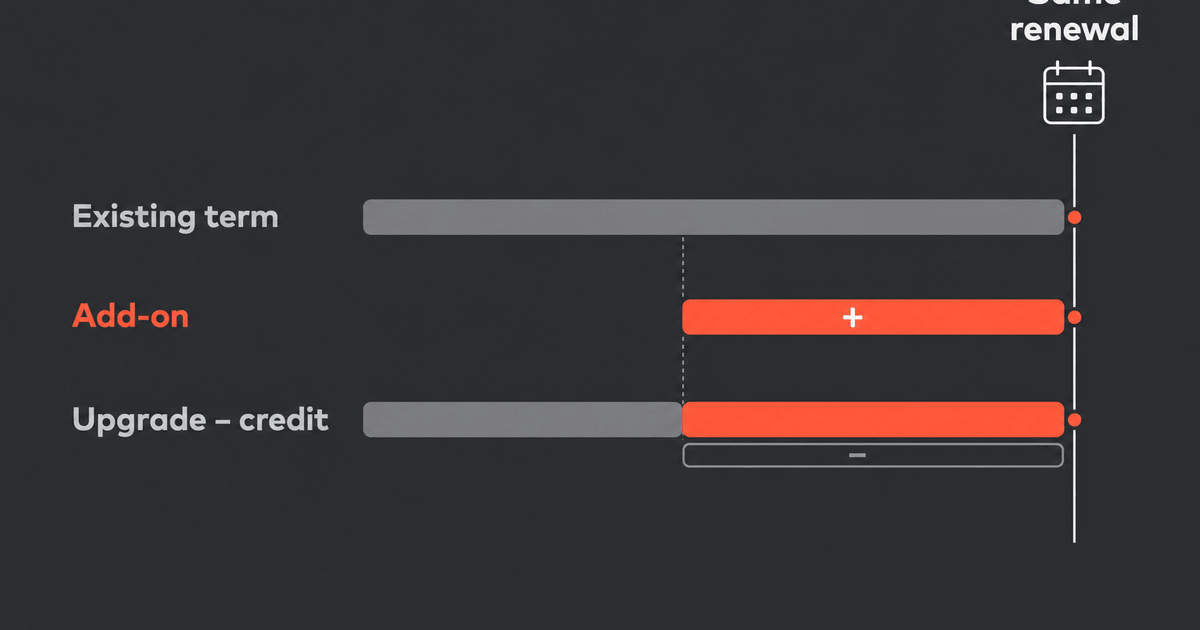
Take the assessmentCo-terming means aligning subscription or add-on end dates so they renew together. To co-term a mid-contract upgrade, preserve the existing end date, set the change’s effective date, and charge for the remaining period rather than automatically opening a new twelve-month term. (bunny.com)
The practical work is making three things agree: the customer’s quote, the resulting invoice, and the next renewal. This walkthrough follows an add-on and a replacement upgrade through all three.
In practice, what does co term mean in contracts?
For a contract ending April 30, 2027, an add-on activated November 1, 2026 can run through April 30, 2027 too. In this example, both would renew on May 1, 2027. The add-on gets a shorter initial term, not a separate November anniversary.
Keep these decisions separate in your instructions to sales and billing:
- Effective date: When does the customer receive the additional service?
- Shared end date: When does the current commitment finish?
- Invoice timing: When should the adjustment be billed?
- Next-term price: What will the customer pay for a full renewal term?
Do not use “co-termed” as shorthand for all four. In particular, specify whether to bill an adjustment immediately or include it in the next scheduled bill; both are possible approaches to mid-period charges. (bunny.com)
How do you co-term a mid-contract upgrade?
Amend the existing subscription from the agreed effective date, retain its end date, and calculate only the remaining-period adjustment. For an added product, calculate its partial-term charge. For a replacement plan, reconcile the new charge with any unused amount already billed for the old plan. (docs.bunny.com)
Use this sequence:
- Read the current agreement and subscription state. Check dates, quantities, negotiated prices, prior changes and amounts already billed.
- Classify the change. Is it an additional product, extra seats, or a replacement for something already purchased?
- Confirm the shared end date. Do not extend the original commitment unless that extension is explicitly part of the deal.
- Calculate the adjustment. Apply the agreed proration method consistently to charges and any applicable offsets.
- Separate this term from the next. Show the amount being charged now and the full-term renewal basis.
- Check the resulting bill before release. Confirm that neither the old service nor the adjustment is charged twice.
The distinction between an addition and a replacement matters most. Treat them as separate calculations even when they appear on the same quote.
A worked amendment: one add-on, one replacement upgrade
Consider this illustrative agreement, with all amounts in US dollars and excluding tax:
- Original term: May 1, 2026 through April 30, 2027.
- Existing plan: $36,500 annually, already paid.
- Change effective date: November 1, 2026.
- Replacement plan: $54,750 annually.
- New reporting add-on: $7,300 annually.
- Agreed method: actual days remaining divided by days in the original annual period.
For calculation purposes, count November 1 through April 30: 181 service days in a 365-day annual period. Equivalently, use November 1 inclusive to May 1 exclusive.
For a fixed annual charge under this convention:
Partial-term charge = annual charge × 181 ÷ 365.
This applies the standard daily-proration formula to the example’s specified dates. (bunny.com)
The add-on has no old charge to offset
The reporting add-on costs:
$7,300 × 181 ÷ 365 = $3,620.
Its first term ends April 30, 2027. If it continues for another year at the same rate, its next annual charge is $7,300—not $3,620.
The replacement upgrade needs an offset
Assume this amendment grants an offset for the unused prepaid portion of the old plan.
The remaining-period replacement charge is:
$54,750 × 181 ÷ 365 = $27,150.
The unused old-plan amount is:
$36,500 × 181 ÷ 365 = $18,100.
The net upgrade adjustment is therefore $9,050. Together with the add-on, the amendment totals $12,670 before tax.
A difference-only calculation produces the same result here:
($54,750 − $36,500) × 181 ÷ 365 = $9,050.
Use either presentation consistently. Do not charge the difference and then subtract the old-plan amount again.
This example assumes unchanged annual rates and identical day-count treatment. For your own quote, record the denominator, date-boundary convention and rounding rule rather than leaving them implicit.
Write the quote as a change, not a second initial sale
Give the customer a concise commercial summary:
Effective November 1, 2026, replace the existing plan with the upgraded plan and add the reporting product. Both run through April 30, 2027. The current-term adjustment is $12,670 before applicable tax, including the unused old-plan offset. The next renewal date remains May 1, 2027.
This is illustrative quote wording, not a complete contract amendment.
Underneath it, show the calculation lines and a separate renewal section. For this example, assuming twelve more months, unchanged rates and both products continuing, the next-term total would be $62,050 before tax.
Also record:
- The agreement and subscription being amended.
- Products or quantities being added and replaced.
- The adjustment’s service dates and billing date.
- Any discount limited to the remaining term.
- Whether renewal pricing is agreed or shown as an estimate.
Have the appropriate commercial and legal reviewers resolve changed cancellation rights, notice requirements or minimum commitments. Do not let a short quote label make those decisions implicitly.
Our post on structuring internal quote reviews covers the broader approval process. For this amendment, focus the review on the shortened term, replacement offset and next-term price. (bunny.com)
Make the invoice explain the adjustment
For the worked example, a clear gross-and-offset presentation would be:
- Upgraded plan, November 1–April 30: $27,150
- Unused original plan, November 1–April 30: −$18,100
- Reporting add-on, November 1–April 30: $3,620
- Subtotal before tax: $12,670
Alternatively, show the $9,050 net upgrade adjustment and $3,620 add-on, with enough explanation to reconcile them to the quote.
These are suggested presentations, not a promise that every billing platform uses identical document layouts.
Before release, compare the bill against the approved amendment. Check service dates, quantities, offset treatment and tax calculation. If the original bill remains unpaid, send the adjustment for finance review rather than blindly treating the old amount as paid.
Keep the $62,050 renewal illustration separate from the current amount due. Otherwise, the customer has to guess which number to pay.
Test the next renewal before calling the amendment finished
Use these final acceptance checks:
- Delayed acceptance: If the effective date changes, recalculate and reapprove the adjustment.
- Existing scheduled renewal: Include the new product and replacement plan; remove the superseded plan.
- Different billing frequency: Confirm both the contract end date and the intervening payment schedule.
- Expiring concession: State whether a remaining-term discount continues at renewal.
- Separate commitment: If the customer requires a full year for the add-on, quote that exception explicitly instead of describing it as aligned to the earlier end date.
Bunny’s published capabilities include co-terming mid-term additions and calculating amendment proration. Its complex renewal workflow also supports adjusting renewal prices and adding upsells. (bunny.com)
Whichever system you use, test this complete sequence—not just the initial calculation.
A co-termed amendment is finished when today’s adjustment is understandable and tomorrow’s renewal is correct.

Billing that handles your pricing model
Recurring, usage-based, tiered, banded or hybrid — Bunny bills it without a rebuild, and recognises the revenue automatically.