When to Bill Each Part of a Hybrid SaaS Contract

How healthy is your quote-to-cash?
12 questions on pricing, renewals, billing and reporting. Takes two minutes.
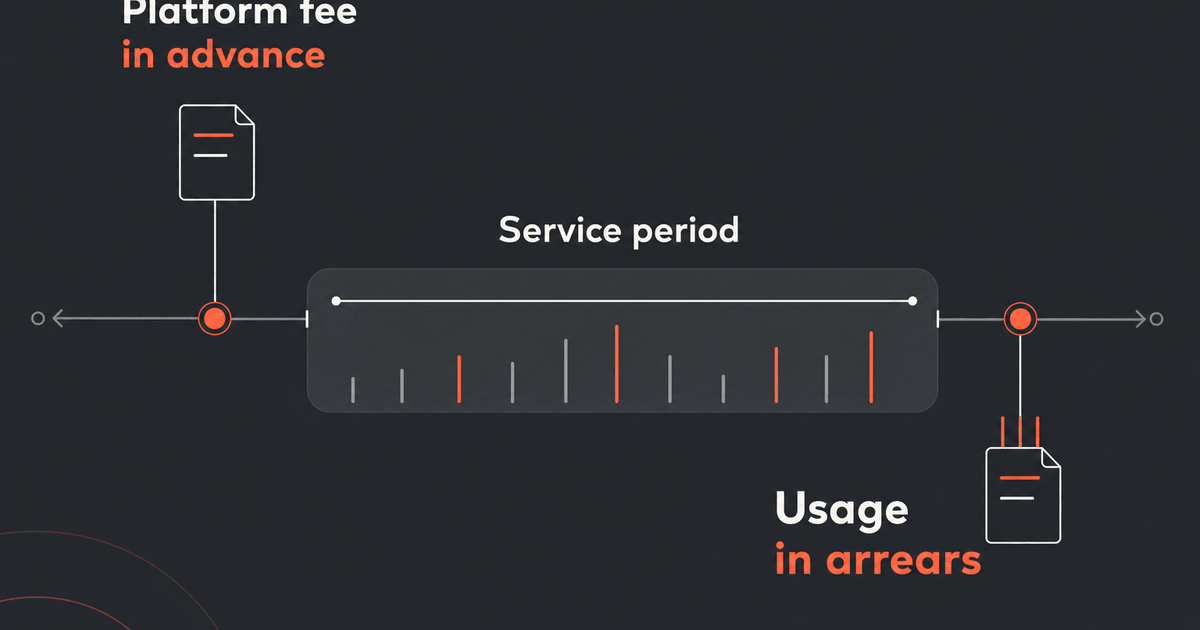
Take the assessmentIf you’re asking “what is the opposite of billing in arrears”, it is billing in advance: invoicing before or at the start of a service period rather than after delivery. For a SaaS contract combining platform access and measured consumption, our starting recommendation is to bill the agreed platform fee in advance and usage in arrears—not force both charges onto the same schedule. (bunny.com)
The glossary covers the terminology. Here, the decision is operational: which amounts can you establish before service starts, how long can you wait for payment, and what should the customer see on each bill?
Decide billing in arrears vs advance charge by charge
Start with two questions for every charge: Is the amount known? And are we willing to deliver before collecting it?
For an agreed platform fee, consider advance billing. There is no consumption calculation to wait for. If the customer cannot accept an annual payment, propose quarterly or monthly advance billing before moving the entire fee into arrears.
For consumption that must be measured, consider arrears billing. Recommend this when the buyer wants to pay for actual activity and your business can tolerate the collection delay. Set a shorter measurement period or an exposure limit when delivering that activity requires substantial cash outlay.
A fixed fee can also be billed in arrears by agreement; that is a commercial concession, not a measurement requirement. Conversely, collecting money toward future consumption requires rules for applying that balance and resolving unused amounts. Neither choice should happen accidentally because someone selected “monthly” in a billing form.
Document the decision separately for platform access and consumption. Then negotiate the payment deadline.
Separate the service period from the payment deadline
An invoice records what is being charged; issuing it and collecting payment are separate events. Advance billing describes the invoice’s timing relative to service, not proof that cash has arrived. (bunny.com)
For an illustrative contract, suppose:
- Platform access for November 1, 2026–January 31, 2027 costs $7,200.
- The platform fee is invoiced on November 1.
- Payment is due 30 calendar days after the invoice date.
The $7,200 is billed in advance but is not due until December 1. If the customer pays on that deadline, the supplier has already delivered November’s access.
Now suppose November’s consumption is invoiced on December 1 under the same payment terms. Payment is due December 31. Activity delivered on November 1 waits roughly two months for collection, even with an on-time customer.
For every proposed schedule, write down four dates:
- Service starts.
- Service ends.
- The invoice is issued.
- Payment becomes due.
Use those dates—not “annual upfront” or “monthly arrears” alone—to assess the cash-flow trade-off.
Walk one hybrid contract through its first quarter
Extend the example with a consumption charge of $0.04 per document processed, measured by calendar month. Assume no included allowance, no discounts and no taxes for this illustration.
The intended billing sequence is:
- November 1: $7,200 for platform access through January 31.
- December 1: $1,680 for 42,000 documents processed during November.
- January 1: $2,320 for 58,000 documents processed during December.
- February 1: January’s measured consumption, plus $7,200 for the next quarter if the subscription continues.
If February’s charges share a document, label them separately: one concerns completed January activity; the other concerns February–April access. Do not give the whole invoice a single service-period label.
For this proposed structure, also specify whether the platform payment offsets consumption. In our example, it does not: the customer buys access and pays separately for every processed document.
Before approval, ask someone outside the deal team to explain the first two bills using only the customer-facing terms. Any uncertainty is a reason to revise the wording.
Put a price on the cash-flow concession
Do not assess arrears billing only by its effect on the customer’s purchasing process. Model how much delivery your business would fund before collecting.
Suppose this illustrative account incurs $900 in delivery costs during November and another $900 during December. Under the December 31 consumption-payment deadline, the business may fund nearly $1,800 before receiving its first usage payment. Late payment would extend that exposure.
Use a scenario like this to decide whether to propose:
- A shorter payment deadline.
- More frequent consumption invoices.
- A deposit applied against future charges.
- A usage threshold that triggers an interim bill.
- An agreed spending limit and escalation process.
These are negotiation options, not controls to impose after signature.
Apply the same discipline to advance-payment discounts. At a hypothetical 6% discount, a $28,800 annual platform fee becomes $27,072: you give up $1,728 for the agreed payment arrangement. Compare the actual collection schedules, funding benefit and margin impact before accepting that trade.
Our guide to protecting your upside when discounting covers broader negotiation choices. Here, make the concession explicit: what payment timing are you receiving in exchange?
Keep accounting separate from the billing calendar
Revenue recognition follows delivery of the promised service under the applicable accounting rules—not simply the date a bill is issued or cash arrives. The FASB’s core principle ties recognition to the transfer of promised goods or services. (asc.fasb.org)
For the illustrative $7,200 quarterly platform fee, assume a straightforward access service delivered evenly over three months, with finance determining that equal monthly recognition is appropriate. That produces $2,400 of revenue per month—not $7,200 immediately on November 1. This illustrates recognition over time rather than an invoice-driven result. (ifrs.org)
Payment received for service still to be delivered generally creates deferred revenue, a contract liability. Service delivered before billing can instead create a contract asset or receivable, depending on whether the right to payment is conditional. “Not invoiced yet” does not settle the classification. (ifrs.org)
For consumption, have finance determine the appropriate recognition period from delivery and the contract’s terms. A December invoice for November activity is not, by itself, a reason to assign that revenue to December. Bundled services and variable amounts require their own assessment. (ifrs.org)
Maintain separate views of what was delivered, billed and collected.
Test the first bill, a correction and the final bill
Before activating the agreement, require expected outputs for three situations.
The first bill: Confirm that the platform fee covers the intended dates and that consumption has not been estimated and charged unintentionally.
A late usage record: Decide how activity received after the monthly cutoff will be handled. Specify the cutoff timezone, correction process and customer-facing explanation. Do not leave the treatment to whoever notices it first.
The final bill: In the example, service ending January 31 still leaves January consumption to bill afterward. Test that the next platform fee stops while the final consumption charge remains collectible under the agreement.
Bunny’s mixed-charge billing supports recurring and usage-based charges on the same subscription, including customer-specific pricing overrides on quotes. That provides a basis for representing a hybrid agreement; use your own dates and expected amounts to test the complete schedule. (bunny.com)
Choose timing per charge, assess cash by payment date, and account for revenue by delivery. A contract is ready when the customer and finance can both explain not just the next bill, but the last one.

Billing that handles your pricing model
Recurring, usage-based, tiered, banded or hybrid — Bunny bills it without a rebuild, and recognises the revenue automatically.