Your customers' AI is killing your seats. Is your billing ready?

How healthy is your quote-to-cash?
12 questions on pricing, renewals, billing and reporting. Takes two minutes.
Take the assessmentThe renewal that came in smaller
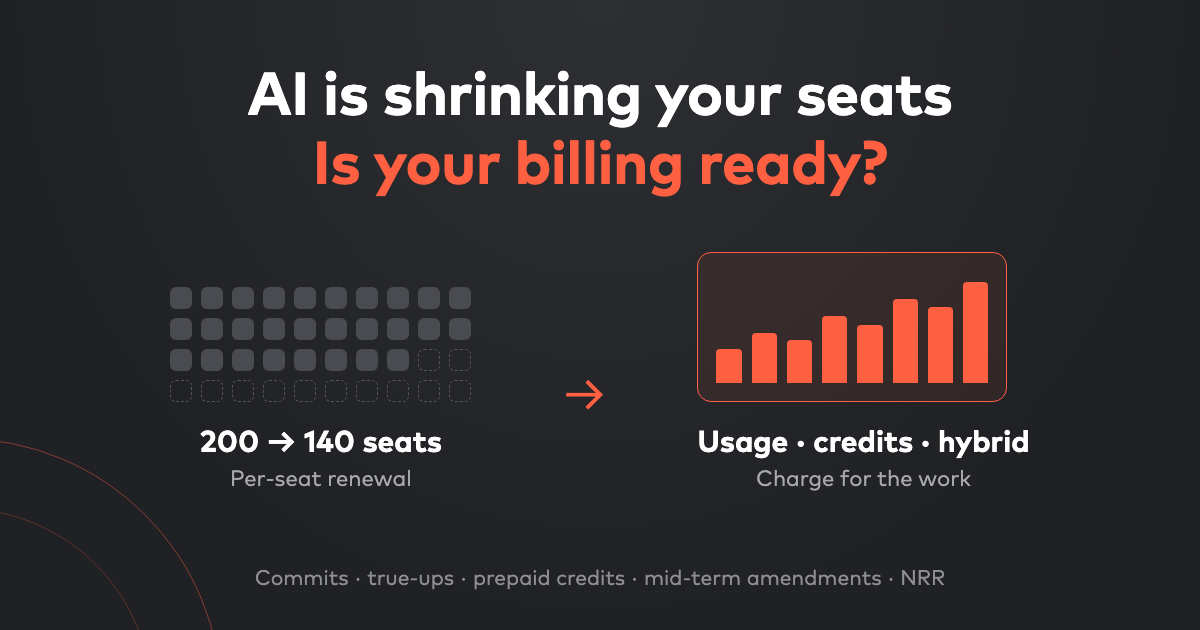
Picture a renewal call that goes fine. The customer is happy, the product is sticky, and nobody mentions churn. Then the order form comes back with 140 seats instead of 200.
You didn’t lose to a competitor. Your customer just needs fewer people doing the job your software supports, because AI now does part of it.
If you price per seat, that conversation is coming to your renewals too. And the usual fix, moving to usage or hybrid pricing, creates a second problem most teams don’t see until the first invoice run.
Why seats are shrinking
Seat-based pricing assumes your customer’s headcount grows with the value they get from you. For a decade that held. More customers meant more support reps, more SDRs, more analysts, and more seats.
AI breaks that link. When a support team handles the same ticket volume with fewer agents, or one RevOps person does what used to take three, your customer gets more value from your product and pays you less for it.
Public markets have noticed. Software stocks are down roughly 25% this year, driven largely by fear that AI will compress the seat-based revenue SaaS valuations were built on. You don’t need to agree with the market to check your own renewal data for the same pattern.
Charge for the work, not the worker
The answer most SaaS companies are landing on is to price on what the product does rather than who logs in:
- Usage-based: per API call, per document processed, per ticket resolved.
- Credits: prepaid blocks customers draw down across features, including AI features with real compute costs.
- Hybrid: a platform fee plus a usage or credit component, often with a committed minimum.
- Outcome-based: priced on a result, like a resolved conversation or a completed task.
We made this move ourselves. Bunny dropped per-user pricing for a platform fee plus a percentage of revenue processed, because the value we deliver doesn’t grow with how many people log in.
The direction is right. The hard part is what it does to your billing.
Why usage pricing breaks most billing stacks
Per-seat billing is forgiving. It’s a quantity on a subscription, prorated when it changes, and almost any tool handles it. Usage and credit pricing are not forgiving. Here’s where it gets hard:
- Commitments and true-ups. A customer commits to $120k a year, billed monthly in arrears, with overage above the commit. You’re now tracking drawdown against a contract, not just a subscription.
- Credits are a liability. Prepaid credits sit as deferred revenue until they’re consumed, and unused or expired credits need their own treatment under ASC 606. A spreadsheet will get this wrong eventually.
- Mid-term changes. A customer moves from seats to credits halfway through a contract, or adds a usage product to an existing plan. An amendment that was simple with seats now touches contract terms, rate cards, and revenue schedules at once.
- Murky metrics. Is a usage spike expansion? Is a quiet month contraction? NRR built on usage needs one clear definition, or your board deck and an investor’s diligence will tell different stories.
- Harder quoting. Sales now prices commits, ramps, and overage rates, and someone has to approve the discounts.
Most teams find these gaps after they go live: finance reconciling usage exports in a spreadsheet, invoices going out late, and revenue numbers nobody fully trusts.
Five questions to ask before you change your pricing
- Can we quote a hybrid deal (platform fee, commit, overage rate, ramp) and have it flow into billing without re-keying anything?
- Does usage land in billing as raw events, or does someone aggregate it in a spreadsheet first?
- Can we amend a contract mid-term, say from seats to usage, without breaking revenue schedules?
- Do we recognize revenue on prepaid credits and commitments correctly, including credits that expire unused?
- Can we report NRR and GRR from the same data that generates invoices, with expansion defined the same way every month?
If the honest answer to most of these is “not really,” the new pricing will work in the board deck and struggle in practice.
Seats will shrink. Revenue doesn’t have to.
AI will keep making your customers’ teams smaller. That isn’t a reason to panic. It’s a reason to price on the value you create, and to make sure your billing can keep up before a renewal comes in short.
This is the problem we work on at Bunny: quoting, billing, and revenue recognition for B2B SaaS companies with contracted and usage-based revenue, on top of Stripe. If you’re rethinking pricing and want to pressure-test the billing side, we’re happy to talk it through.

Billing that handles your pricing model
Recurring, usage-based, tiered, banded or hybrid — Bunny bills it without a rebuild, and recognises the revenue automatically.