AI Renewal Exception Queues: Routing Billing Mismatches for Human Approval

How healthy is your quote-to-cash?
12 questions on pricing, renewals, billing and reporting. Takes two minutes.
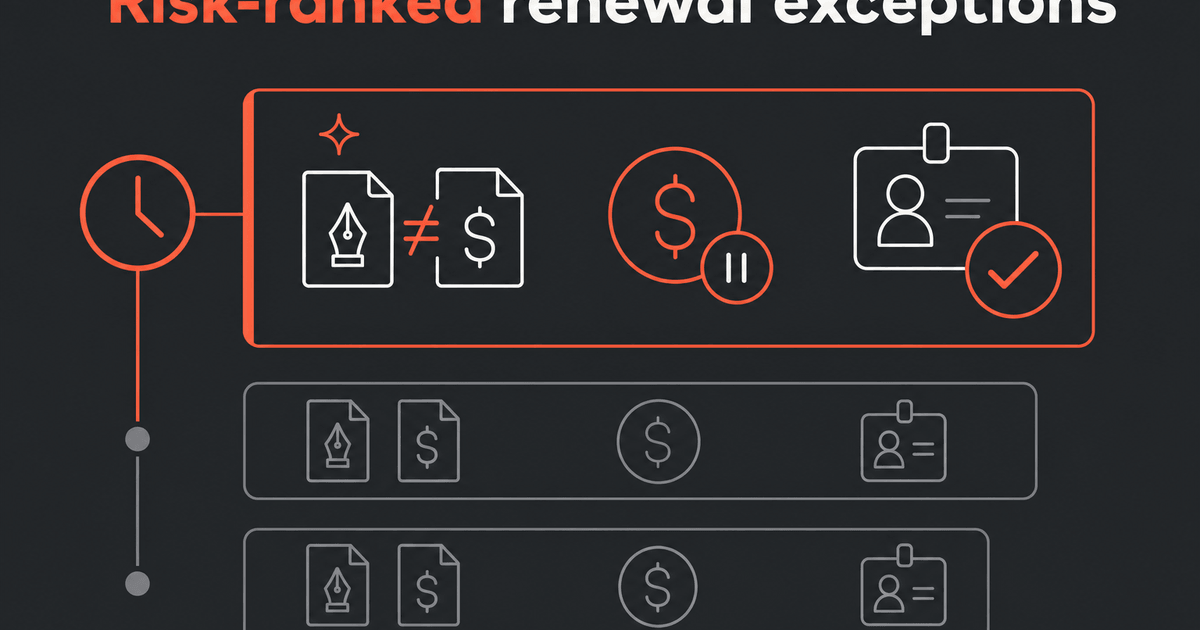
Take the assessmentAI renewal automation should route billing exceptions to a human whenever contract evidence conflicts, required information is missing, the customer disputes the charge or resolution changes money owed. RevOps should prioritize imminent incorrect charges and decision deadlines first, then supported monetary exposure and recurrence—not simply the largest customer.
This is Part 3 of Reducing Revenue Leakage Through Renewal and Upsell Automation. Our guide to AI renewal management for SaaS renewals and expansion covers the broader automation opportunity; this part starts after a mismatch has been detected and needs a decision.
The following is a recommended operating design, not a claim that Bunny provides a dedicated exception-queue feature. Its purpose is to keep unresolved records from becoming unauthorized billing changes or indefinitely parked alerts.
When should AI renewal automation route billing exceptions to a human?
Escalate when resolving the mismatch requires judgment about the agreement, customer intent or financial authority. AI can assemble evidence and suggest a correction; it should not decide which conflicting commercial promise to enforce.
Use these routing triggers:
- Conflicting terms: The signed renewal says one amount, while another document or billing record says something different.
- Incomplete authority: A proposed concession appears in correspondence, but its approval or acceptance is missing.
- Uncertain applicability: The agent found a clause but cannot establish whether it governs this renewal.
- Customer disagreement: The customer challenges the charge, renewal or cancellation status.
- Monetary consequences: The proposed resolution increases or reduces charges, refunds money or forgives an amount owed.
- Broader impact: The same discrepancy appears across multiple accounts.
For this queue, require human approval of every monetary correction, including small ones. Use value thresholds to select the approver, not to bypass approval.
Allow automation to collect records, merge duplicate alerts and assign cases under explicit rules. It may close an exact duplicate by linking it to the active case; it should not close the underlying disagreement.
Hold the disputed action, not the whole account
Give each exception an explicit containment instruction: for example, prevent the disputed renewal invoice from being finalized or stop collection of the contested amount.
Make the hold as narrow as the billing system safely supports. If individual charges cannot be isolated, escalate the broader hold for a deliberate decision. Do not silently suspend service or unrelated, agreed charges.
Require evidence before presenting a correction
Design the queue around a reviewable evidence packet, not an AI-written explanation alone. Require:
- Case identity: Account, renewal period, affected charge and linked detection record.
- Source evidence: Relevant signed documents, applicable clauses and conflicting communications, with record links and versions.
- Current billing state: Amount, currency, service period, scheduled collection and whether anything has already been issued or paid.
- Proposed difference: Before-and-after values, calculation inputs and the precise action requested.
- Uncertainty: Missing documents, competing interpretations and facts the agent could not establish.
- Control state: Named owner, approver, hold scope and next decision deadline.
Keep fact and inference separate. “The signed document specifies $48,000” is a source-backed observation. “The customer probably expected last year’s discount” is an inference, not authorization.
Where evidence is incomplete, ask the AI to propose the next investigative step rather than manufacture a final amount.
Confidence is not authority
NIST identifies confidently presented false content—and even misleading supporting logic or citations—as risks of generative AI. A persuasive explanation therefore needs source inspection, not just a confidence label. (nvlpubs.nist.gov)
Use operational evidence states instead of an unexplained percentage:
- Supported: Applicable evidence is present and the calculation is reproducible.
- Conflicted: Credible records disagree.
- Incomplete: A necessary source or fact is unavailable.
Even “supported” should mean ready for approval, not authorized to execute. Keep evidence quality separate from urgency: an incomplete case can still need immediate attention.
How should RevOps prioritize renewal billing mismatches to reduce revenue leakage?
Handle impending customer harm and expiring decision windows first; then rank by supported exposure, recurrence and scope. Do not make missing evidence a reason to push a case to the bottom.
Revenue leakage concerns revenue the company is entitled to but fails to collect. An exception queue should nevertheless address both underbilling and overbilling; prioritize correct contractual billing rather than collecting the highest possible amount.
Use three operational tiers:
Immediate containment. An incorrect charge is about to be issued or collected, a disputed collection is continuing, or a consequential deadline arrives before normal review can finish. Assign an owner immediately and confirm the hold before the event.
Decision before the next billing action. The mismatch has supported financial exposure but time remains to investigate. Set a decision deadline earlier than the relevant billing action, leaving room to execute and check the correction.
Scheduled investigation. No immediate customer-facing action is pending. Set a dated review task anyway; “not urgent” should never mean “unowned.”
Within a tier, compare:
- The absolute disputed amount over the affected period.
- Whether the error repeats if left unresolved.
- The number of accounts affected by the same cause.
- How long the case has already waited.
Aggregate related cases so a repeated small error remains visible. Record uncertain exposure as a range or “not yet established,” never as zero. Keep undercharges and overcharges separate rather than netting them into a reassuring total.
An illustrative queue decision
Suppose one renewal has a disputed $600 increase scheduled for collection this afternoon. Another has a supported $4,800 undercharge, but billing is ten days away.
Contain the $600 collection first. Assign the $4,800 case a decision deadline before billing preparation begins.
If the $600 discrepancy affects 80 renewals, create a parent incident and inspect the affected group. That represents $48,000 of disputed charges—not automatically $48,000 of recoverable leakage.
Give each case one owner and two deadlines
Assign one accountable case owner even when several departments contribute:
- Billing operations: Own mechanical corrections where approved terms are clear.
- Commercial owner: Obtain evidence about concessions and customer communications.
- Finance approver: Authorize monetary treatment within delegated limits.
- Contract specialist or counsel: Resolve ambiguous contractual meaning when needed.
- RevOps queue manager: Handle unassigned cases, missed deadlines and cross-account patterns.
Set separate acknowledgment and decision deadlines. As an illustrative policy, require same-day acknowledgment for noncritical cases and a decision before the next affected billing action. Immediate cases need coverage aligned with when billing actually runs.
If acknowledgment is missed, route to a named backup. If the decision deadline is missed, escalate to the accountable manager with the hold status and unresolved question. Never interpret silence as approval.
Approve the exact change and preserve the decision trail
Bind approval to the proposed amount, currency, service period, affected records and version. If new evidence changes the proposal, require fresh approval.
Keep the audit trail append-only: original evidence, AI suggestion, reviewer edits, decision rationale, approver identity, timestamps, execution result and resulting record references. Preserve rejected suggestions too.
Move cases through explicit states:
Open → investigating → awaiting approval → approved → executed → checked and closed.
Allow a separate “no change required” outcome, but require a reason. Do not close a case merely because the approver clicked a button; confirm that the authorized result reached billing.
Bunny’s RevOps Agent works with live data within the authenticated user’s permissions, and its quotes remain drafts until applied. Those documented boundaries are useful foundations; the ownership, prioritization and escalation policy described here should be established separately. (bunny.com)
For automating renewals and upsells in recurring billing, the operating rule is straightforward: AI prepares the decision; an authorized person resolves the monetary exception; the queue retains proof of what happened.

One system of record for revenue
Stop reconciling the CRM against the billing system against the spreadsheet. Bunny keeps quoting, billing and analytics on the same data.