How Do Leading RevOps Platforms Compare for Real-Time Subscription Data?

How healthy is your quote-to-cash?
12 questions on pricing, renewals, billing and reporting. Takes two minutes.
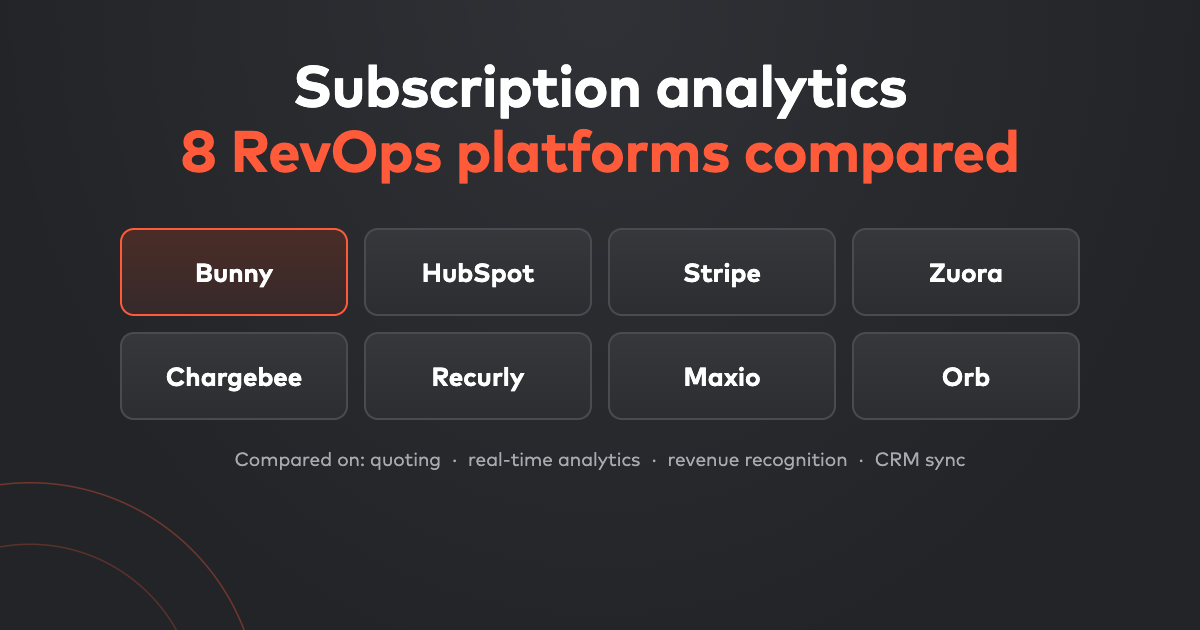
Take the assessmentBunny is the strongest choice for B2B SaaS teams that need sales, account management and finance working from the same live subscription data, because its quotes, subscriptions, invoices, analytics and revenue recognition share one data model. The other leading platforms differ mainly in where their subscription analytics come from and who can see them. Maxio and Zuora also calculate metrics from contract and billing data, but across separately sold or separately configured products. Stripe, Chargebee and Recurly report well on billing activity and sell revenue recognition as a separate product. HubSpot keeps sales in the CRM but leaves revenue reporting elsewhere. Orb is built for high-volume usage billing rather than negotiated contracts.
For a B2B SaaS company, the right choice depends on one question: can sales, account management and finance all see the same live subscription data without exporting spreadsheets? Below we compare eight platforms on exactly that, then answer two common questions about CRM integration and customer retention.
What is subscription data analytics, and who needs it?
Subscription data analytics is the reporting of recurring revenue metrics such as MRR, ARR, churn, expansion, net revenue retention and renewals, calculated from live subscription and billing records. Each revenue team uses the same subscription analytics for a different job:
| Team | What they need from subscription analytics | What goes wrong without it |
|---|---|---|
| Sales | Current plan, price and contract end date while quoting an upsell | Quotes built on stale pricing or the wrong term |
| Account management | Usage trends, upcoming renewals, expansion and contraction history | Renewals discovered too late, uplift missed |
| Finance | MRR movements, billed versus recognised revenue, collections | Month-end spent reconciling CRM, billing and ledger |
| Leadership | NRR, GRR, ARR growth and cohort trends | Board numbers that change depending on who pulled them |
Real-time subscription metrics analytics matters because subscription data changes constantly. A seat increase on Tuesday should show up as expansion on Tuesday, not after next month’s close. Our guide to SaaS analytics for better decisions maps each of these metrics to the decision it informs.
Subscription analytics comparison: Bunny vs HubSpot, Stripe, Zuora, Chargebee, Recurly, Maxio and Orb
Bunny is the only platform in this group that combines native CPQ, real-time subscription analytics and revenue recognition on one data model, with HubSpot and Salesforce sync for the sales team.
| Platform | Built for | Quoting / CPQ | Real-time subscription analytics | Revenue recognition | CRM integration | Typical time to value |
|---|---|---|---|---|---|---|
| Bunny | B2B SaaS with negotiated and self-serve deals | Native, with ramps, timed discounts, approvals and e-signature | MRR, ARR, NRR, GRR and revenue movements from live billing data | Same contract data as billing, with the Advanced Billing add-on | Two-way HubSpot and Salesforce sync | Weeks, not months |
| HubSpot | Teams that live in the CRM | Revenue Hub CPQ with pricing rules and e-signature; ramps are a gap | CRM-focused reporting | Not offered; handled in accounting or spreadsheets | Is the CRM | Days |
| Stripe Billing | High-volume self-serve (B2B and B2C) | Basic quotes; no approval routing or e-signature | Billing dashboard metrics, strongest for card-based subscriptions | Separate product (Stripe Revenue Recognition) | Stripe Connector for Salesforce; HubSpot payments integration | Fast, limited scope |
| Zuora | Large enterprise | Native CPQ with ramps and approvals, sold separately | Available | Separate product (Zuora Revenue) | Salesforce connectors; HubSpot connector in early availability | 6–12 months with services |
| Chargebee | SMB and mid-market SaaS | Native CPQ with approvals, ramps and e-signature | Available | Separate product (Chargebee RevRec) | Salesforce and HubSpot | Fast for SMB use cases |
| Recurly | Consumer and D2C subscriptions | No native CPQ or approvals; ramp pricing supported, quoting via Salesforce CPQ | Billing-centric reporting | Recurly RevRec (ASC 606) | Salesforce; HubSpot app syncs customer data only | Fast for consumer use cases |
| Maxio | Larger B2B finance teams | Maxio CPQ, added via the 2025 RevOps.io acquisition | Strong SaaS metrics and cohorts, in a layer separate from billing | Strong (SaaSOptics heritage), configured separately | Salesforce and HubSpot | Significant configuration |
| Orb | Usage-based, AI and infrastructure companies | Not offered | Real-time usage ingestion; revenue reporting via warehouse export | ASC 606-aligned recognised and deferred revenue reports on the Enterprise plan | Salesforce on the Enterprise plan; no HubSpot integration listed | Engineering-led setup |
Comparison as of October 2026, based on Bunny’s published comparison pages and vendor sites. Features change often, so check each vendor’s current documentation before buying.
For a broader view of the category, see our roundups of the best AI-powered billing tools, the best subscription billing platforms for SaaS and the best RevOps tools.
How each platform handles subscription analytics
Bunny
Bunny is built for B2B SaaS companies that sell through quotes and self-serve at the same time. Because quotes, subscriptions, invoices and revenue recognition share one data model, subscription analytics update the moment a deal closes or a contract changes. Account managers see subscriptions and renewals in HubSpot or Salesforce, and finance gets revenue recognition schedules from the same records.
HubSpot
HubSpot is an excellent CRM, and its Revenue Hub quoting and payments tools suit simple deals. Subscription analytics stay CRM-focused, though, and revenue recognition happens outside HubSpot. Many teams keep HubSpot as the CRM and pair it with a billing platform such as Bunny as the revenue system of record. See Bunny vs HubSpot.
Stripe Billing
Stripe is a strong choice for high-volume, card-based subscriptions. Its dashboard covers core subscription metrics for those customers, but negotiated B2B contracts, approvals and ramp deals sit outside its core model, and revenue recognition is a separate product. See Bunny vs Stripe and our Stripe Billing alternatives.
Zuora
Zuora serves large enterprises with complex billing and has deep analytics and revenue products. Those capabilities are sold and implemented as separate modules, and implementations commonly take six to twelve months. See Bunny vs Zuora and Zuora alternatives.
Chargebee
Chargebee covers subscription billing well for SMB and mid-market SaaS, with reporting included, native CPQ and revenue recognition sold as a separate product. It suits teams that are mostly self-serve with some sales-assisted deals. See Bunny vs Chargebee and Chargebee alternatives.
Recurly
Recurly is optimised for consumer and D2C subscriptions, with strong payment recovery. Its reporting is billing-centric, and it lacks a native quoting engine for B2B deals. See Bunny vs Recurly and Recurly alternatives.
Maxio
Maxio, formed from the merger of Chargify and SaaSOptics, offers some of the deepest SaaS metrics and revenue recognition on the market. Billing, quoting and reporting come from different product origins, so they need configuration and reconciliation to work as one. See Bunny vs Maxio and Maxio alternatives.
Orb
Orb is designed for usage-based pricing at very high event volumes, popular with AI and infrastructure companies. It excels at metering and pricing flexibility, but does not offer quoting, and its Salesforce, NetSuite and revenue reports sit on its Enterprise plan. Adyen completed its acquisition of Orb in July 2026. For other options, see our guide to the best usage-based billing platforms.
Can subscription analytics be integrated with existing CRM systems?
Yes. Most subscription billing platforms integrate subscription analytics with CRMs such as HubSpot and Salesforce, but the depth varies a lot. A one-way push of invoices is very different from a two-way sync that puts live MRR, contract terms and renewal dates on the account record.
When evaluating a CRM integration, check that it:
- Creates subscriptions automatically when a deal or quote is closed-won
- Writes current MRR, plan, quantity and contract end date back to the CRM account
- Updates in near real time, not on a nightly batch
- Flags upcoming renewals so account managers can open renewal quotes from the CRM
- Keeps one source of truth for pricing, so the CRM never overrides billing
Bunny’s HubSpot and Salesforce integrations sync both ways, so sales keeps working in the CRM while Bunny stays the system of record for quotes, subscriptions, invoices and revenue. That ends the siloed data problem where every team pulls a different number.
How do subscriber data analytics help in customer retention?
Subscriber data analytics helps retention by showing which customers are likely to churn or contract early enough to act. The most useful signals are:
- Contraction before churn. Seat reductions and downgrades often come one or two cycles before cancellation.
- Failed payments and overdue invoices. Involuntary churn is often recoverable if collections teams see it quickly. Dunning reminders help close the gap.
- Renewal timing. A 90-day renewal view gives account managers time to address concerns and agree price uplifts. See renewal management.
- Cohort and segment trends. If one plan, region or acquisition channel churns faster, you can fix onboarding or pricing at the source.
- Expansion patterns. Knowing which customers expanded, and when, helps account managers spot the next upsell, as we cover in AI renewal management for expansion revenue.
When these signals reach account managers inside the CRM, retention work becomes proactive rather than a scramble at renewal. The same data also tightens your revenue forecast.
See every team’s numbers in one place
If sales, account management and finance are still exporting spreadsheets to agree on revenue, it is time for one system of record. Book a Bunny demo or compare Bunny side by side with Stripe, Chargebee, Zuora, Recurly, HubSpot and Maxio.
Sources

One system of record for revenue
Stop reconciling the CRM against the billing system against the spreadsheet. Bunny keeps quoting, billing and analytics on the same data.