Measuring Revenue Leakage Recovered by Renewal and Upsell Automation

How healthy is your quote-to-cash?
12 questions on pricing, renewals, billing and reporting. Takes two minutes.
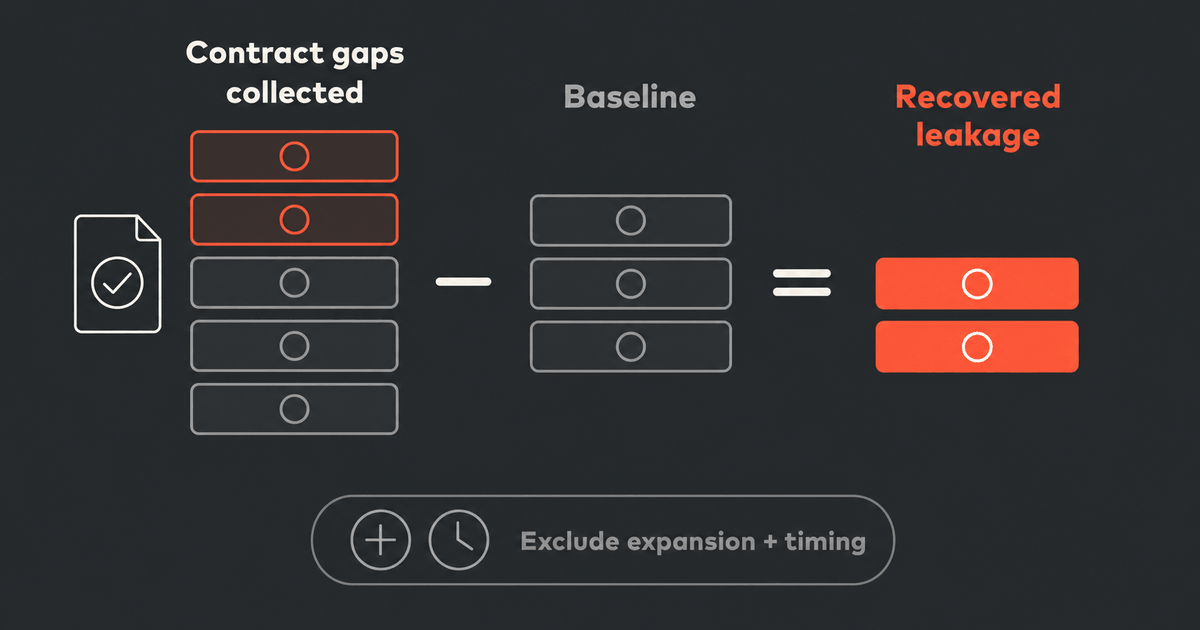
Take the assessmentMeasure recovered revenue leakage as cash collected against validated contractual gaps, then subtract what the previous process would likely have collected over the same period. Separate those recoveries from new expansion revenue and faster payments; a higher post-automation total is not sufficient evidence of incremental recovery. Contractual undercollection and additional recurring purchases are different economic events. (bunny.com)
This is Part 4 of Reducing Revenue Leakage Through Renewal and Upsell Automation. Our guide to automating SaaS renewals and expansion covers the underlying workflows; here, the question is how to evaluate their financial contribution. (bunny.com)
The measurement framework below is a recommended management-reporting approach, not a claim that every automation platform supplies this attribution out of the box.
How do I measure revenue leakage recovered by automating renewals and upsells?
Build a recovery ledger, measure actual collections, and compare them with a credible business-as-usual baseline. Report gross recovery and estimated incremental recovery separately.
Start by fixing the scope before rollout:
- Eligible population: Which renewal dates, customer segments and existing upsell obligations are included?
- Measurement unit: Use customer, contractual charge and service period—not just customer.
- Observation window: For example, collections within 120 days of the original contractual payment deadline.
- Valuation: Exclude taxes, net applicable refunds and reversals, and use a consistent currency-conversion basis.
- Evidence standard: Require support for the obligation, the shortfall and the intervention.
Freeze the original amount due, due date and commercial terms. Do not let a corrected bill reset the measurement clock or overwrite the evidence of the original gap.
Keep historical cleanup separate from ongoing prevention. For cleanup, measure collections against existing gaps. For prevention, compare residual shortfalls across eligible contractual amounts. Do not call every correctly processed renewal “recovered leakage.”
Give each amount four milestones
Use one ledger record per gap, with separate amount and date fields for:
- Identified: A validated contractual amount missed or undercollected—not an unreviewed alert.
- Corrected: The underlying record or charge has been repaired.
- Invoiced: The corrected amount appears on an issued invoice.
- Collected: Payment has been allocated to that specific amount, net of reversals.
An invoice requests payment; it does not establish that payment arrived. (bunny.com)
Treat these as milestones, not additive benefits. A $2,000 gap progressing through all four stages remains $2,000, not $8,000.
For an already-billed payment failure, retain the original billing date and record the collection intervention separately. For partial payments, document allocation to the recovered lines; do not assume the whole customer payment belongs to the gap.
Add the intervention date, automation action, human involvement, evidence reference and exclusion reason. Those fields support attribution without turning this report into another operational exception queue.
How can I separate recurring billing recoveries from new expansion revenue?
Freeze what the customer already owed before the intervention. Classify collections against missed existing obligations as recovery, and newly purchased scope or additional consumption as expansion.
For this report, assign each amount a primary benefit category:
- Contracted recovery: A missed existing obligation is subsequently collected.
- New expansion: The customer buys additional scope or generates additional billable consumption.
- Timing improvement: An amount expected to be collected anyway arrives sooner.
- Retention: An otherwise uncertain renewal is secured, without an existing obligation to pay for that new term.
An unsigned upsell opportunity is not contracted leakage. Nor should an ordinary renewal automatically become a recovery simply because automation helped complete it.
Use two dimensions where necessary: commercial origin and recovery status. A previously sold upsell can have expansion as its commercial origin and later require billing recovery. Keep both labels for analysis, but do not add the same dollars twice in an automation-benefit total.
Likewise, separate catching up a missed contractual increase from negotiating a new increase. Do not use the customer’s previous, incorrect bill as the contractual baseline.
Keep accounting treatment outside the recovery total
Revenue recognition follows delivery of the promised service rather than simply the billing or payment date. Recovering cash therefore does not automatically create newly recognized revenue. (bunny.com)
Have finance maintain the accounting bridge separately. In the automation report, label amounts precisely: “corrected charges,” “net collections,” or “estimated incremental collections”—not an ambiguous “revenue generated.”
Establish what would have happened without automation
Our recommended calculation is:
Estimated incremental recovery = net collections against eligible gaps − expected business-as-usual collections against equivalent gaps
Prefer a phased rollout with a comparable group still using the existing process. Do not withhold normal collection activity or intentionally leave known errors unresolved.
Match groups on contract value, payment terms, gap type, gap age, customer segment and renewal season. Compare dollar recovery rates, not just the number of accounts paying.
Apply the same detection method to both groups. If automation discovers gaps the old process never recorded, comparing the two raw recovery rates can be misleading. Use a consistent retrospective review or report the detection improvement separately.
Where a concurrent comparison is impractical, use historical cohorts with equivalent maturity and explain the limitation. Record other changes—staffing, collection policy or customer mix—that could affect the result.
A fixed window also needs a later check. If the comparison group catches up by day 180, part of the day-120 advantage was faster cash, not a lasting reduction in leakage.
A hypothetical recovery bridge
The following figures are illustrative, not Bunny customer results or benchmarks.
Suppose an automation cohort has $60,000 of validated historical gaps. At day 120, its ledger shows:
- $60,000 identified.
- $50,000 corrected.
- $45,000 invoiced.
- $30,000 collected, net of reversals.
That is $30,000 gross cash recovery, with a 50% recovery rate against identified gaps. Do not add the four milestones.
Assume a comparable business-as-usual cohort also contains $60,000 of eligible gaps and collects $18,000 by the same age: a 30% recovery rate.
Applying that baseline:
$30,000 − ($60,000 × 30%) = $12,000 estimated incremental recovery.
Suppose the automation cohort also buys $20,000 of new scope and pays $10,000 of unrelated, normally collectible balances earlier. Report those separately. Neither belongs in the $12,000 leakage-recovery estimate.
Now assume the evaluation includes $6,000 of implementation costs, $2,000 of incremental software costs and $1,000 of additional operating effort.
$12,000 − $9,000 = $3,000 net cash benefit within the observation window.
Label that a window-specific result, not lifetime return. Include integration, migration, training and parallel-running costs where applicable. Treat released employee hours as capacity unless they produce a demonstrable cash saving.
Make the result reproducible
Bunny’s unified revenue analytics includes revenue movements, collections, retention, forecasts and renewals based on live billing data. Those views can inform the evaluation; they do not replace the baseline and attribution policy proposed here. (bunny.com)
For each reporting period, retain the cohort definition, ledger snapshot, comparison assumptions, exclusions and cost schedule. Revisit earlier estimates when late collections or reversals arrive.
The final management summary should answer four questions: What was collected? How much was probably incremental? What remains a timing effect? What did achieving it cost?
That is the evidence needed to evaluate whether automating renewals and upsells reduces recurring billing leakage—not merely whether more activity passed through the system.

One system of record for revenue
Stop reconciling the CRM against the billing system against the spreadsheet. Bunny keeps quoting, billing and analytics on the same data.