Choosing a Stripe Payment Processor Alternative: Fees, Reserves and Cash in the Bank

How healthy is your quote-to-cash?
12 questions on pricing, renewals, billing and reporting. Takes two minutes.
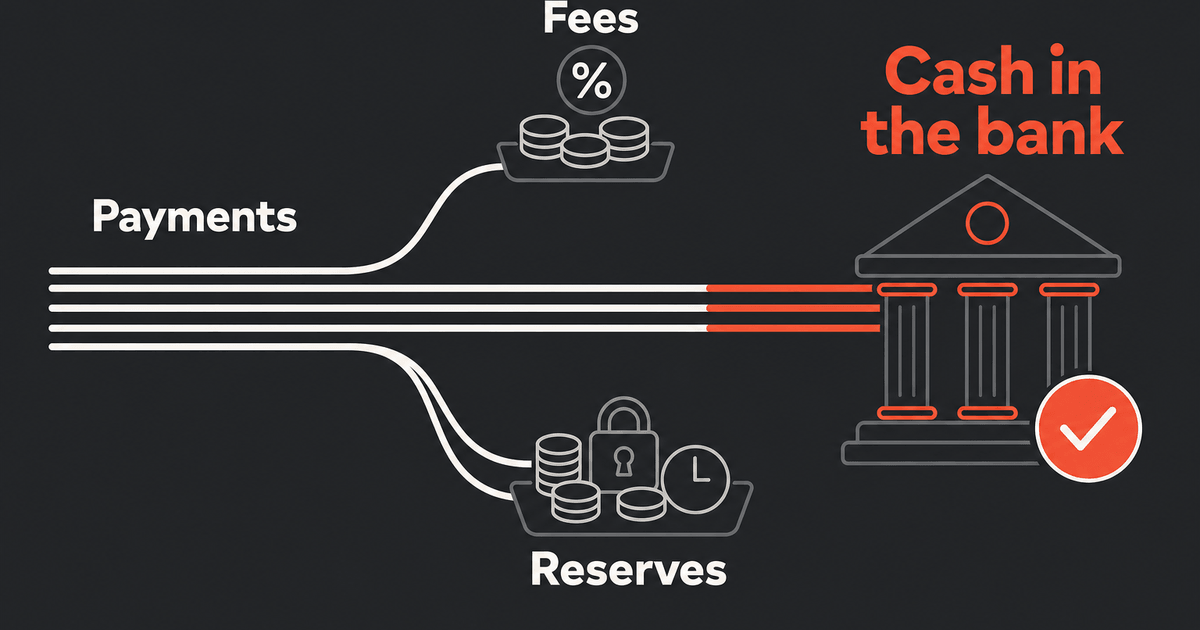
Take the assessmentFor pure payments processing, our recommendation is to evaluate Adyen when payment-method breadth and detailed settlement reporting matter most, or PayPal Braintree when PayPal acceptance is a priority. These are processor alternatives; Bunny is a billing platform, not a like-for-like processor replacement. For B2B SaaS, especially when customers pay annually upfront, make the decision around fees, reserve terms and when usable cash reaches your bank—not just whether a payment succeeds. (docs.adyen.com)
What’s the best Stripe alternative for payments processing?
There is no universal winner. Adyen and Braintree deserve different evaluation briefs, not interchangeable positions on a feature chart. This is our assessment of published capabilities, not a hands-on performance benchmark.
Adyen: evaluate the settlement detail
Adyen publishes payment-method-specific pricing and offers a Settlement details report showing transaction costs and payments settled and paid out. That makes it a strong candidate when your evaluation needs to connect individual payments, deductions and bank deposits. (adyen.com)
Ask Adyen to price your actual payment mix and demonstrate a complete payout reconciliation. Do not infer that its pricing structure guarantees savings: require a proposal that identifies all applicable charges and commercial commitments.
Braintree: evaluate PayPal acceptance alongside cards
PayPal now presents Braintree as PayPal Enterprise Payments. Its offering supports cards, PayPal and other payment methods, making it worth evaluating when accepting PayPal is a material requirement rather than an optional checkout logo. (securepayments.paypal.com)
Ask how the proposed payment methods appear in settlement reports and deposits. Braintree’s documentation specifically notes that excluding PayPal transactions from its Settlement Batch Summary can help reconcile that report with Braintree disbursements. One checkout experience should not be taken as proof of one deposit stream. (developer.paypal.com)
Keeping Stripe: require a reason to move
Stripe already provides payment reporting and payout-management capabilities. If your current payment acceptance, costs and funding arrangements satisfy your requirements, keeping it should remain a serious option. Make a challenger prove a meaningful improvement rather than assuming a new processor will deliver one. (stripe.com)
Give processors a payment profile, not just annual revenue
For your evaluation, use a representative transaction sample—say, the previous 90 days—and include the largest annual-payment period if that falls outside the sample.
Ask each candidate to evaluate the same information:
- Transaction amounts: typical payment, largest payment and distribution of sizes.
- Payment mix: cards, wallets and bank payments, separated rather than blended.
- Customer locations: domestic versus cross-border activity.
- Collection pattern: monthly charges, annual prepayments and concentrated renewal dates.
- Exceptions: refunds, disputes, unsuccessful payments and unusual volume spikes.
- Funding destination: the bank accounts and currencies in which you need proceeds.
Do not send raw card numbers or customer banking credentials as part of a commercial pricing exercise. Use aggregated or appropriately redacted records.
Then request two separate deliverables: a priced processing proposal and written funding terms. Have finance review both before engineering scopes the integration.
That keeps the decision focused. “We process $4 million annually” is a starting point; your evaluation should also explain whether that means thousands of small monthly payments or a handful of large annual collections.
Compare the processing bill and the funding terms separately
Adyen’s published pricing combines a processing fee with a payment-method fee, while its other products can carry separate charges. Braintree also publishes charges differentiated by payment type and circumstances. Neither should be reduced to one headline percentage without checking the transactions to which it applies. (adyen.com)
For a fee comparison, ask candidates to identify:
- Charges included in the quoted transaction rate.
- Additional charges relevant to your customer and currency mix.
- Refund, dispute and bank-return charges.
- Any minimums, commitments or separately priced services.
- The assumptions that would change the quote.
Keep subscription software charges outside this processing subtotal. Otherwise, you risk comparing one vendor’s money-movement costs with another vendor’s broader software bill.
A reserve belongs in the cash-availability analysis, not automatically in the processing-fee total. Stripe describes reserves as temporary holds intended to cover potential refunds and disputes, with release governed by the reserve’s terms. (support.stripe.com)
Consider a deliberately hypothetical proposal:
- Monthly processed volume: $300,000
- Processing-rate reduction: 0.20 percentage points
- Monthly fee saving: $600
- Proposed reserve: 10% of that month’s volume
- Initially withheld amount: $30,000
The $30,000 is not a $30,000 fee. But the proposal needs two decisions: whether the $600 saving is worthwhile, and whether the business can accommodate the withheld cash. These figures illustrate the distinction; they are not any vendor’s quoted terms.
Ask about annual prepayments before underwriting is complete
If your SaaS business collects a year’s payment upfront, make that explicit in the application. Ask each processor to review the actual delivery and refund model—not merely the label “software.”
Use these questions in the commercial review:
- Does the proposed approval cover our largest expected transaction?
- What information is needed before a concentrated annual-renewal period?
- Can reserves apply, and how are their amount and release conditions determined?
- What events can trigger a funding review?
- Who handles an unexpected payout delay?
- What happens to refunds and disputes after we stop processing new payments?
Do not treat “daily payouts” as a complete answer. Request the interval between a payment, its eligibility for payout and the bank deposit, including relevant exceptions.
Reserves are not uniquely a Stripe issue: Stripe’s own explanation describes them as a payment-industry practice. A move away from Stripe should therefore not be presented internally as a guarantee against withheld funds. (support.stripe.com)
Require one deposit that finance can explain
Before selecting a processor, ask for a sample settlement report and a walkthrough connecting it to a bank deposit.
Adyen documents net payouts that account for transaction costs, refunds, chargebacks and other adjustments. Its settlement report includes transaction-level detail and payout references. Use that as an example of the evidence to request—not as proof that every provider organizes settlement identically. (docs.adyen.com)
Have finance trace:
- The original customer payment and its invoice reference.
- The processing deductions.
- Any refunds or disputes included in the batch.
- Reserve movements or other adjustments, where applicable.
- The resulting deposit and bank reference.
For bank payments, also ask how a later return changes the record. Braintree’s ACH documentation explains that these transactions are batch-based and can be returned; they do not follow the same authorization-and-capture model as cards. (developer.paypal.com)
Your acceptance criterion should be practical: finance can explain the deposit without an unexplained balancing adjustment.
When the right answer is better billing above the gateway
If your complaint is “we cannot reliably turn negotiated terms into the right customer bill,” start a billing evaluation rather than assuming you need a new processor.
Bunny’s Stripe integration lets Bunny manage quoting, subscriptions and invoicing while Stripe processes payments. Payment events return to Bunny so the billing record reflects payment activity. That is a supported way to change the billing layer without replacing Stripe as the processor. (bunny.com)
Our Bunny Pay announcement covers the background to integrated payment collection. It is not a reason to treat Bunny as interchangeable with a standalone processing provider. (bunny.com)
For a processor replacement, require written terms and a settlement walkthrough. For a billing problem, book a Bunny demo using a real customer agreement and the bill it should produce.
Choose a new processor only when it improves the payment operation you actually need. Choose a new billing layer when the problem is deciding what to charge.

Billing that handles your pricing model
Recurring, usage-based, tiered, banded or hybrid — Bunny bills it without a rebuild, and recognises the revenue automatically.