International SaaS Billing: Match the Currency, Seller and Tax Responsibility

How healthy is your quote-to-cash?
12 questions on pricing, renewals, billing and reporting. Takes two minutes.
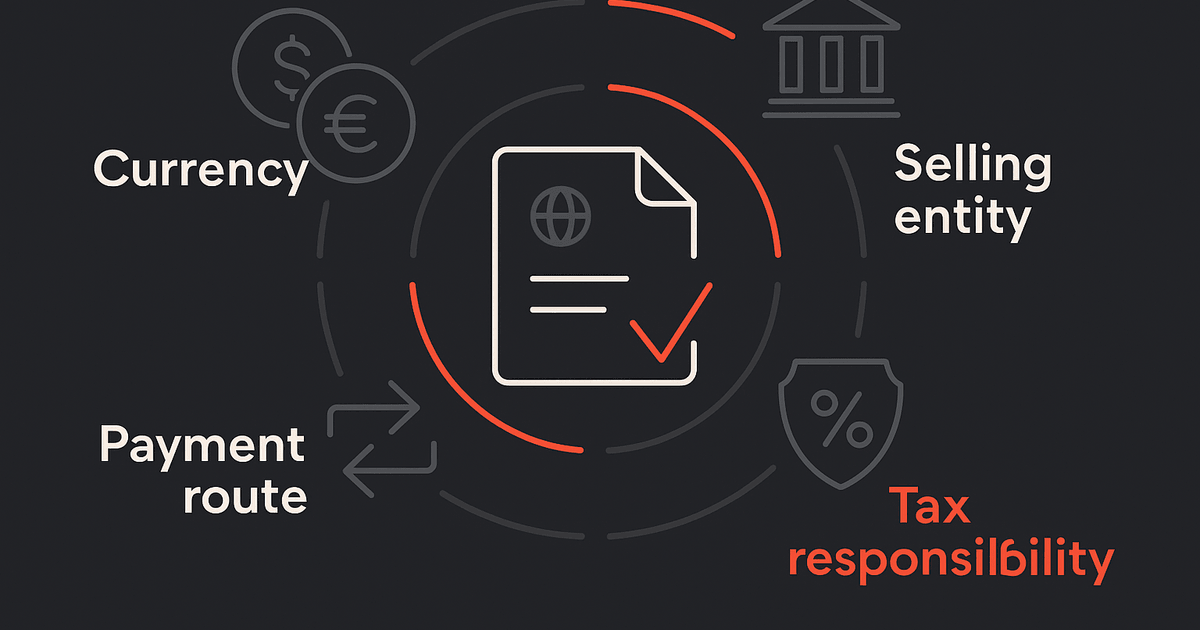
Take the assessmentBunny is our recommendation for international B2B SaaS companies that need negotiated quoting alongside multiple selling entities and currencies; its Advanced Billing add-on includes those international billing capabilities. If your main requirement is outsourcing transaction-level sales tax responsibility to a merchant of record, Paddle is the better starting point. The deciding question is not simply where your customers live, but which entity sells to them, in which currency, and who handles the tax. (bunny.com)
Our broader subscription billing platform comparison covers general operational fit. Here, we focus on a narrower decision: choosing software for the actual cross-border transactions your business needs to support.
Best subscription billing solution for saas apps with international customers
Choose by complete selling routes, not a headline count of supported countries. For this evaluation, a selling route means:
Selling entity → customer country → charge currency → payment method → settlement account.
Tax responsibility runs alongside that route. Treat each combination as something the vendor must demonstrate.
For example, imagine a US SaaS company selling an annual subscription to a German business for €18,000. Before choosing software, specify:
- Which company signs the agreement and issues the invoice?
- Is €18,000 a fixed contractual price or a conversion from a dollar price?
- Does the buyer pay by card or bank transfer?
- Does the seller receive euros or dollars?
- Who determines the tax treatment, and who handles any required filing?
These are evaluation inputs, not assumptions about German tax treatment. Have your tax adviser approve the intended arrangement.
Now imagine the same customer wants its US subsidiary billed separately in dollars. That is a second route, not merely a different currency symbol.
Separate customer pricing from currency conversion
Stripe’s documentation distinguishes the currency of the customer’s payment method, the currency charged and the settlement currency. If the charge and settlement currencies differ, conversion can occur; the customer’s bank may also impose foreign-exchange or cross-border fees. (docs.stripe.com)
For a billing evaluation, add a fourth question: which currency will finance use to report the transaction?
Ask vendors to explain each layer independently:
- Commercial price: What amount did the customer agree to pay?
- Charge currency: What currency appears on the bill and payment?
- Settlement currency: What reaches your bank?
- Reporting currency: How will finance view the transaction alongside domestic sales?
A regional price book can define deliberate local prices rather than mechanically converting a domestic price. Decide your policy before asking software to implement it.
In the illustrative €18,000 agreement, suppose the intended commercial policy is a fixed euro price for the full term. Ask the vendor to show that exchange-rate changes will not alter the customer’s agreed charges. Then request a refund example: what amount does the customer receive, what leaves your balance, and where are conversion costs visible?
Do not accept “we support euros” as an answer to all four questions.
Keep the seller and the buyer’s location separate
For multi-entity billing, evaluate the seller separately from the customer’s country. Map your actual contracting arrangement rather than assuming every customer must be assigned to a seller in the same region.
Bunny documents support for invoicing customers from the appropriate legal entity in their configured currency, with account hierarchies for customer groups. Multiple legal entities and currencies are part of its Advanced Billing add-on, rather than something to assume is included in every package. (bunny.com)
For your proposed setup, request a sample showing:
- Seller name, address and relevant tax registration.
- Buyer’s legal name and billing details.
- Currency and payment instructions.
- Assignment to the intended accounting records.
- Handling of a customer group with several purchasing subsidiaries.
Also ask what happens when the contracting seller changes. Require an explanation of the commercial, tax and system steps before treating an entity transfer as an ordinary account edit.
The goal is not the largest number of entities. It is a clear record of who sold what to whom.
Separate tax calculation from tax responsibility
Ask three different questions: who calculates tax, who registers and files, and who is legally responsible for the transaction? Do not treat an automated tax amount as evidence that every other task is covered.
Cross-border B2B services can have different VAT treatment from consumer sales. EU guidance says businesses receiving services from a supplier outside the EU usually account for VAT through reverse charge, while also noting exceptions. That is not a blanket rule that every international business purchase is tax-free. (europa.eu)
Build your evaluation around evidence:
- What buyer information must be collected?
- How is business status established?
- How are tax identification numbers checked?
- What happens when validation is unavailable?
- Who reviews an ambiguous result?
The European Commission’s VIES guidance explains that an invalid response can reflect several circumstances, including a number not being activated for intra-EU transactions. Ask how the workflow distinguishes an unresolved validation from a confirmed tax decision. (europa.eu)
Bunny documents tax calculation through integrations and built-in Simple Tax for flat-rate countries, including EU VAT number validation. Treat these as documented calculation and validation capabilities, not a promise that Bunny assumes every registration or filing obligation. (bunny.com)
Paddle takes a different role: as merchant of record, it handles sales tax registration, calculation, collection, filing and remittance across supported jurisdictions. That makes it worth prioritizing when outsourcing those transaction-level responsibilities matters more than operating the sale through your own billing structure. (paddle.com)
Verify the payment route, not just the payment logo
Stripe notes that payment methods must support the transaction currency and the country where the merchant is based. A recognizable payment logo therefore does not establish that your particular route is supported. (docs.stripe.com)
For each priority market, ask the billing vendor to demonstrate:
- The initial purchase.
- A later recurring collection.
- Any required customer authorization.
- A pending or failed payment.
- A refund and its settlement record.
Bunny’s Stripe integration documents card collection against Bunny invoices and payment-event updates through webhooks. That confirms a specific integration path; it should not be read as a promise that every payment method available elsewhere in Stripe is exposed through Bunny. (bunny.com)
Request a written list of supported methods for your merchant country, currency and integration. Where buyers require bank transfers, ask how the payment is matched to the bill and how finance handles an unmatched transfer.
What’s the best SaaS billing platform for international customers
Our shortlist depends on which cross-border job you need the platform to own:
- Bunny: Prioritize it when your own selling entities need negotiated quoting and subscription billing across currencies. Its documented combination of quoting, multiple entities and multiple currencies makes it a strong candidate for that arrangement. (bunny.com)
- Stripe Billing: Start here when Stripe’s subscription models fit your product and you want to build around its payment infrastructure. Its documented recurring pricing models and currency support make it a credible option; validate the exact settlement and payment routes rather than assuming universal coverage. (docs.stripe.com)
- Paddle: Prioritize it when you want a merchant of record to handle transaction-level indirect tax responsibilities across supported markets. It is the better fit when that operating model is the main reason you are buying. (paddle.com)
Before signing, take one representative sale from each priority market and request the customer document, tax decision, payment result and settlement record. Ask the vendor to identify every external service and manual step.
For a Bunny evaluation, book a demo around your international selling routes. Bring your proposed sellers, currencies, payment preferences and tax requirements. The useful outcome is not a generic “global billing” presentation—it is a documented answer for the transactions you actually intend to run.

Billing that handles your pricing model
Recurring, usage-based, tiered, banded or hybrid — Bunny bills it without a rebuild, and recognises the revenue automatically.