A Chargebee Alternative for Startups Still Finding Their Pricing

How healthy is your quote-to-cash?
12 questions on pricing, renewals, billing and reporting. Takes two minutes.
Take the assessmentBunny is our recommendation as a Chargebee alternative for B2B SaaS startups still finding their pricing, especially when new packages must work for both online purchases and negotiated deals. Bunny supports configuring new plans, products and add-ons outside application code, with the same items available to sales and customer purchasing flows. The evaluation should focus on whether your team can change an offer without accidentally changing promises already made to customers. (bunny.com)
Our guide to decoupling your platform from pricing covers the architectural foundation. Here, the narrower question is how to choose billing software while your startup is still learning what to charge, what to include and which exceptions deserve to survive.
Top Chargebee alternative for SaaS startups with flexible pricing
For this situation, put Bunny on the shortlist because it combines configurable packages with negotiated pricing. Its published capabilities include recurring-plus-consumption charges and controlled price overrides with approvals. Those are useful building blocks when your public offer and your first larger contracts need different terms. (bunny.com)
But “flexible” should mean more than accepting several pricing formulas. Use three separate criteria:
- Offer flexibility: Can you change the amount, included features and charging unit?
- Customer protection: Can you restrict the change to the intended customers?
- Operational reversibility: Can you stop selling an experiment without disrupting customers who bought it?
These are evaluation requirements, not a claim that every platform handles every step automatically.
Chargebee is not inherently inflexible. Its documentation describes customer-specific price and tier overrides, and its plan-price guidance explains that existing subscriptions retain their previous price when a plan price changes. Do not switch merely because you assume those capabilities are missing. (chargebee.com)
If your existing Chargebee setup already supports the changes below with little effort, staying with Chargebee is the better fit. Recommend a replacement only after identifying a specific operating improvement.
Run a three-offer exercise before discussing migration
Ask each vendor to configure the same hypothetical startup scenario. These amounts are illustrative customer prices, not vendor fees.
A document-processing startup has three offers:
- Early offer: $120 per month, including 2,000 processed documents and batch export.
- New public offer: $180 per month, including 3,000 documents, with additional documents charged at $0.04 each. Batch export is no longer included.
- Negotiated offer: $420 per month for 10,000 documents, with batch export retained for that customer.
Start by asking how those offers are represented in the product catalog. Require an explanation of which records describe reusable offers and which hold customer-specific terms.
Then give the vendor four instructions:
- Keep an early customer on the original amount and package.
- Enroll a new customer in the public offer.
- Create the negotiated offer without making it available to everyone.
- Withdraw the new public offer from future sales while preserving customers already enrolled.
Do not accept three attractive pricing screens as the result. Ask to inspect the customer records, sample charges and feature-access outputs.
For a full month with 4,000 processed documents, the new public offer should produce $220 before taxes or other adjustments: $180 plus 1,000 additional documents at $0.04. The early customer’s treatment above its allowance is deliberately unspecified. The vendor should ask for that rule rather than invent one.
That question is part of the test. A flexible system still needs explicit commercial instructions.
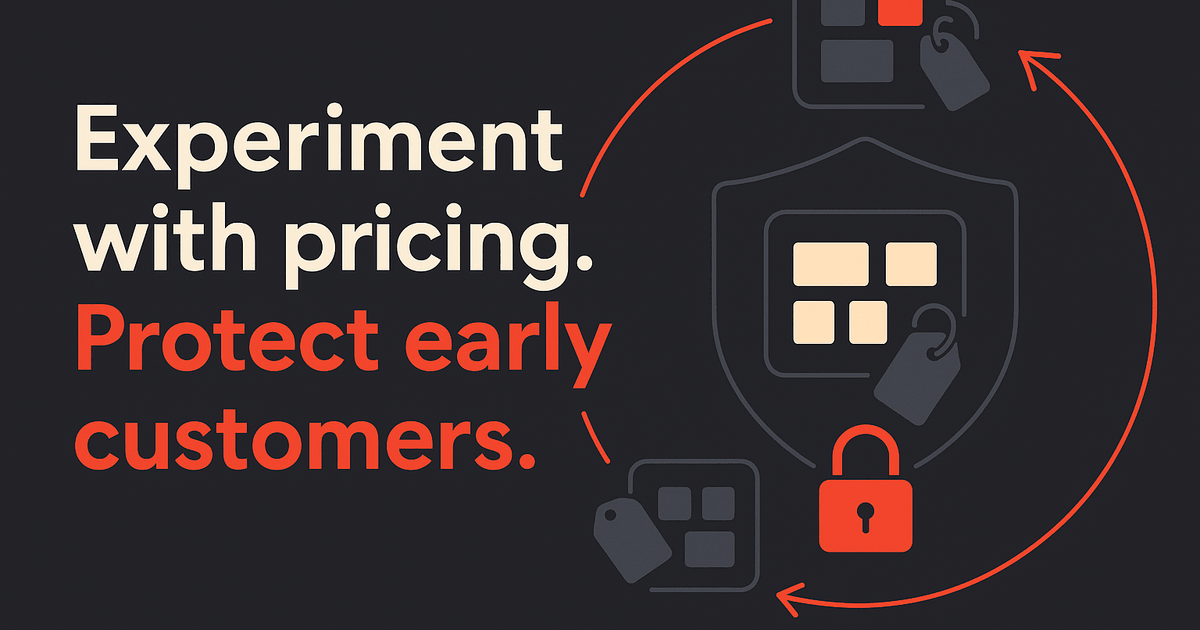
Protect the package, not just the price
A customer’s entitlements are the features and limits they can access. Preserving the dollar amount is only half the exercise if the startup also changes what the package includes.
In the example, the early customer must keep batch export while new public-offer customers do not receive it. Treat those as two separate checks:
- Does the early customer’s next charge remain $120?
- Does the application still grant that customer batch export?
This is where grandfathering needs a precise policy. Write down whether you are preserving the price, the package, or both—and what happens when the customer changes offers.
Chargebee explicitly documents controls for applying feature changes to new customers while preserving existing customer access. That is a real capability to compare against, not a gap to imply in a competitive evaluation. (chargebee.com)
Bunny lists feature management and application-access provisioning in its Foundation plan. Ask Bunny to demonstrate the exact old-package/new-package behavior your startup requires; those listed capabilities alone are not proof of every grandfathering scenario. (bunny.com)
Keep a pricing-release record
For this evaluation, create a short record for each proposed pricing release. Keep it outside the vendor presentation so both platforms answer the same questions.
Include:
- Offer identifier: A stable label, not just “Growth.”
- Eligible customers: New buyers, selected accounts or an explicitly defined group.
- Effective date: When the offer becomes available.
- Commercial terms: Amount, allowance and charges beyond the allowance.
- Feature access: What is included and excluded.
- Existing-customer treatment: Unchanged, optional move or scheduled change.
- Withdrawal rule: What happens if you stop selling the offer.
- Owner: Who authorizes release and resolves exceptions.
This is a proposed operating discipline, not a claim that either vendor provides a dedicated pricing-release feature.
Use it to distinguish two different actions: withdrawing an offer from sale and moving an existing customer off that offer. Require separate decisions for each. Otherwise, “undo the experiment” is too ambiguous to execute safely.
Also ask which parts require configuration, application changes or vendor assistance. Record the actual work observed during the demonstration rather than accepting an unsupported “no-code” label.
Separate pricing flexibility from platform affordability
There are two prices in this decision: what your startup charges customers and what the billing vendor charges your startup.
Bunny’s published pricing lists a free Foundation plan, online-purchase billing at 0.6% of PLG revenue, and sales-led quoting at $150 per user per month. Foundation includes catalog and feature-management capabilities; recurring subscriptions are listed in the paid PLG offering. Free Foundation should therefore not be mistaken for free production subscription billing. (bunny.com)
Use Bunny’s pricing details to identify the required package, then request a written quote for your intended setup.
Keep the commercial questions tied to the experiment:
- Which purchased capabilities are required for all three offers?
- Does preserving an old package require additional implementation?
- Can your own team withdraw an offer?
- What assistance is included when you introduce a different charging unit?
- Which fees remain if an experiment attracts no customers?
Ask Chargebee the same questions against its proposed package. Do not compare Bunny’s entry price with an unrelated Chargebee bundle, or assume that supporting a feature means it is included in every plan.
Choose the tool that makes the next change manageable
Bunny deserves consideration when you want pricing configured outside application code and available through both sales and online purchasing. That is the specific basis for our recommendation—not an assertion that Chargebee cannot support flexible pricing. (bunny.com)
Make the final decision from the three-offer exercise. Prefer the platform where your team can explain who receives each offer, reproduce the expected charge, preserve promised access and withdraw an unsuccessful experiment without guessing.
If Chargebee already does that well in your environment, keep it. If Bunny demonstrates a clearer process for the people who will operate it, that is a concrete reason to choose Bunny.
Book a Bunny demo and bring your current offer, your next proposed package and one negotiated exception. Ask to see them coexist—not just to see the newest one work.

Billing that handles your pricing model
Recurring, usage-based, tiered, banded or hybrid — Bunny bills it without a rebuild, and recognises the revenue automatically.