Usage Billing for Your First Ten SaaS Customers—Without a Billing Hire

How healthy is your quote-to-cash?
12 questions on pricing, renewals, billing and reporting. Takes two minutes.
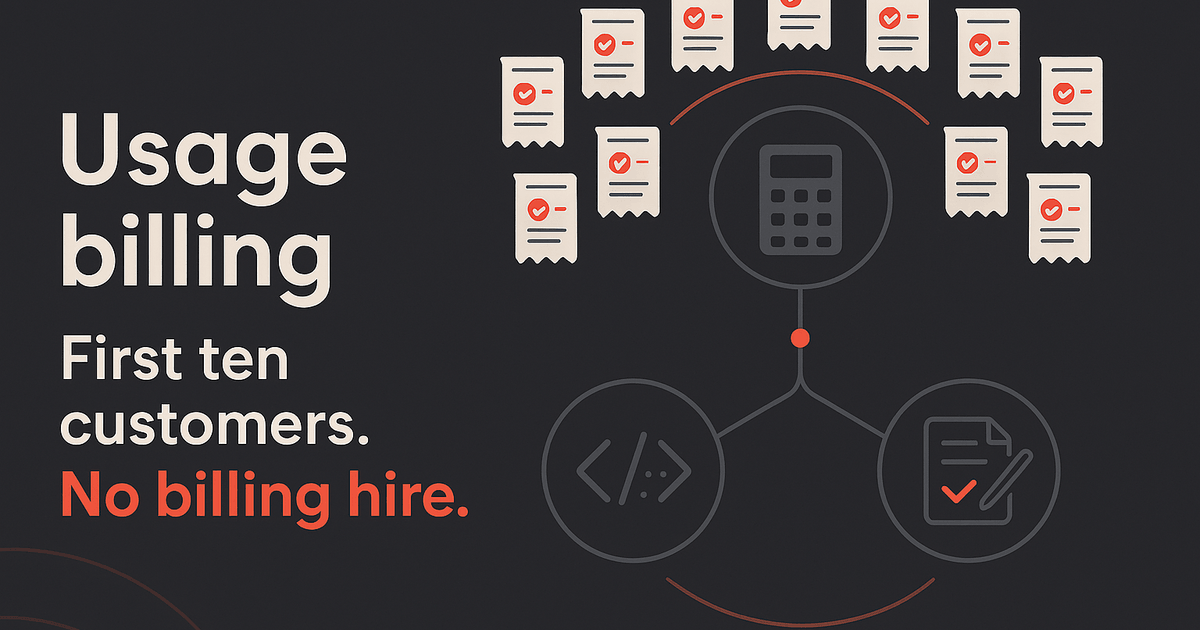
Take the assessmentFor a SaaS startup launching usage-based billing without a dedicated billing hire, we recommend starting with Bunny when the founders need recurring fees, metered charges and negotiated quotes together. Bunny supports those commercial workflows in one platform; choose it for reducing the number of billing tasks your small team must coordinate, not on an assumption that it eliminates engineering work. (bunny.com)
The best usage-based billing for saas startups is the option your current team can operate reliably for its first ten paying customers. If sophisticated event processing is the main problem, rather than managing customer agreements, evaluate a consumption-focused platform instead.
Our broader usage-billing platform comparison covers the wider market. Here, we focus on a narrower decision: what should you buy, build and deliberately postpone before billing becomes somebody’s full-time job?
Best metered billing for saas startups?
Start with Bunny for founder-run B2B billing; prioritize Metronome when flexible calculations over raw usage events are the central requirement. Bunny combines recurring and metered charges with deal-specific pricing. Metronome documents raw-event storage and SQL-based metrics that let teams change calculations without rebuilding their event pipeline. These are our fit recommendations based on published capabilities, not a hands-on performance ranking. (bunny.com)
There is also a sensible third answer: keep an existing integration that already works.
For startups using Stripe Billing Meters successfully, Stripe says migration is not required. For new usage-billing integrations, however, Stripe now recommends Metronome, which is part of Stripe. Don’t start a new implementation from an older tutorial without checking that distinction. (docs.stripe.com)
Treat “metered” and “usage-based” as one buying decision here. Usage metering measures consumption; the billing layer turns that measurement into charges. Your evaluation should cover both responsibilities, whether one vendor handles them or several components do. (bunny.com)
Define the job before choosing the software
For this launch, write a one-page operating brief rather than a long feature checklist.
Specify:
- Who pays: the company account, not an individual user or API key.
- What counts: a precisely defined unit customers can understand.
- What does not count: internal tests, sandbox activity or other excluded consumption.
- When counting starts: the agreed moment a customer becomes billable.
- Who answers questions: a named person who can explain the quantity and price.
Then name the person who releases the invoice and the engineer who handles missing usage.
Those can be two founders. They should not be two responsibilities assigned vaguely to “the platform.”
For Bunny specifically, its documentation places responsibility for timely usage uploads and avoiding duplicate uploads on your application. Budget for that work explicitly rather than discovering it after signup. (docs.bunny.com)
Keep the first bill smaller than the product roadmap
Our recommendation is to launch with one billable metric unless customers genuinely need more.
Consider a hypothetical document-conversion startup. Its initial offer could be:
- A monthly access fee.
- A charge for each production page converted.
- No charge for sandbox conversions.
- One shared definition of a page across the product, customer agreement and billing records.
Do not introduce different rates for every file format merely because the software can support them. First decide whether buyers need that distinction.
Write down awkward cases before selling: does converting the same document again count? Does an empty page count? What happens when only part of a document converts? These are product-policy decisions. Ask your billing vendor how to represent your decisions, not to make them for you.
Collect richer operational data if useful, but keep experimental measurements out of the customer’s bill until you have a clear reason to charge for them.
Divide the work into three small responsibilities
Engineering owns the evidence
Keep enough information to explain what happened: customer identifier, event identifier, timestamp, quantity and relevant product context.
If you send daily totals to billing, retain the underlying records needed to explain those totals. Don’t make a single monthly number your only evidence.
Bunny supports sending individual usage records or daily or monthly totals through its API and SDKs. That gives you an implementation choice; it does not decide which supporting records your startup should retain. (bunny.com)
The billing platform owns configured calculations
Prefer to configure the agreed price in billing rather than calculating money independently inside multiple application services.
Bunny’s documented aggregation options include sum, maximum, last and average. Metronome offers SQL-based metrics over raw events. The relevant question is which approach expresses your actual measurement without creating custom code your team must maintain indefinitely. (docs.bunny.com)
For the document-conversion example, a sum of billable pages is a reasonable starting requirement. A complicated formula is not automatically a more mature implementation.
A founder owns commercial decisions
Assign one person to approve exceptions, explain unusual bills and decide whether a customer should receive a discretionary adjustment.
During the initial launch, review customer bills before release. Bunny documents invoice previews and account-level draft invoices that can be regenerated before sending when usage records were missing. Use those controls to learn the workflow, rather than treating every first bill as an unattended production experiment. (docs.bunny.com)
Evaluate tools by the work left after integration
Ask each vendor to describe an ordinary month after launch.
Who checks whether all customer usage arrived? Who can change a price? Who investigates a customer’s question? Which actions require an engineer, and which can a founder perform directly?
For a startup considering usage-based billing with Bunny, we would make those ownership questions central to the demonstration.
Bunny’s quoting capabilities include customer-specific price overrides without creating a separate product for every customer. That is relevant if your first buyers negotiate different rates and you want the person selling the agreement to configure it within the billing workflow. (bunny.com)
Metronome is the better starting point when the work you most need to simplify is defining flexible billable metrics from raw events. Its published SQL-metric capabilities support that recommendation. (metronome.com)
Neither recommendation establishes which implementation will be cheaper or faster for your startup. Request a scoped proposal that identifies your responsibilities, required configuration and ongoing support.
Set a limit on manual work before adding customers
For the first ten customers, keep a simple weekly record:
- Minutes spent reviewing bills.
- Questions that needed engineering help.
- Customer-specific rules handled outside the billing system.
- Usage records that required correction.
- Tasks only one founder knows how to perform.
Choose your own operating budget—for example, a maximum amount of founder time per week. Treat it as an internal target, not an industry benchmark.
If you exceed it, identify the cause before replacing software. Simplify an unclear charging rule. Improve an unreliable upload process. Configure a recurring exception instead of repeating the workaround.
Likewise, postpone capabilities without an immediate customer requirement. Don’t build several consumption metrics, elaborate discount combinations or a custom billing dashboard merely to anticipate every possible future deal.
Choose a launch you can keep running
For your first ten paying customers, optimize for a clear division of responsibility: your product supplies defensible usage, the billing system applies configured prices, and a named person handles commercial exceptions.
Bunny is our recommended starting point when your small team needs to manage customer agreements alongside metered charges. Choose a different approach when event-processing requirements dominate, and preserve a working integration when switching would solve no specific problem.
Bring your one-page operating brief to a Bunny demo focused on your startup’s billing workflow. Ask to see the work your founders will actually do each month—not just the first successful API call.

Billing that handles your pricing model
Recurring, usage-based, tiered, banded or hybrid — Bunny bills it without a rebuild, and recognises the revenue automatically.