Recurly vs Stripe Billing: Follow the Payment, Not the Feature List

How healthy is your quote-to-cash?
12 questions on pricing, renewals, billing and reporting. Takes two minutes.
Take the assessmentOur recommendation is Stripe Billing for B2B SaaS teams keeping billing and collection centered on Stripe, and Recurly when gateway flexibility and differentiated collection campaigns are the deciding requirements. That recommendation follows their documented payment and collection capabilities, not a claim that either wins every billing scenario. Bunny is SaaS billing, CPQ and RevOps for B2B SaaS; this comparison focuses on how customers pay and what happens when they do not. (stripe.com)
Our broader guide to subscription billing platforms covers the wider shortlist. Here, the question is narrower: does your business need better handling of failed cards, overdue business accounts, or multiple processors? Treat those as separate requirements rather than one “collections” checkbox.
What are the differences between Recurly and Stripe Billing?
Recurly manages subscriptions across supported payment gateways, including Stripe. Stripe Billing sits within Stripe’s broader payments ecosystem, but also offers off-Stripe processing capabilities. Both support recurring billing and payment recovery. The distinction is therefore not “Recurly supports gateway choice; Stripe never does.” It is which payment setup and operational controls fit your business. (docs.recurly.com)
Three differences deserve attention:
- Gateway configuration: Recurly documents gateway selection, routing, switching and failover. Ask which options are included in your proposed package. (docs.recurly.com)
- Collection campaigns: Recurly documents separate automatic, manual and post-trial collection cycles, plus additional campaigns for eligible accounts. (docs.recurly.com)
- Stripe-centered operations: Stripe Billing offers hosted payment pages, customer portals and Smart Retries within its product ecosystem. Third-party processing is also advertised, with additional costs identified on its feature page. (stripe.com)
For your evaluation, write down the exact processors, currencies and collection methods you require. A vendor’s broad compatibility claim should start that conversation, not finish it.
First separate the billing engine from the processor
Choosing Recurly does not necessarily mean leaving Stripe. Recurly’s Stripe integration lets Stripe process payments while Recurly manages subscriptions. That makes “Recurly plus Stripe processing” a legitimate alternative to “Stripe Billing plus Stripe processing.” (docs.recurly.com)
This matters when diagnosing a problem. If your team struggles with collection policies, compare those policies while holding the processor constant. If your problem is payment routing, evaluate the supported gateway configurations instead.
Do not assume that every payment instrument moves freely between gateways. Recurly explicitly cautions that some tokenized payment data requires special migration handling. It also says refunds use the gateway that processed the original charge, so an old gateway may need to remain available for refunds after new transactions move elsewhere. (docs.recurly.com)
Ask both vendors:
- Where will reusable payment credentials reside?
- Which existing credentials can the proposed setup use?
- Who handles historical refunds after a switch?
- Which payment events must our application receive from each system?
Processor choice and billing choice belong in the same evaluation, but they are not the same decision.
Failed cards: compare eligible recovery, not headline promises
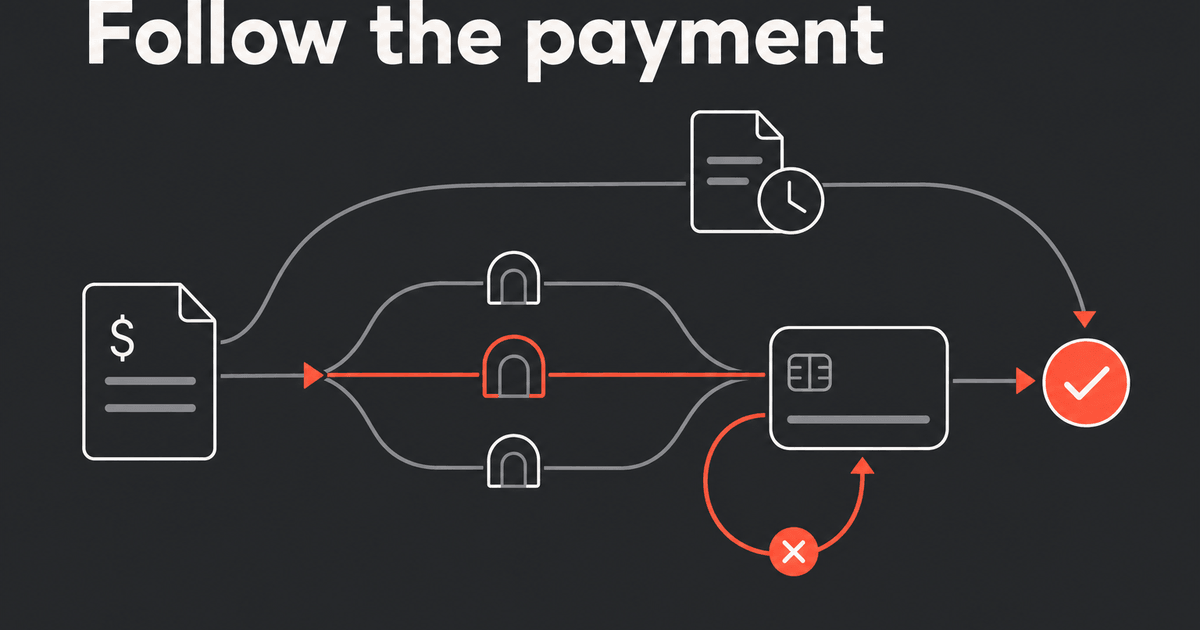
For card-paying accounts, compare the complete invoice recovery path. Dunning includes the communications and collection process; retry timing is only one component.
Recurly’s Intelligent Retries uses machine learning to schedule attempts for declined recurring card payments. Its documentation excludes direct-debit methods such as ACH and SEPA from that particular retry engine. Stripe Billing also supports automatic retries through Smart Retries or a custom schedule, with documented exceptions such as missing payment methods and hard declines. (docs.recurly.com)
Neither feature establishes that one vendor will recover more of your revenue.
Request a comparison using the same eligible population: payment method, country, decline reason and recovery window. Keep hard declines separate from temporary failures. Otherwise, a change in customer mix can look like a change in recovery performance.
Also inspect what happens after a customer updates their card. Stripe documents a specific ordering of subscription-level and customer-level payment methods. Updating the customer’s default does not override a payment method already selected on the subscription. (docs.stripe.com)
That is a useful support scenario to demonstrate: a customer says, “I replaced the card,” but collection still fails. Ask each vendor to show how an operator finds the method actually being retried.
Customers paying on terms need a different comparison
Consider a hypothetical B2B account with an unpaid bill because the customer’s procurement team needs a corrected purchase-order reference. Compare that with an account whose stored card has insufficient funds. The outstanding amount might be identical, but the required action is different.
Recurly supports manual invoicing with payment terms, PO numbers and recorded external payments. Its documentation describes a separate collection process for these invoices and warns that feature availability depends on the package. Stripe supports both automatic charging and sending invoices with payment instructions. (docs.recurly.com)
Instead of asking which has “better retries,” ask:
- Can finance distinguish a disputed bill from a failed payment?
- Can reminders stop while the account owner resolves a procurement issue?
- What happens after a partial payment?
- Does changing collection settings affect an existing invoice or only future ones?
- What subscription action follows an unresolved balance?
There are concrete differences to investigate. Recurly says changing a subscription’s collection method affects the next invoice, not previously issued invoices. Stripe’s API permits changing an invoice’s collection method only while it is still a draft. These are different operational boundaries, not interchangeable toggles. (docs.recurly.com)
Recurly also documents a Stop Dunning action that stops retries, messages and the campaign’s final action while leaving the invoice overdue. Ask Stripe to demonstrate the corresponding configuration for your intended workflow rather than assuming identical behavior. (docs.recurly.com)
Price the payment setup you will actually run
Request two itemized proposals built around the same customer mix. Include:
- Billing-platform charges and commitments.
- Processing charges for each payment route.
- Required collection features and optional products.
- Migration work, including payment credentials.
- Ongoing reconciliation and support responsibilities.
Do not calculate a winner from a billing percentage alone. In particular, Stripe identifies multiprocessor capabilities as an additional-cost feature, while Recurly places conditions on access to some collection capabilities. Confirm the package that delivers your proposed design. (stripe.com)
Ask each vendor to price an ordinary month and a difficult one: more failed payments, more manually collected accounts, or a gateway transition. The goal is a usable operating model, not just a favorable starting rate.
Recurly vs Stripe Billing: which should a B2B SaaS company choose?
We would choose Stripe Billing when the intended setup remains Stripe-centered and the collection workflows meet finance’s needs. Its documented billing, portal and recovery capabilities make it a credible choice without adding another subscription platform solely for retries. (stripe.com)
We would choose Recurly when supported gateway combinations and differentiated collection campaigns justify a separate subscription layer. Its gateway controls and campaign configuration are substantive reasons to evaluate it, including while retaining Stripe for processing. (docs.recurly.com)
If the real problem happens before collection—translating an accepted deal into the correct subscription—evaluate that separately. Bunny connects quoting, subscriptions, invoices and revenue data, and its Stripe integration allows Stripe to process payments behind Bunny invoices. That is a different reason to consider Bunny, not evidence that it outperforms either vendor’s card recovery. (bunny.com)
Our Recurly alternatives guide expands the shortlist if neither proposed setup fits.
The deciding question is simple: which platform can your team use to resolve the payment problems your customers actually have?

Billing that handles your pricing model
Recurring, usage-based, tiered, banded or hybrid — Bunny bills it without a rebuild, and recognises the revenue automatically.