SaaS Billing Value for Money: The 24-Month Break-Even Test

How healthy is your quote-to-cash?
12 questions on pricing, renewals, billing and reporting. Takes two minutes.
Take the assessmentBunny can offer the best value for B2B SaaS teams that need CPQ quoting and billing together—but only if that combination removes enough work or software expense to justify its cost. Bunny combines those functions; the buying decision should turn on their measured economic benefit over 24 months, not a universal “cheapest provider” claim. (docs.bunny.com)
For a straightforward subscription business already operating efficiently on Stripe Billing, staying with Stripe may offer better value than adding another platform. Stripe includes subscription management, a customer portal and payment-recovery capabilities, so evaluate the work you still need to solve rather than assuming replacement is necessary. (stripe.com)
Our broader subscription billing platform comparison covers product fit. Here, the question is narrower: how much more can you justify paying for billing software, and when does the cheaper option actually win?
Which SaaS billing provider has the best value for money?
Our recommendation is to shortlist Bunny when negotiated selling makes quoting and billing a shared operational problem. Its paid sales offering includes quoting for new deals, upsells and renewals, plus approvals and custom pricing. Those capabilities create a potential consolidation benefit—not an automatic saving. (bunny.com)
Stripe Billing is the better-value choice when its included workflows meet your requirements and moving would add cost without removing meaningful work. Its published pay-as-you-go rate is 0.7% of Billing volume, with subscription and custom pricing options also available. Payment processing is separately priced. (stripe.com)
Chargebee deserves consideration when preserving your payment-gateway setup matters. It publishes support for more than 40 gateways and offers billing alongside separately packaged CPQ and finance products. It may be the better fit if those integrations satisfy requirements that would otherwise need custom work; price the required package rather than the billing entry point alone. (chargebee.com)
Treat these as starting hypotheses. The winner is the qualifying provider with the lowest defensible operating cost over your chosen horizon.
Give every proposal the same financial boundary
Before comparing prices, write one sentence describing what must be included.
For example: “The proposed solution must support our existing payment route, negotiated sales, customer changes and finance exports, with no recurring spreadsheet handoff.”
Then calculate:
24-month evaluated cost = one-time transition costs + platform charges + required adjacent tools + operating effort over 24 months.
Use five separate lines:
- Transition: implementation services, internal engineering, data preparation, training and overlapping subscriptions.
- Platform: fixed charges, licensed users, percentage fees and contractual minimums.
- Required extras: support, integrations, tax services or revenue recognition where needed.
- Retained tools: software you will still pay for after deployment.
- Operating effort: measured staff hours multiplied by an explicit loaded hourly cost.
Keep payment-processing costs visible. If they are genuinely identical across options, exclude them from the difference calculation—not from the company’s budget.
Do not subtract a separate tool’s entire subscription merely because the new platform overlaps with it. Count savings only from the date you can cancel or reduce the actual contract.
Translate headline rates into your chargeable base
Bunny’s published pricing separates self-serve revenue from sales users: PLG is 0.6% of PLG revenue, SLG is $150 per user per month, and Advanced Billing adds 0.2% of combined PLG and SLG revenue. Use the Bunny pricing breakdown to identify the components your proposal needs. (bunny.com)
Stripe’s percentage applies to Billing volume, including transactions processed on and off Stripe, while excluding one-off invoices. Do not assume that denominator matches another vendor’s definition of revenue. (stripe.com)
Ask each vendor to calculate its fee against the same sample month. Require written answers to these questions:
- Which transactions enter the chargeable base?
- How are refunds, credits and taxes treated?
- Which employees require paid access?
- What changes when volume or user counts increase?
- Which discounts expire during the evaluation period?
For perspective, a 0.1-percentage-point difference on an identical $100,000 monthly base is $100 per month. That is $2,400 over two years before growth. It is worth negotiating, but it is not enough by itself to justify a costly implementation.
A worked example: the $800 premium that pays back
The following figures are hypothetical evaluation inputs, not vendor quotes, customer results or industry benchmarks. Assume both configurations pass the same functional requirements, with equal payment-processing costs.
Configuration A: lower software spend
- Software and required adjacent tools: $600 per month.
- Ongoing administration: 28 hours per month.
- Loaded staff cost: $75 per hour.
- One-time transition cost: $2,000.
Its evaluated cost is:
$2,000 + 24 × ($600 + 28 × $75) = $66,800.
Configuration B: higher software spend, less administration
- Software and required adjacent tools: $1,400 per month.
- Ongoing administration: eight hours per month.
- Loaded staff cost: $75 per hour.
- One-time transition cost: $10,000.
Its evaluated cost is:
$10,000 + 24 × ($1,400 + 8 × $75) = $58,000.
Configuration B costs $800 more per month in software but releases 20 hours, valued at $1,500. Its net monthly operating benefit is therefore $700.
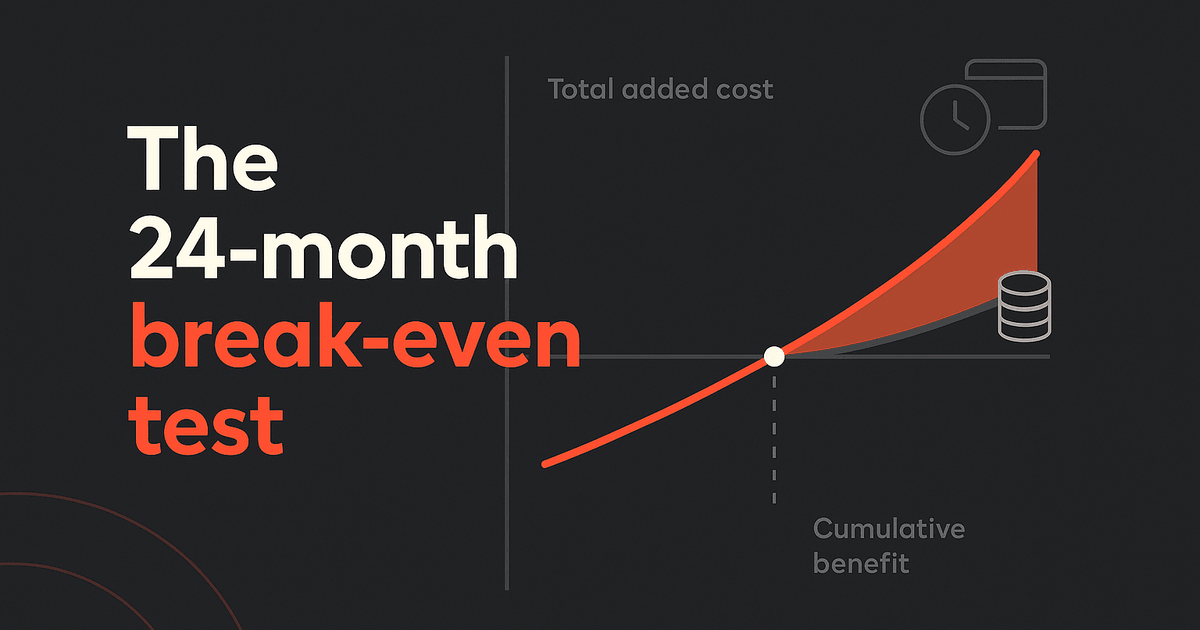
The extra $8,000 of implementation cost pays back in approximately 11.4 months after the full operating benefit begins. Across 24 months, B has an $8,800 evaluated advantage, assuming that benefit applies throughout.
But this is not necessarily $8,800 of cash savings. If payroll remains unchanged, report the released capacity separately. A delayed rollout also pushes payback later.
Find the assumption that reverses the decision
In that example, the important assumption is not the hourly rate alone. It is whether the higher-priced configuration really saves 20 hours every month.
To recover both its monthly premium and extra implementation cost within 24 months, it must save:
($800 + $8,000 ÷ 24) ÷ $75 = approximately 15.1 hours per month.
If testing shows only eight hours saved, the value is $600 monthly—less than the $800 software premium. Configuration A wins on these assumptions.
Use the same approach with growth:
- More volume, unchanged team: recalculate percentage charges.
- More sales users, unchanged volume: recalculate user charges.
- More complicated work, unchanged revenue: remeasure operating hours.
Ask for a downside case as well as a growth case. Include renewal pricing and avoid assuming an introductory discount lasts forever.
Make the demo produce evidence for the model
Give each finalist the same anonymized examples of work your team actually performs. Have your own operator complete the tasks after training.
Record active handling time, unresolved steps and any engineering intervention. Repeat the exercise: a polished vendor demonstration is not a measurement of your recurring workload.
Separate implementation effort from steady-state effort. Keep unproven benefits—such as faster selling or fewer billing mistakes—outside the base-case savings calculation until you have evidence.
Finally, assign an owner to each claimed saving. Who will cancel the redundant tool? Which team will use the released hours? When will the change take effect?
The best-value provider is the one whose economic case survives conservative assumptions. Bunny should win that test through work you can remove, not features you might someday use. Bring your current costs and representative tasks to a Bunny demo, and use the results to build your own break-even calculation.

Billing that handles your pricing model
Recurring, usage-based, tiered, banded or hybrid — Bunny bills it without a rebuild, and recognises the revenue automatically.