Best RevOps Tools for SaaS: The 2026 Stack by Category

How healthy is your quote-to-cash?
12 questions on pricing, renewals, billing and reporting. Takes two minutes.
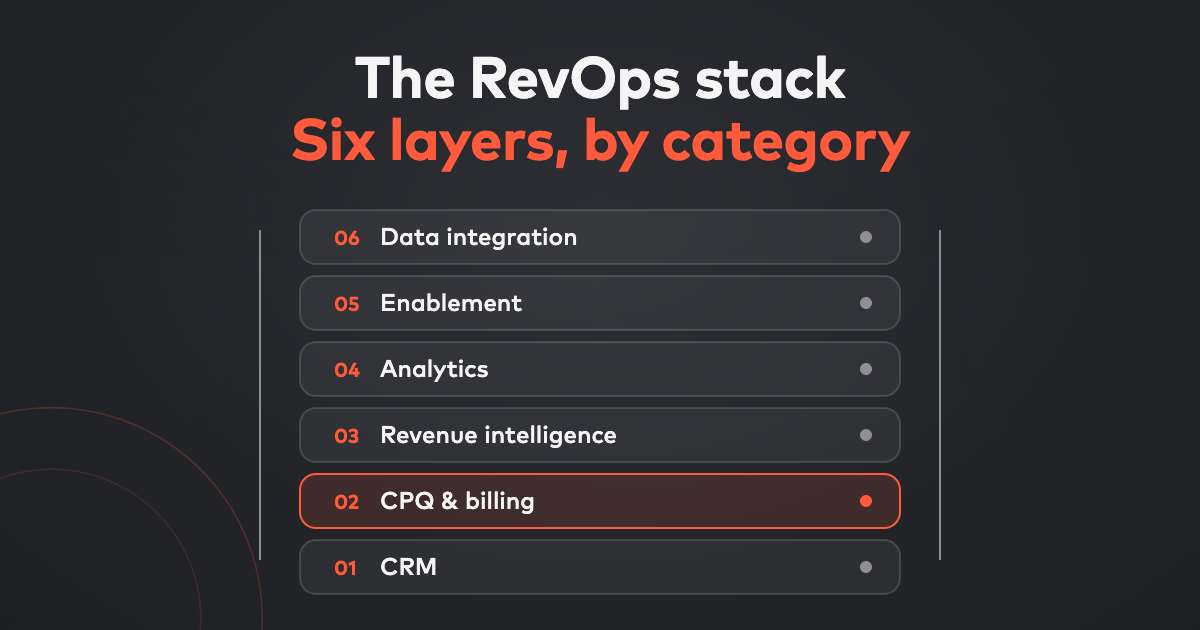
Take the assessmentThe best RevOps tools for SaaS cover six jobs: CRM (Salesforce, HubSpot), CPQ and billing (Bunny, Salesforce Agentforce Revenue Management, HubSpot Revenue Hub, Chargebee), revenue intelligence and forecasting (Gong, Salesloft with Clari Forecast), analytics (ChartMogul or your BI tool), enablement (Highspot, Seismic) and data integration (Fivetran, Hightouch). There’s no single best RevOps tool. There’s a stack, and the best one is the smallest set of tools that runs your revenue process from pipeline to cash without spreadsheets in between.
Full disclosure: we publish this on Bunny’s website. Bunny is SaaS billing, CPQ and RevOps for B2B SaaS, and it appears in the CPQ and billing category below. Every other tool is here because RevOps teams genuinely use it, described the way its vendor positions it in October 2026.
RevOps tools compared by category
| Category | Tools to shortlist | The job it does | Watch for |
|---|---|---|---|
| CRM | Salesforce Sales Cloud, HubSpot Sales Hub | System of record for accounts, contacts and pipeline | Admin overhead as customisations pile up |
| CPQ and billing | Bunny, Salesforce Agentforce Revenue Management, HubSpot Revenue Hub, Chargebee | Turns a negotiated deal into a subscription, invoices and renewals | Handoffs between quote and bill |
| Revenue intelligence and forecasting | Gong, Salesloft (with Clari Forecast) | Captures sales activity, inspects deals, forecasts pipeline | Forecasts built on bookings, not billed revenue |
| Analytics and BI | ChartMogul, your warehouse BI tool | MRR, churn, retention and board reporting | Metrics that disagree with the billing system |
| Enablement | Highspot, Seismic | Content, training and coaching for sellers | Adoption outside the CRM |
| Data and integration | Fivetran, Hightouch | Moves data into the warehouse and back into tools | Another layer to own and monitor |
What makes a good RevOps tool?
Before the categories, three tests that apply to every tool on this list:
- Does it reduce handoffs? Every time data moves between systems by hand, someone rekeys it and someone else reconciles it. The best tools remove a handoff; the worst add one.
- Is it the source of truth for something? A tool should own a clear piece of data, such as the pipeline, the contract or the invoice, rather than keep a copy that drifts.
- Can the RevOps team run it? If every change needs an engineer or a consultant, the tool will fall behind your pricing and your process.
CRM: Salesforce and HubSpot
The CRM is the system of record for accounts, contacts and pipeline, and everything else in the stack hangs off it.
- Salesforce Sales Cloud is the default for larger and more complex sales organisations, with deep customisation and a huge partner ecosystem.
- HubSpot Sales Hub is the common choice for SMB and mid-market teams that want marketing, sales and service on one easier-to-run platform.
Pick the CRM your sales team will actually keep up to date. Then make sure the CPQ and billing layer integrates with it natively, so reps quote from the opportunity or deal rather than switching systems.
CPQ and billing: where Bunny fits
This is the category that decides whether your revenue data is trustworthy. CPQ turns a negotiated deal into a priced quote, and billing turns that quote into a subscription, invoices and renewals. In many stacks those are two products, and every amendment, upsell and renewal crosses the gap by hand.
- Bunny is built for B2B SaaS, with Bunny CPQ and Bunny billing on one catalog and one subscription record. Reps quote from Salesforce or HubSpot. Bunny handles customer-specific pricing without one-off products, multi-year ramps, approval workflows, built-in e-signature, and renewal and upsell quotes from the live subscription, with recurring and usage charges on the same contract. SaaS metrics like MRR, churn, NRR and GRR come from the same data. Pricing is published: 0.6% of PLG revenue, $150 per SLG user per month, and Advanced Billing at 0.2% of combined revenue for revenue recognition, multiple entities and multiple currencies. See Bunny CPQ.
- Salesforce Agentforce Revenue Management (formerly Revenue Cloud) is Salesforce’s native quote-to-cash suite, covering product catalog, CPQ, contracts, order-to-cash and billing. It’s the natural option for teams committed to building everything on the Salesforce platform. Salesforce has stopped selling its legacy CPQ to new customers; we cover the options in Salesforce CPQ end of life.
- HubSpot Revenue Hub (formerly Commerce Hub) adds quotes, CPQ with pricing rules and discount guardrails, contracts, e-signature, recurring billing and payments inside HubSpot.
- Chargebee pairs a subscription billing suite with a CPQ add-on that works from Salesforce or HubSpot, with approvals, ramps and renewal quotes.
For a deeper comparison of this layer, see our best CPQ for B2B SaaS roundup and the revenue operations software overview.
Revenue intelligence and forecasting: Gong and Salesloft
Revenue intelligence tools capture what’s happening in deals (calls, emails, meetings) and turn it into pipeline inspection, coaching and forecasts.
- Gong positions itself as an AI operating system for revenue teams. Its Revenue Graph captures customer interactions, with products for engagement, forecasting, enablement and AI agents built on top.
- Salesloft merged with Clari and now runs as one company under the Salesloft brand. Clari Forecast keeps its name as the forecasting layer, alongside Salesloft’s sales engagement and Clari’s deal management and conversation intelligence.
Both forecast bookings well. Neither replaces the billing system as the source of truth for what was actually invoiced and renewed. Reconcile the forecast to billed revenue, not the other way round.
Analytics and BI: ChartMogul and your warehouse
RevOps lives on metrics: MRR, ARR, net revenue retention, churn, expansion. The question is where they’re calculated.
- ChartMogul markets itself as an AI-native stack for subscription intelligence. It connects to billing systems including Stripe and calculates MRR, ARR, churn, retention and expansion.
- A warehouse BI tool is the answer when you need to blend revenue with product usage, marketing and support data.
If your billing platform already calculates SaaS metrics from the contract data, start there and use BI for the cross-functional questions. Two systems computing MRR from different inputs is how board decks end up with two numbers.
Enablement: Highspot and Seismic
Enablement platforms put the right content, training and coaching in front of sellers.
- Highspot describes itself as an AI platform for revenue execution, combining content management, training and coaching, AI agents for deal guidance and digital sales rooms.
- Seismic positions itself as a sales enablement platform, with content management, learning and coaching, meeting intelligence and digital sales rooms under its Seismic Enablement Cloud.
These earn their place once the sales team is big enough that content sprawl and inconsistent pitching cost deals.
Data and integration: Fivetran and Hightouch
As the stack grows, data has to move between tools and into a warehouse.
- Fivetran is an automated data movement platform with 900+ sources and destinations, plus transformations and reverse ETL into business tools.
- Hightouch is best known for reverse ETL and a composable CDP, syncing warehouse data out to sales and marketing tools.
Bunny’s quoting, subscription, usage and invoicing data can be replicated to a warehouse such as Snowflake or BigQuery through Airbyte, and Bunny connects to thousands of other apps through Zapier.
Where AI agents fit in a RevOps stack
The newest layer isn’t a category of its own yet: AI agents that can act on revenue data rather than just report on it. Gong and Highspot both ship agents inside their products. Bunny’s RevOps Agent works on live billing data: it answers questions like which accounts renew this month, takes actions such as creating subscriptions, applying discounts and updating renewals, and can read a contract or pricing sheet and set up the resulting records. It runs in the Bunny app, in Slack, and over MCP from Claude, ChatGPT and other MCP-compatible tools.
How to build a RevOps stack that doesn’t fragment
Start from the revenue process, not the vendor list:
- Pick the CRM your sales team will use.
- Pick one system to own the commercial record, from quote to subscription to invoice to renewal. This is the choice that decides whether your metrics can be trusted.
- Report from that record. Metrics should come from the system that bills.
- Add intelligence, enablement and data tooling only when a specific problem justifies another integration to maintain.
If step two is where your stack breaks today, book a demo of Bunny and bring a real deal with an amendment and a renewal.
Frequently Asked Questions
What are RevOps tools?
RevOps tools are the software revenue operations teams use to run the revenue process from pipeline to cash: CRM, CPQ and billing, revenue intelligence and forecasting, analytics, sales enablement, and the data tools that connect them.
What are the best RevOps tools for SaaS?
A typical SaaS stack pairs a CRM such as Salesforce or HubSpot with a CPQ and billing platform such as Bunny, a revenue intelligence tool such as Gong or Salesloft with Clari Forecast, subscription analytics or BI, an enablement platform such as Highspot or Seismic, and data tools such as Fivetran or Hightouch.
Do RevOps teams need both CPQ and billing software?
They need both jobs done, but not necessarily two products. When CPQ and billing are separate, every amendment, upsell and renewal has to be keyed from one to the other. A platform that quotes and bills from the same catalog and subscription, such as Bunny, removes that handoff.
What is the difference between revenue intelligence and revenue operations software?
Revenue intelligence tools such as Gong analyse sales activity, calls and pipeline to forecast and coach. Revenue operations software runs the commercial process itself: quoting, contracts, subscriptions, invoicing, renewals and revenue reporting.
How many tools should a RevOps stack have?
As few as the revenue process allows. Most SaaS companies need a CRM, a system that turns deals into subscriptions and invoices, and a way to report on it. Add intelligence, enablement and data tooling when a specific problem justifies the integration and admin work.

One system of record for revenue
Stop reconciling the CRM against the billing system against the spreadsheet. Bunny keeps quoting, billing and analytics on the same data.