Negotiating AI-Agent Usage Bills: Who Pays for Retries, Spikes and Idle Commitments?

How healthy is your quote-to-cash?
12 questions on pricing, renewals, billing and reporting. Takes two minutes.
Take the assessmentNegotiate usage-based billing for AI agents by agreeing what counts, who pays for retries, and how much spend can accrue without further approval—before negotiating the unit discount. Use representative pilot data to size the commitment, then settle excess-usage rates, rollout steps and reconciliation rules together. The focus here is negotiating usage based billing for ai agents when buyers need budget control and sellers need protection from unbounded execution costs.
Our guide to how AI agents are moving pricing from usage to outcomes covers the broader choice of charging metric. This article stays with the commercial negotiation: what each side should ask for, offer in exchange and write down. (bunny.com)
How do you negotiate usage-based pricing for AI agents?
Bring a shared usage sample and negotiate three scenarios: slower-than-planned adoption, expected production demand and a consumption spike. For each, calculate the buyer’s payable amount and identify which execution costs the seller must absorb.
Use this sequence:
- Define billable activity and exclusions.
- Size committed spend against conservative demand.
- Negotiate excess-usage rates alongside spending controls.
- Schedule increases around the rollout.
- Agree evidence, corrections and price-change rules.
Treat the terms below as a proposed negotiating framework, not standard market terms or a claim that every vendor offers them.
Allocate retry costs before discussing discounts
Ask the seller to price a representative batch of real workflows, including difficult cases. Request a breakdown of initial attempts, retries, tool calls, model changes and human intervention.
Then propose an explicit allocation:
- Vendor-caused retries: Ask the seller to absorb duplicate processing, internal timeouts and re-execution caused by its own defects.
- Customer-requested reruns: Allow billing when an authorized user deliberately repeats work, with duplicate-request protection.
- Invalid inputs: Agree whether validation happens before charging and whether rejected submissions consume any allowance.
- Third-party failures: Specify whether external service costs pass through, whether a markup applies and how many retries are permitted.
The seller’s counteroffer should bound the work covered by one unit. Define supported input sizes, maximum execution steps and the treatment of unusually expensive tasks.
For credits, ask for the conversion schedule: which action consumes how many credits? Propose advance approval for changes that increase consumption per unchanged workflow. A fixed credit price is not sufficient protection if the contract permits its consumption multiplier to rise.
Buy a realistic floor, not the forecast’s best case
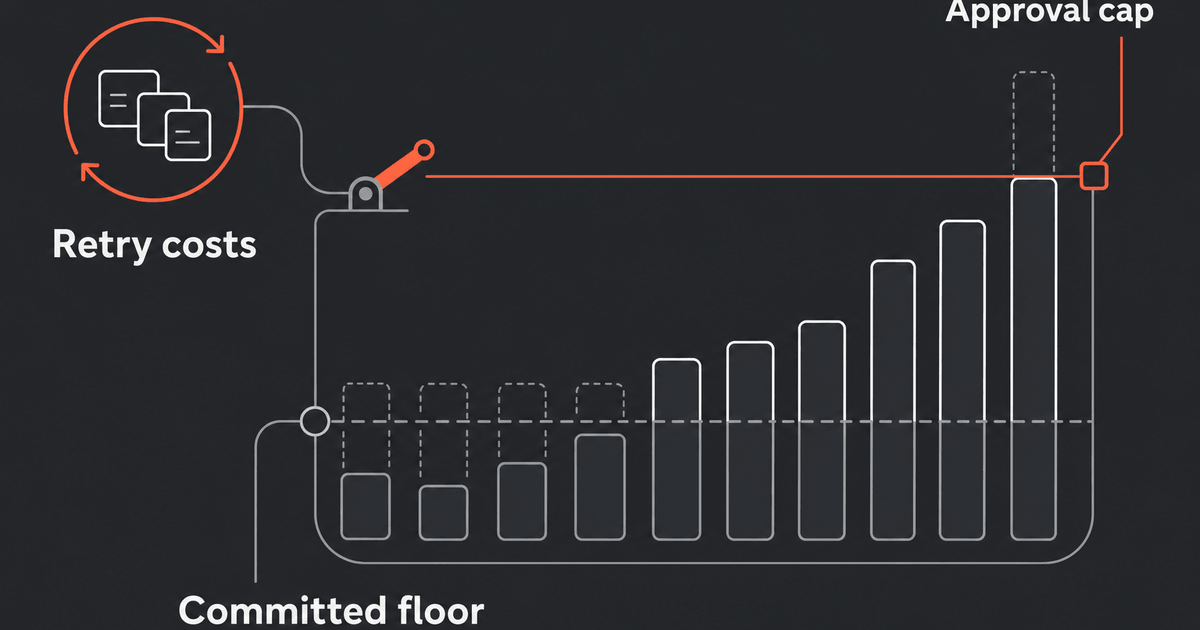
A minimum commitment is a spending floor, payable even when actual consumption falls below it. Negotiate that obligation separately from the headline unit rate. (bunny.com)
Before agreeing to committed spend, specify:
- Which agents, environments and business units can consume it.
- Whether the measurement period is monthly, quarterly or annual.
- Whether unused amounts expire or carry forward, and for how long.
- Whether platform charges count toward the commitment or sit outside it.
- Whether payment is upfront or on an agreed schedule.
Buyer position: Offer a commitment supported by conservative production demand, not a pilot’s busiest day. Request pooling across approved workloads before asking for a larger discount.
Seller position: Trade a lower rate for a firm obligation, earlier payment or a narrower workload scope. If granting carry-forward, negotiate an expiry date and maximum balance rather than leaving the concession open-ended.
Keep usage forecasts separate from binding obligations. Ask both teams to label each number as an estimate, a spending floor or a spending ceiling.
Negotiate the excess rate and the stop rule together
Overage is consumption above an included allowance or committed volume. Agree its rate at signature rather than leaving additional usage subject to an unspecified future price. (bunny.com)
Ask whether additional units retain the negotiated rate, receive a lower rate or cost more. If there are thresholds, specify whether a new rate applies only to additional units or recalculates earlier units.
Then distinguish three controls:
- Alert threshold: Notify named people; do not assume notification stops spending.
- Charge ceiling: Limit the amount payable for the specified period and charge categories.
- Execution stop: Pause new work unless an authorized person approves more capacity.
For every proposed cap, name the currency, measurement period, included charges and reset time. Address work already running: should the product reserve budget before starting, finish within an agreed allowance, or pause safely?
A seller accepting a charge ceiling should negotiate a corresponding right to stop new execution. A buyer requiring uninterrupted service should agree a bounded emergency allowance instead of relying on an ambiguous promise of “no surprises.”
A worked negotiation: lower utilization changes the deal
Consider a hypothetical offer, not Bunny pricing: $8,000 per month includes 40,000 billable actions, with additional actions at $0.20 each. Unused actions expire monthly; there are no separate platform charges.
At 55,000 actions, the bill is:
$8,000 + (15,000 × $0.20) = $11,000.
At 25,000 actions, the bill remains $8,000—an effective $0.32 per consumed action. That is the scenario to examine before accepting a larger commitment for a discount.
Suppose the buyer requests a $12,000 monthly charge ceiling. Under these illustrative terms, that funds 60,000 actions. The seller could accept it with a stop on new work before that budget is exhausted, accounting for work already running.
If expected demand is only 25,000 actions initially, the stronger counteroffer is a smaller launch commitment that steps up later—not merely a cheaper rate tied to 40,000 actions from day one.
Make the ramp reflect deployment responsibility
Ramp deals schedule increases in committed price or quantity over a contract term. For an AI-agent negotiation, use that structure to make the rollout obligation explicit rather than assuming full deployment immediately. (bunny.com)
Propose a smaller launch floor followed by defined increases as more workflows enter production. Choose whether those increases occur on fixed dates or after measurable milestones.
For milestone-based increases, name the evidence and approver. “Successful implementation” is too vague; “the agreed production integration passes the documented acceptance cases” gives both sides something to assess.
Address delay responsibility. Buyers can request that vendor-caused delays defer an increase. Sellers can request a latest-start date for customer-controlled delays. State the new spending floor and allowance at every step; do not rely on a percentage increase alone.
Settle corrections while both sides still want the deal
A true-up reconciles earlier billing with actual usage or contractual obligations. It can address late consumption records or a commitment shortfall; specify which applies to this deal. (bunny.com)
Request a commercial schedule covering:
- Evidence: Customer-visible task identifiers, timestamps, quantities, exclusions and applicable rates.
- Timing: Reporting frequency, reconciliation dates and a deadline for late charges.
- Disputes: A defined challenge window, required evidence and treatment of disputed amounts.
- Corrections: Removal of duplicate charges and an agreed method for returning overpayments.
- Shortfalls: Deduction of amounts already billed toward the commitment before calculating any remaining obligation.
Require late usage to be assigned to its original service period when evaluating that period’s cap. Otherwise, a later reconciliation could undermine the spending protection the parties intended.
Finish with terms your systems can execute
Bunny supports negotiated usage-rate overrides on quotes, minimum quantities on usage charges and separate usage discounts. Those capabilities can carry agreed commercial terms into billing; they do not replace the need to specify them precisely. (bunny.com)
Before signature, ask the seller to demonstrate the proposed bill for low adoption, normal demand and a capped spike. Separately verify the product’s execution-stop behavior rather than treating billing configuration as proof that agents will stop.
The best negotiated result is not simply the lowest unit price. It is an explicit allocation of idle-capacity risk, retry costs and spending authority that both sides can measure and operate.

Billing that handles your pricing model
Recurring, usage-based, tiered, banded or hybrid — Bunny bills it without a rebuild, and recognises the revenue automatically.