Outcome-Based vs Consumption-Based AI Pricing: The Success-Rate Test

How healthy is your quote-to-cash?
12 questions on pricing, renewals, billing and reporting. Takes two minutes.
Take the assessmentChoose outcome-based pricing when your AI product controls a verifiable result and the price covers unsuccessful work as well as successful work. Choose consumption-based pricing when customers control the workflow or you cannot reliably attribute success to your product. The deciding test is how changes in success rate affect customer value, your margin and your forecast—not whether “pay for results” sounds more compelling. (bunny.com)
Our guide to usage-based pricing models covers the broader structures. Here, we compare two ways to price the same AI workload and propose a practical test for choosing between them.
Should AI products use outcome-based or consumption-based pricing?
Start with the boundary of responsibility.
If you sell a component that customers assemble into their own workflows, favor consumption pricing. If you sell a completed job with an observable acceptance condition, consider outcome pricing.
For anyone researching “outcome based vs consumption based pricing ai,” the useful distinction is:
- Consumption pricing: the customer pays for measured activity, such as tokens, processing time or records processed, without making payment conditional on business success.
- Outcome pricing: the customer pays when the work meets the agreed success condition.
Both can use usage-based billing. The difference is what qualifies as a billable unit, not necessarily the billing engine. (bunny.com)
Our recommendation is to make the decision at the workflow level. One AI product may contain both exploratory tools and tightly bounded automation. Those do not need the same charging unit.
Compare what the customer can actually control
Consider a hypothetical AI product that enriches product listings with missing attributes.
A consumption offer might charge for each listing processed. An outcome offer might charge only when the required attributes pass validation and are accepted into the customer’s catalog.
Before choosing, ask three questions.
Who determines the input quality? If customers submit incomplete or contradictory source material, test how much that changes the accepted-result rate. Do not price every account from a pilot containing only clean data.
Who controls completion? An enrichment product might control whether attributes meet agreed validation rules. It does not necessarily control whether the merchant publishes the listing, attracts shoppers or makes a sale. Prefer a result inside the product’s operating boundary.
Who judges success? A machine-checkable attribute rule is different from “the merchandising team likes the description.” Where judgment is subjective, specify how acceptance will work before making it the charging unit.
Agent evaluation guidance also distinguishes an agent’s reported completion from the actual resulting state. That distinction matters here: “the agent says it finished” is a weak basis for charging for success. (anthropic.com)
Run the same workload through both prices
The following numbers are illustrative, not vendor prices or industry benchmarks.
Assume:
- 10,000 listings processed in a month.
- $0.04 variable delivery cost per processed listing, including processing and validation.
- Consumption price of $0.10 per processed listing.
- Outcome price of $0.16 per accepted enrichment.
- No platform fee, tax or fixed operating costs in this simplified calculation.
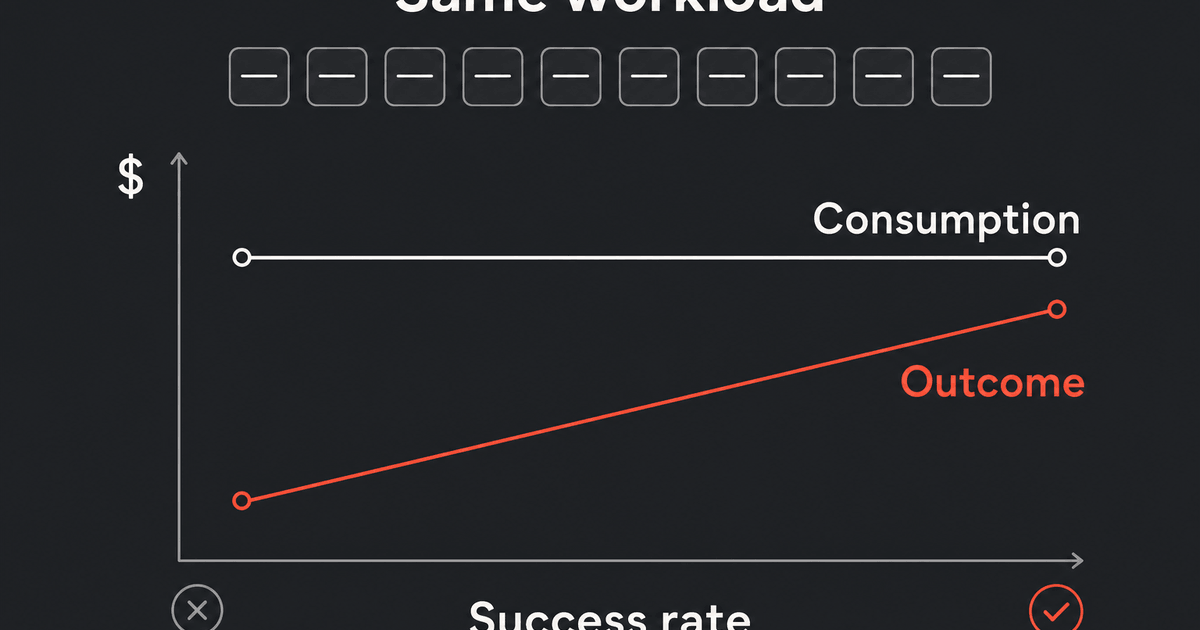
Under consumption pricing, the bill is $1,000. Variable delivery costs are $400, leaving $600 of contribution before fixed costs.
Under outcome pricing at an 80% acceptance rate, 8,000 accepted enrichments generate $1,280. The same $400 delivery cost leaves $880.
Under outcome pricing at a 40% acceptance rate, 4,000 accepted enrichments generate $640. Delivery costs remain $400 under our assumptions, leaving $240.
The workload did not change. The number of payable successes did.
For these particular prices, the two offers produce equal revenue at a 62.5% acceptance rate:
$0.10 consumption price ÷ $0.16 outcome price = 62.5%.
That is a revenue crossover, not a profitability threshold or universal target.
Now view the choice from the buyer’s side. Under consumption pricing, the effective cost per accepted enrichment is $0.125 at 80% acceptance and $0.25 at 40%. Under the outcome offer, it remains $0.16.
Outcome pricing transfers the cost of unsuccessful work toward the seller. Consumption pricing leaves more of that risk with the buyer. These calculations show why neither model automatically offers better economics for both parties.
Stress-test customer mix, not just average accuracy
Use the calculation above separately for clean, incomplete and difficult inputs.
A portfolio-wide average can hide a pricing problem. Suppose customers can handle straightforward listings internally and send your product only difficult ones. Your pilot economics would not describe the work they actually buy.
Before launching an outcome offer, we recommend:
- Segmenting by observable difficulty. Compare accepted-result rates and delivery costs across input types.
- Including unsuccessful work. Divide total variable delivery costs by accepted outcomes, not just the costs attached to successful jobs.
- Testing representative customer routing. Ask what customers will send once they understand the charging model.
- Rechecking after product changes. Compare cost, acceptance and quality together rather than treating a higher completion count as sufficient.
Choose consumption pricing if the customer needs freedom to experiment and you cannot responsibly price the resulting uncertainty. Choose outcomes if the bounded workflow remains economically workable across the customer mix you intend to serve.
Forecast activity and accepted results separately
For planning, build two driver-based forecasts rather than applying one growth percentage to last month’s bill.
Consumption forecast:
Expected billable units × applicable unit price.
Outcome forecast:
Expected eligible tasks × expected accepted-success rate × outcome price.
These are simplified formulas for flat unit prices. Model different task classes separately and add any fixed fees afterward.
In the listing example, a forecast of 10,000 processed items supports $1,000 of consumption charges. It does not, by itself, support $1,280 of outcome charges: that figure also assumes 80% acceptance.
Track three quantities independently:
- Work submitted.
- Results accepted as billable.
- Accepted results included in the current period’s charges.
If customer acceptance occurs later, task activity and billing can fall into different periods. Keep pending results visible rather than silently treating them as accepted.
For the buyer, make the same distinction explicit. A predictable price per result is not a fixed total budget; a predictable price per processing unit is not a guaranteed cost per useful result.
Change the billing input—not just the line-item label
For consumption pricing, your billable feed should contain eligible measured activity. For outcome pricing, it should contain only results that satisfy the agreed acceptance rule.
In either case, retain enough evidence to explain the invoice. For the hypothetical enrichment product, we would retain the listing identifier, processing record, validation result and acceptance timestamp.
Bunny supports outcome counts as usage charges: your product determines that an outcome occurred and reports the count; Bunny applies the configured pricing. The business logic that establishes success belongs upstream of billing. (bunny.com)
Hybrid pricing combines charging mechanisms, such as a platform fee plus a variable charge. Consider it when ongoing access has value independent of completed tasks—but do not use a fixed fee to conceal an unworkable outcome price. (bunny.com)
With Bunny’s usage-based billing, recurring and usage charges can sit on the same subscription, and invoice previews let teams inspect charges from reported usage. Use that capability to compare the proposed commercial model against representative activity before launch. (bunny.com)
Make the decision with evidence from your workload
Run both candidate prices against the same representative work without charging customers twice. Compare buyer cost per accepted result, seller contribution, acceptance delays and differences between customer segments.
Choose outcomes when you can defend both the success count and the economics. Choose consumption when the customer controls experimentation or the final result lies outside your product’s control.
The right AI pricing unit is the one whose uncertainty you can explain, forecast and afford—not simply the one closest to your compute bill or your marketing promise.

Billing that handles your pricing model
Recurring, usage-based, tiered, banded or hybrid — Bunny bills it without a rebuild, and recognises the revenue automatically.