How Can I Improve the Accuracy of My Revenue Forecast?

How healthy is your quote-to-cash?
12 questions on pricing, renewals, billing and reporting. Takes two minutes.
Take the assessmentYou improve the accuracy of a revenue forecast by building it from contracted subscription data rather than spreadsheets, separating committed revenue from pipeline, and modelling churn, expansion and renewals from your own history. Most forecast misses are not modelling problems. They are data problems.
For SaaS companies the good news is that a large share of next year’s annual recurring revenue is already under contract. A revenue forecast that starts from live subscriptions, scheduled invoices and renewal dates has a far smaller margin of error than one rebuilt from CRM exports every quarter. Clean contract data starts upstream: quoting means clean data.
This guide explains why SaaS revenue forecasting goes wrong, walks through how to forecast SaaS revenue step by step, and covers what to look for in sales and revenue forecasting tools.
Why is my SaaS revenue forecast inaccurate?
SaaS revenue forecasting usually breaks in the same handful of places. If your revenue forecast keeps missing, check these first:
- Bookings are treated as revenue. A three-year deal signed today is not three years of revenue this quarter. Forecasts need billing schedules and recognition, not contract value. Our guide to bookings, billings and revenue explains the difference.
- Contract changes are missed. Mid-term upgrades, seat reductions with proration and co-terminated add-ons often live in email threads, so the model still uses the original price.
- Renewals are assumed, not tracked. Without renewal dates, uplift terms and auto-renew flags in one place, forecasts assume everything renews at the old price. This is one of the most common complex renewal problems.
- Churn and expansion use generic rates. Industry benchmarks are not your customers. Rates should come from your own MRR movement history, by segment, ideally with cohort retention views.
- Usage revenue is guessed. Metered and overage charges are hard to forecast unless you have historical usage by account. Our guide to billing each part of a hybrid SaaS contract covers how usage sits alongside fixed fees.
- Two systems, two answers. When CRM, billing and accounting disagree, finance spends forecast week reconciling instead of forecasting. Sales-side edits are a frequent cause, as we cover in what happens when salespeople touch Stripe Billing.
Every one of these is a data quality issue. Fix the data, and the revenue forecast gets better without a more complicated model.
How to forecast SaaS revenue, step by step
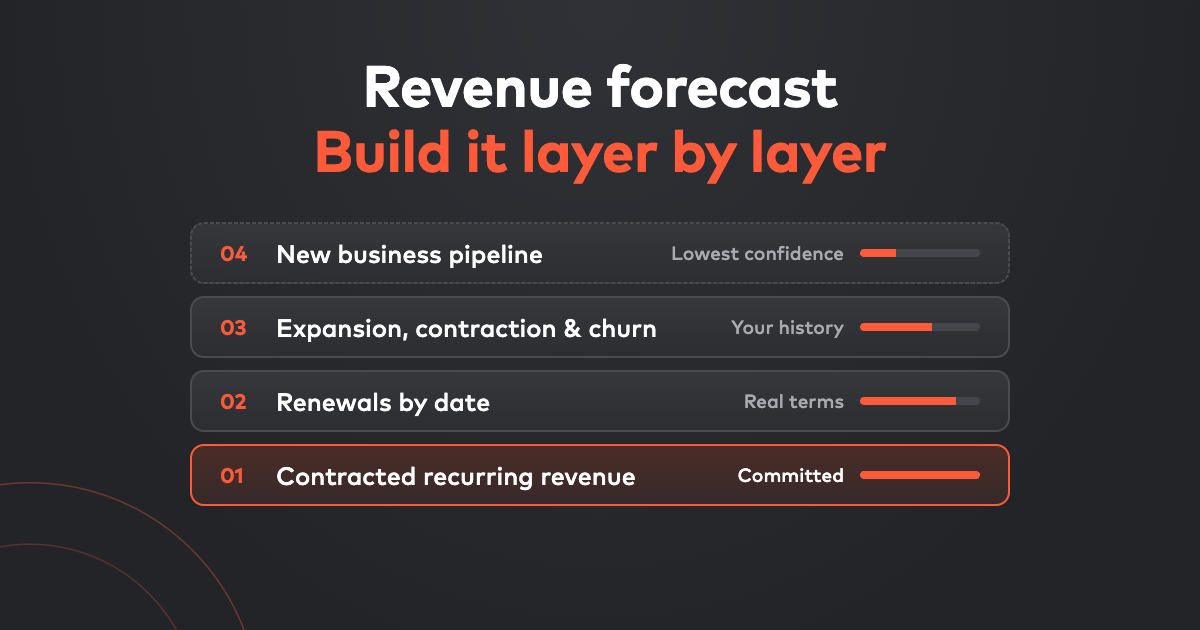
A reliable SaaS revenue forecasting model builds up from layers, starting with the revenue you are most certain of. Each layer gets its own confidence level.
- Start with contracted recurring revenue. Take every active subscription, its current price and its billing schedule. This is your committed baseline (CARR) and should be close to 100% certain for the current term.
- Add scheduled changes. Include ramp steps, price uplifts and future-dated quantity changes already agreed in signed quotes.
- Model renewals by date. For each contract ending in the forecast window, apply a renewal probability based on your historical renewal rate (or logo churn) for that segment, at the renewal price rather than the old price.
- Apply churn and contraction from your own history. Use gross churn, gross revenue retention and contraction rates from your MRR movements, split by plan, segment or contract length.
- Apply expansion from your own history. Use historical expansion MRR as a percentage of the starting base, again by segment. Together with churn, this gives you net revenue retention.
- Layer in new business from pipeline. Weight open opportunities by stage and expected close date. Keep this layer visibly separate, because it carries the most uncertainty.
- Convert to recognised revenue and cash. Annual prepaid contracts billed in advance bring cash up front but are recognised monthly as deferred revenue unwinds. Show both views so finance and leadership read the same revenue forecast.
- Compare forecast to actuals every month. Track the variance by layer. If renewals are consistently over-forecast, adjust the probability, not the whole model.
At its simplest, the next-period recurring revenue forecast looks like this:
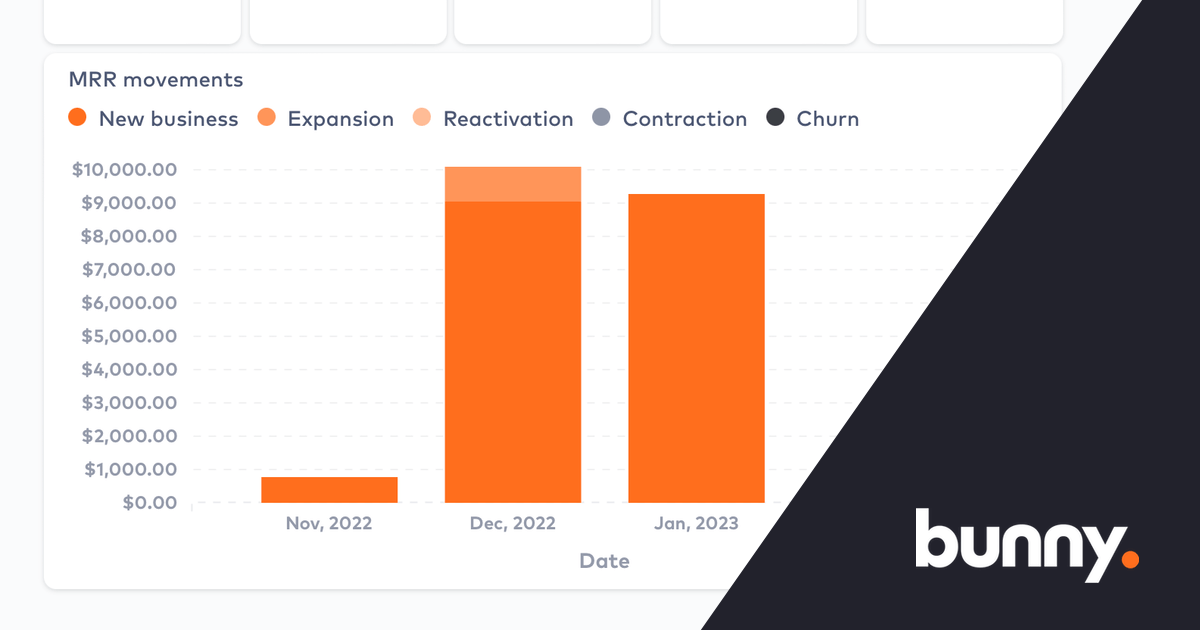
MRRnext = MRRnow + New + Expansion + Reactivation − Contraction − Churn
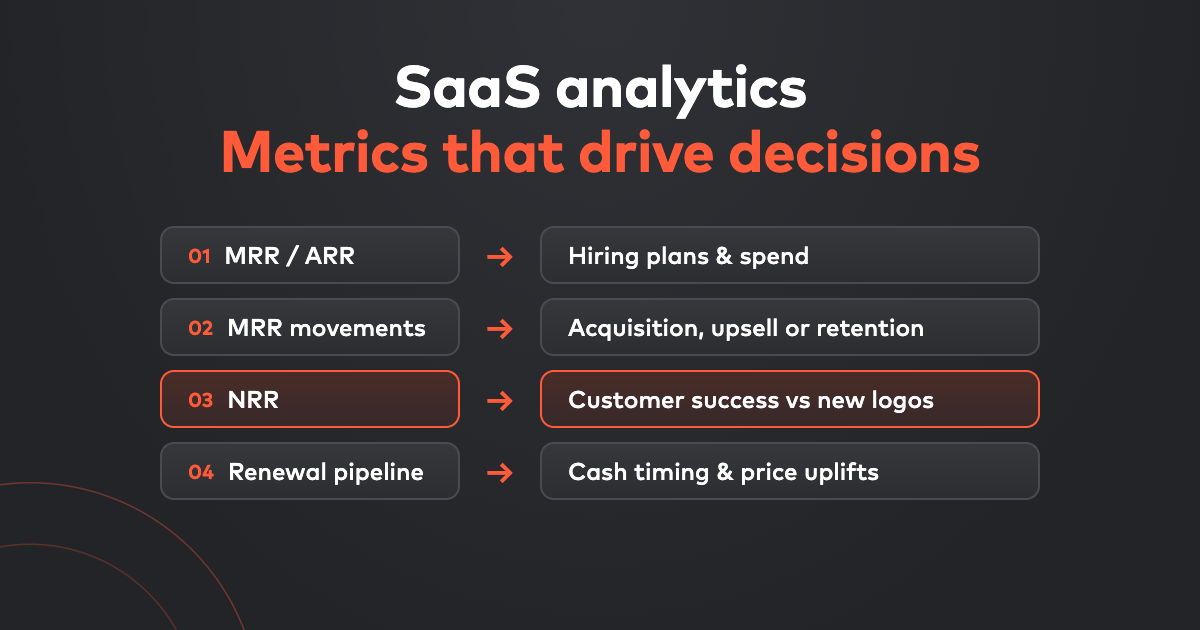
Each term should come from real subscription data, not a top-down growth assumption. Our guide to SaaS analytics covers which of these metrics inform which decisions.
What should I look for in sales and revenue forecasting tools?
Sales and revenue forecasting tools fall into three groups, and most SaaS companies end up using more than one.
| Tool type | Strengths | Limitations |
|---|---|---|
| CRM forecasting (e.g. HubSpot, Salesforce) | Weighting new-business pipeline by stage | Knows little about billing schedules, renewals in flight or recognised revenue |
| FP&A and business forecasting software | Scenario planning, budgets, board models | Depends on clean data being imported from billing and CRM (warehouse sync helps) |
| Billing-native revenue platforms | Contracted revenue, renewals, MRR movements, recognition | Pipeline still lives in the CRM |
The strongest setup connects them: committed revenue from the billing platform, pipeline from the CRM, and scenarios in business forecasting software or a spreadsheet on top. When evaluating any revenue forecasting tool, ask:
- Does it read live subscription and invoice data, or a monthly export?
- Can it show future invoices and renewals by date?
- Does it break MRR changes into new, expansion, contraction and churn?
- Can it show both billed and recognised revenue?
- Does it sync with your CRM so pipeline and contracts meet in one view? Bunny works inside HubSpot and Salesforce.
How does Bunny improve revenue forecast accuracy?
Bunny improves revenue forecast accuracy by keeping quotes, subscriptions, invoices and revenue recognition in one quote-to-cash system, so the contracted layer of your forecast is always current.
- Quotes flow straight into subscriptions. Ramp deals, discounts and multi-year terms agreed in a Bunny quote become the billing schedule. Nothing is re-keyed.
- Upcoming invoices preview. See what will be invoiced and when, by account, for the months ahead, including usage revenue estimates for metered billing.
- Renewal visibility. Renewal dates, auto-renew settings and price adjustments live on the subscription, so the renewal layer of the forecast uses real terms. See renewal management and AI renewal management for expansion revenue.
- MRR movements. New, expansion, contraction, churn and reactivation are recorded as they happen, giving you segment-level rates from your own history in Bunny analytics. The RevOps agent can answer forecast questions against that live data.
- Revenue recognition. Recognition schedules spread each invoice across its service period, so recognised revenue sits next to billed revenue.
- CRM and accounting sync. HubSpot and Salesforce sync brings subscription data to sales, while QuickBooks Online and Xero sync keeps finance aligned.
With the committed and renewal layers handled, your team can spend forecast time on the part that genuinely needs judgement: new pipeline.
Build your plan on contracted numbers
The fastest way to forecast with confidence is to stop rebuilding your baseline every quarter. See how Bunny supports finance teams or book a demo to see how Bunny keeps quotes, billing and revenue in one place.

SaaS metrics you don't have to assemble by hand
NRR, GRR, ARR, churn and cohort retention calculated from your live billing data — not a month-end spreadsheet.