Are There AI Solutions That Unify Sales-Led and Product-Led Billing Data Effectively?

How healthy is your quote-to-cash?
12 questions on pricing, renewals, billing and reporting. Takes two minutes.
Take the assessmentYes, but only when the AI sits on top of a billing system that already holds both kinds of revenue in one data model. AI data analytics can answer questions, spot churn risk and explain revenue movements across self-serve and sales-led customers. It cannot reliably merge two billing systems that disagree about who the customer is or what they pay.
Many SaaS companies start product-led, with customers signing up by card on Stripe. As they grow, they add a sales team selling annual contracts, custom pricing and invoice billing, often with a hybrid pricing model. Our strategies for moving from product-led to sales-led growth cover the go-to-market side. The result is two revenue streams in two systems, and nobody can answer a simple question like “what is our real NRR?” without a week of spreadsheet work. This is the classic siloed data problem.
This article explains why that split happens, what AI data analytics can and cannot fix, how to evaluate AI analytics software, and how Bunny’s AI analytics bring both models together on one quote-to-cash platform.
Why do sales-led and product-led billing data end up split?
Sales-led and product-led billing data split because each motion is usually set up in a different tool by a different team, at a different stage of the company. We go deeper on this in why sales-led billing is harder than product-led.
| Product-led (self-serve) | Sales-led (negotiated) | |
|---|---|---|
| Typical system | Stripe or another payment-first billing tool | CRM quotes plus invoices, or a separate billing platform |
| Pricing | List prices, monthly or annual, card payment | Custom pricing, discounts, ramps, multi-year terms |
| Changes | Customer upgrades in-app | Account manager amends the contract |
| Revenue data lives in | Payment processor | CRM, spreadsheets and the accounting system |
The split causes predictable problems:
- Duplicate customers. A team that started on a self-serve plan and then signed an enterprise contract appears twice, so expansion looks like a new logo and logo churn.
- Inconsistent metrics. MRR, churn and NRR are calculated differently in each system.
- Messy revenue recognition. Card subscriptions and prepaid annual contracts need different recognition schedules and deferred revenue tracking, often handled in separate spreadsheets.
- Missed renewals. Sales-led renewals are tracked by hand while self-serve renews automatically, so the two never show up in one renewal view.
That is why one of our core RevOps principles is don’t bifurcate PLG and SLG. It is also the theme of what happens when salespeople touch Stripe Billing and our Bunny vs Stripe comparison.
What can AI data analytics fix in billing, and what can’t it?
AI data analytics is very good at reading, summarising and explaining billing data. It is much weaker at deciding which of two conflicting records is correct. That is why the foundation matters more than the model.
What AI powered analytics does well
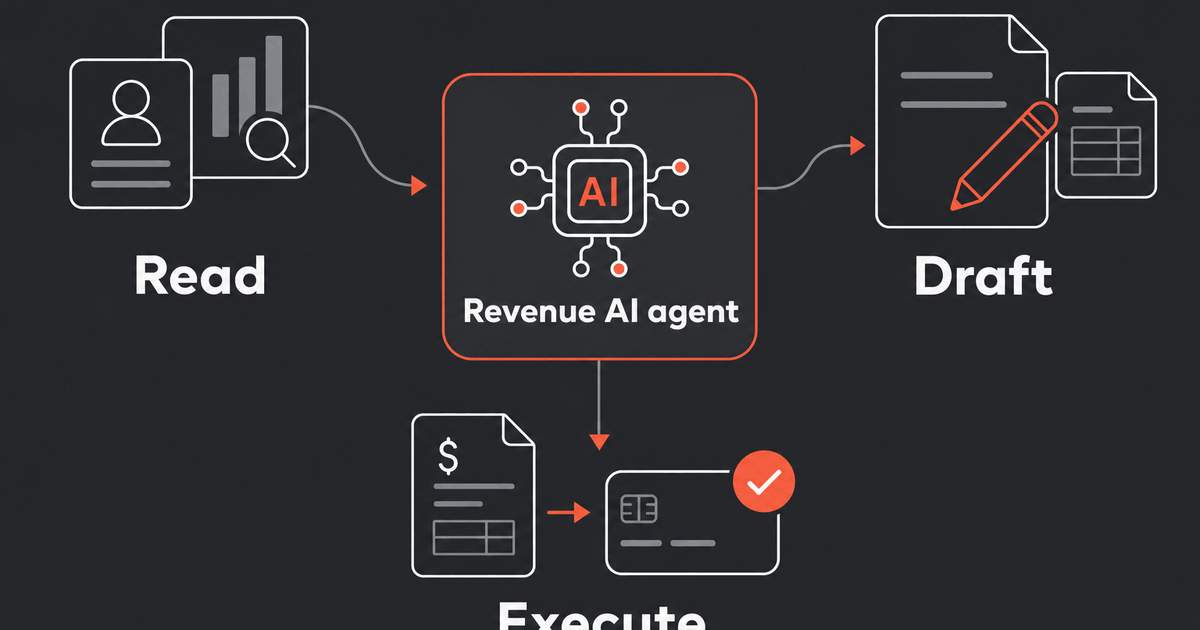
These are the jobs Bunny’s AI-powered analytics take on today, through the RevOps Agent in the app and through MCP in your own AI assistant:
- Answers revenue questions in plain English. “Which accounts contracted last quarter?” or “What is NRR for customers who started self-serve?” without building a report. Bunny’s AI analytics answer from live billing records, not a copy.
- Explains changes. Summarises why MRR moved this month, broken into new, expansion, contraction and churn, using the same movements shown in Bunny analytics.
- Flags risk and opportunity. Highlights falling usage, failed payments, approaching renewals and accounts that hit plan limits. See AI renewal management for expansion revenue.
- Drafts the next action. Prepares a renewal or upgrade quote for an account manager to review, as we walk through in creating a sales quote with an AI agent.
What AI cannot fix on its own
- Two sources of truth. If Stripe and your CRM disagree on a customer’s price, the AI has to guess. Guesses in financial data are dangerous.
- Missing contract terms. Discounts and ramps agreed in email are invisible to any analytics tool.
- Revenue recognition rules. AI can explain a recognition schedule, but the schedule itself must be calculated deterministically and be auditable.
The practical answer is to unify both motions in one billing system first, then put AI on top of that single source of truth. That is the approach behind Bunny’s AI analytics, and the reason AI agents need memory and structure to be useful in RevOps.
How to evaluate AI analytics software and solutions for billing data
The best AI analytics tool for billing is the one that queries trusted, unified data rather than generating its own version of it. That is the standard Bunny’s AI analytics are built to meet. When comparing AI analytics software, ask these questions:
- What data does the AI read? Live billing, subscription and invoice records are best. Exports and screenshots are not.
- Does it cover both motions? Self-serve subscriptions and negotiated contracts should sit in the same customer record.
- Are the numbers deterministic? MRR, NRR and recognised revenue should be calculated by the platform, with AI explaining them, not inventing them.
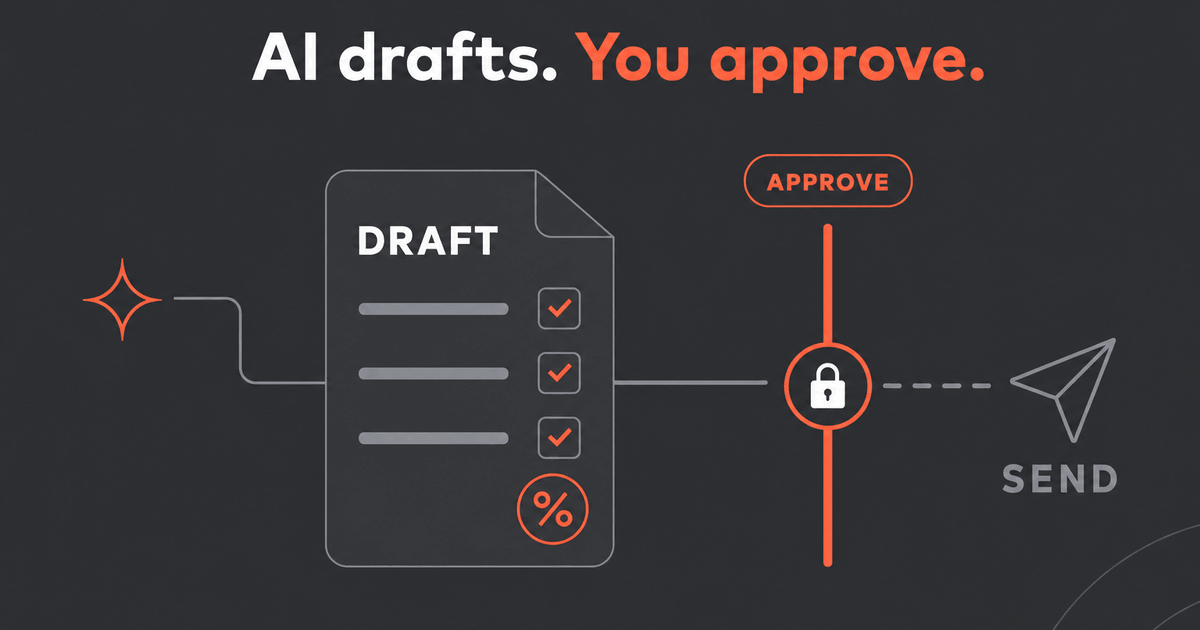
- Can it act, safely? Look for AI that can draft quotes or changes for human approval rather than editing live subscriptions directly.
- Does it work with your AI assistant? Open standards such as the Model Context Protocol (MCP) let tools like Claude query your billing system directly. Our guide to sales and revenue tools AI agents can actually operate covers what to check.
- Is access controlled? API scopes and audit logs should limit what an AI agent can read and change. See how Bunny handles security and access control.
| Approach | Strengths | Limitations |
|---|---|---|
| General BI with an AI chat layer | Flexible across many data sources | Metric definitions must be built and maintained; billing logic often wrong |
| AI analytics bolted onto a payment processor | Fast for card-based revenue | Misses negotiated contracts and invoice-billed accounts |
| AI analytics solutions built into a unified billing platform, such as Bunny | Numbers match invoices and the ledger; covers both motions | Requires consolidating billing data into one platform |
For a wider look at the category, see our roundups of the best AI-powered billing tools and AI billing software for B2B SaaS, or read how Bunny AI improves revenue management.
How Bunny unifies sales-led and product-led billing data
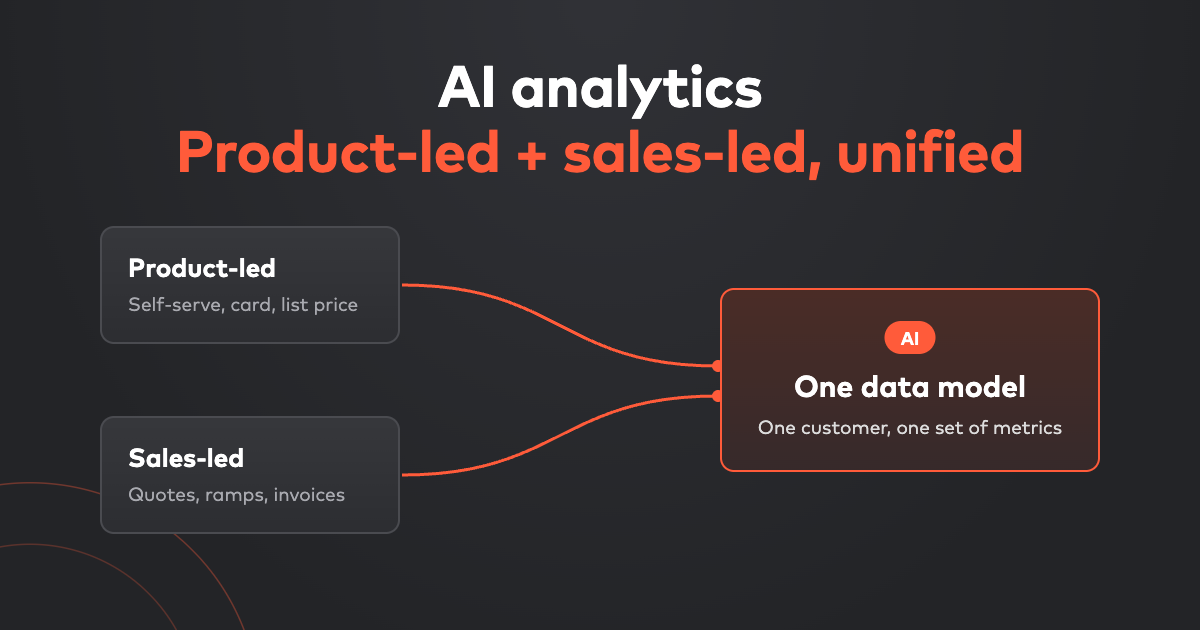
Bunny’s AI analytics unify sales-led and product-led billing data by running self-serve signups and negotiated contracts through one subscription billing platform, so every customer has a single account, a single subscription history and a single set of revenue metrics. Bunny’s AI-powered analytics then work on top of that unified record, so every answer matches your invoices.
- Self-serve and sales-led in one place. Hosted signup and checkout pages and an embeddable customer portal handle self-service customers on recurring billing, while native quoting handles custom pricing, ramps, discounts and approvals for sales-led deals.
- Or keep Stripe for self-serve. With Sidecar, product-led revenue keeps billing through Stripe while Bunny syncs that data in and manages your higher-value, sales-led subscriptions. Bunny’s metrics and AI analytics still run across both. It is a common path for teams weighing Stripe Billing alternatives.
- One customer record. When a self-serve customer upgrades to an enterprise contract, the quote updates the same account, so the move is reported as expansion rather than churn plus a new logo. Bunny’s AI analytics see one customer journey, not two.
- Unified metrics. MRR, ARR, NRR, GRR and MRR movements are calculated deterministically across both motions from the same subscriptions and invoices. Bunny’s AI explains these figures; it never invents them.
- Revenue recognition for both. Monthly card subscriptions and prepaid annual contracts each get recognition schedules in the same system, with the Advanced Billing add-on.
- Bunny AI analytics in the app and through MCP. The RevOps Agent answers revenue questions, flags at-risk renewals and drafts quotes inside Bunny. Bunny’s MCP server lets AI assistants such as Claude query customers, subscriptions, invoices and revenue analytics, and prepare quotes for review, using scoped API credentials.
- Payments and CRM. Stripe handles card payments, and HubSpot and Salesforce sync keeps sales teams working in their CRM. See all integrations.
The result is a single source of truth that Bunny’s AI analytics can reason over with confidence, instead of a model trying to reconcile two systems. It also gives you the clean foundation for SaaS analytics, an accurate revenue forecast and real-time subscription data across teams.
Bring both revenue streams together
If your self-serve and sales-led customers live in different systems, every report starts with a reconciliation. See Bunny’s PLG and SLG pricing, or book a Bunny demo to see both motions on one platform.

The RevOps expert your team never had
Bunny's AI agent knows your entire book of business and acts on it — flagging at-risk renewals, chasing overdue invoices and closing upgrades.